Overview
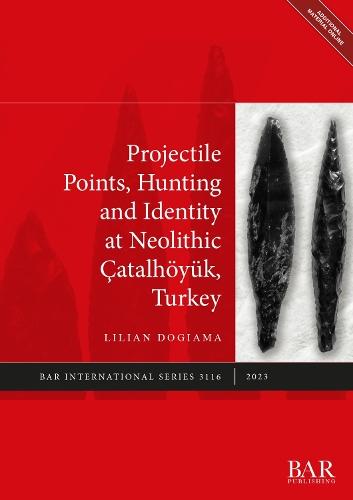
In this book Dr Lilian Dogiama considers the role of hunting at the Neolithic community of Çatalhöyük and its significance in shaping personal and communal identities by focusing on its stone projectile points. Wild faunal remains indicate that hunting remained in practice, even though domesticated animals and plants comprised the staple diet of the people of Çatalhöyük. Hunting and the 'wild' are venerated in the site's iconography, while obsidian projectile points -as the only surviving parts of hunting weapons- were ubiquitous in the site. The author uses a plethora of attributes that include depositional context, use wear, impact damage, fragmentation, raw material and various techno-morphological characteristics to analyse the projectile points from the site. Her findings indicate that the Çatalhöyük projectile point assemblage consisted of two groups that were used and treated in very distinct ways. The first group comprised projectile weapons that were used in hunting and exhibit clear signs of actual use, whereas the second group consisted of bifaces that were likely reserved for ceremonial purposes given their pristine condition and special mode of deposition. Drawing from her analysis and ethnographic examples Dogiama argues that hunting was not merely an alternate subsistence strategy but an arena where symbolic expression and social identities could be performed and negotiated.
Full Product Details
Author: Lilian Dogiama
Publisher: BAR Publishing
Imprint: BAR Publishing
ISBN: 9781407358246
ISBN 10: 1407358243
Pages: 162
Publication Date: 24 February 2023
Audience:
Professional and scholarly
,
Professional & Vocational
Format: Paperback
Publisher's Status: Active
Availability: Available To Order

We have confirmation that this item is in stock with the supplier. It will be ordered in for you and dispatched immediately.
Reviews
'This work is the first comprehensive study that focuses only on the Çatalhöyük projectile points. The author's approach can be taken as a reference in lithic studies. Furthermore, this work is an exemplary study that highlights the reasons why hunting can still continue as a practice in an agropastoral society.' Associate Professor Nurcan Kayacan, Istanbul University 'This is a very interesting study that will expand how interpretations of projectile points (arrowheads and spear points), as well as considerations of bifaces, are made. While the named types and morphologies will differ depending on geography and time periods, the approach used in this research by Dogiama would be of great interest to other researchers.' Professor Deborah Olszewski, University of Pennsylvania
'This work is the first comprehensive study that focuses only on the Çatalhöyük projectile points. The author's approach can be taken as a reference in lithic studies. Furthermore, this work is an exemplary study that highlights the reasons why hunting can still continue as a practice in an agropastoral society.' Associate Professor Nurcan Kayacan, Istanbul University 'This is a very interesting study that will expand how interpretations of projectile points (arrowheads and spear points), as well as considerations of bifaces, are made. While the named types and morphologies will differ depending on geography and time periods, the approach used in this research by Dogiama would be of great interest to other researchers.' Professor Deborah Olszewski, University of Pennsylvania
'This work is the first comprehensive study that focuses only on the Catalhoeyuk projectile points. The author's approach can be taken as a reference in lithic studies. Furthermore, this work is an exemplary study that highlights the reasons why hunting can still continue as a practice in an agropastoral society.' Associate Professor Nurcan Kayacan, Istanbul University 'This is a very interesting study that will expand how interpretations of projectile points (arrowheads and spear points), as well as considerations of bifaces, are made. While the named types and morphologies will differ depending on geography and time periods, the approach used in this research by Dogiama would be of great interest to other researchers.' Professor Deborah Olszewski, University of Pennsylvania
Author Information
Dr Lilian Dogiama received her PhD in Anthropology from McMaster University. She has an MA in Prehistoric Archaeology from the Aristotle University of Thessaloniki and a BA in Archaeology and History of Art from the National and Kapodistrian University of Athens. She specialised in Neolithic and Bronze Age chipped stone tools in the Eastern Mediterranean and was the recipient of the Wenner-Gren Dissertation Fieldwork Grant for her thesis on Çatalhöyük. She has participated in numerous excavation projects in Greece and Turkey spanning from the Palaeolithic to the Early Byzantine period. Her current role is Head of Equality, Diversity, Inclusion and Belonging for International Education at Cambridge University Press & Assessment where she has been working since 2015.