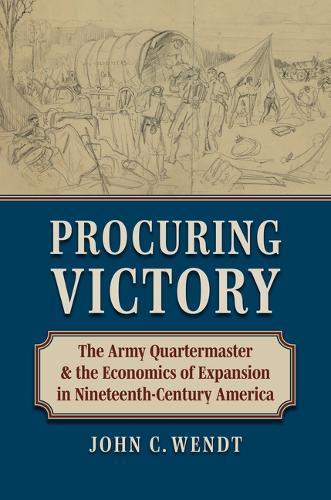
Full Product Details
Author: John Wendt
Publisher: University Press of Kansas
Imprint: University Press of Kansas
ISBN: 9780700640850
ISBN 10: 0700640851
Pages: 296
Publication Date: 28 February 2026
Audience:
Professional and scholarly
,
College/higher education
,
Professional & Vocational
,
Postgraduate, Research & Scholarly
Format: Hardback
Publisher's Status: Active
Availability: Not yet available

This item is yet to be released. You can pre-order this item and we will dispatch it to you upon its release.
Reviews
""John C. Wendt's important and well-written new book resides at the nexus of military history and the history of capitalism and examines the career of army quartermaster George H. Crosman, whose work helped to shape the style and substance of the government's procurement of army supplies from the Second Seminole War through the Civil War. Wendt's innovative research and insightful scholarship illuminates the ways in which the strategy of high-ranking officers and politicians, the tactics of field commanders, and the fighting of enlisted men must be contextualized in the productive capacity of enslaved people and waged seamstresses, the distributive networks of merchants and manufacturers, the financial credit and capital of banks, and, most of all, the work of quartermasters who managed army transactions. Compellingly, Wendt also shows how quartermasters' purchases infused capital into local and regional economies, fostered the process of industrialization, and propelled capitalist transformation.""--Brian P. Luskey, author of Men Is Cheap: Exposing the Frauds of Free Labor in Civil War America ""Procuring Victory connects military, business, labor, and borderlands history, demonstrating both the power and perils of nineteenth century military procurement. Exploring the process across three wars, John Wendt adds great depth to accounts of military logistics focused on the Civil War. Constantly critical and insightful, well-informed from both army and business history perspectives, this book is essential for understanding the US military and its impact in the nineteenth century borderlands.""--Samuel J. Watson, author of Peacekeepers and Conquerors: The Army Officer Corps on the American Frontier, 1821-1846 ""Wendt uses impressive original research to illuminate the long career of one of the most important acquisition and logistics officers in the nineteenth-century US Army. Taking the reader from the swamps of Florida to the deserts of Mexico to the streets of Philadelphia during the Civil War, Wendt shows how George Hampton Crosman and other military professionals grappled with the near-impossible task of outfitting and sustaining armies in an era when cash was scarce and corruption abundant. This is a valuable new contribution to our understanding of American military history, with timely implications for the present day.""--Mark R. Wilson, author of The Business of Civil War: Military Mobilization and the State, 1861-1865 ""This unique book offers insight into the workings of one important quartermaster of the US Army before and during the Civil War. Based on a mass of archival material, John C. Wendt explores how quartermaster George H. Crosman fulfilled his duties in the field, dealing with a variety of problems. It is a deep dip into one aspect of army institutional history during the mid-nineteenth century that will pay dividends to anyone interested in how the American army worked in the Civil War era.""--Earl J. Hess, author of Shattered Courage: Soldiers Who Refused to Fight in the American Civil War ""This is a book that I wish had been written before I wrote either of my books. Scholars have long wondered where exactly money for the military ends up, and Wendt answers that by carefully assembling archival material in a compelling narrative. In the process, he also intervenes in political economy, borderland studies, and financial history, making this a must-read for a range of scholars and non-specialists.""--Lindsay Schakenbach Regele, author of Flowers, Guns, and Money: Joel Roberts Poinsett and the Paradoxes of American Patriotism
""John C. Wendt’s important and well-written new book resides at the nexus of military history and the history of capitalism and examines the career of army quartermaster George H. Crosman, whose work helped to shape the style and substance of the government’s procurement of army supplies from the Second Seminole War through the Civil War. Wendt’s innovative research and insightful scholarship illuminates the ways in which the strategy of high-ranking officers and politicians, the tactics of field commanders, and the fighting of enlisted men must be contextualized in the productive capacity of enslaved people and waged seamstresses, the distributive networks of merchants and manufacturers, the financial credit and capital of banks, and, most of all, the work of quartermasters who managed army transactions. Compellingly, Wendt also shows how quartermasters’ purchases infused capital into local and regional economies, fostered the process of industrialization, and propelled capitalist transformation.""—Brian P. Luskey, author of Men Is Cheap: Exposing the Frauds of Free Labor in Civil War America ""Procuring Victory connects military, business, labor, and borderlands history, demonstrating both the power and perils of nineteenth century military procurement. Exploring the process across three wars, John Wendt adds great depth to accounts of military logistics focused on the Civil War. Constantly critical and insightful, well-informed from both army and business history perspectives, this book is essential for understanding the US military and its impact in the nineteenth century borderlands.""—Samuel J. Watson, author of Peacekeepers and Conquerors: The Army Officer Corps on the American Frontier, 1821–1846 ""Wendt uses impressive original research to illuminate the long career of one of the most important acquisition and logistics officers in the nineteenth-century US Army. Taking the reader from the swamps of Florida to the deserts of Mexico to the streets of Philadelphia during the Civil War, Wendt shows how George Hampton Crosman and other military professionals grappled with the near-impossible task of outfitting and sustaining armies in an era when cash was scarce and corruption abundant. This is a valuable new contribution to our understanding of American military history, with timely implications for the present day.""—Mark R. Wilson, author of The Business of Civil War: Military Mobilization and the State, 1861–1865 ""This unique book offers insight into the workings of one important quartermaster of the US Army before and during the Civil War. Based on a mass of archival material, John C. Wendt explores how quartermaster George H. Crosman fulfilled his duties in the field, dealing with a variety of problems. It is a deep dip into one aspect of army institutional history during the mid-nineteenth century that will pay dividends to anyone interested in how the American army worked in the Civil War era.""—Earl J. Hess, author of Shattered Courage: Soldiers Who Refused to Fight in the American Civil War ""This is a book that I wish had been written before I wrote either of my books. Scholars have long wondered where exactly money for the military ends up, and Wendt answers that by carefully assembling archival material in a compelling narrative. In the process, he also intervenes in political economy, borderland studies, and financial history, making this a must-read for a range of scholars and non-specialists.""—Lindsay Schakenbach Regele, author of Flowers, Guns, and Money: Joel Roberts Poinsett and the Paradoxes of American Patriotism
Author Information
John C. Wendt is Executive Director of the Pueblo County Historical Society in Pueblo, Colorado. He holds a PhD in history from Texas A&M University.