Overview
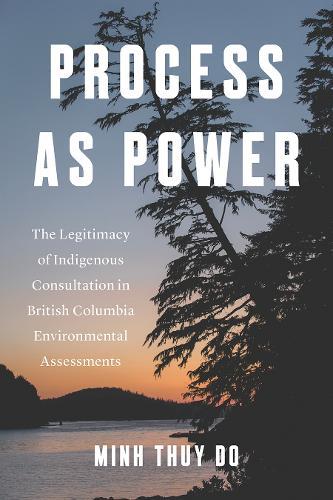
In British Columba, an environmental assessment is required before approving major resource development projects, and Indigenous Peoples whose territory will be affected are legally entitled to be consulted as part of that process. Projects from the Galore Creek mine to the Trans Mountain pipeline expansion have involved Indigenous consultation, yet Indigenous participants consistently regard these efforts as inadequate. Process as Power draws on interviews, judicial decisions, and environmental assessment reports to demonstrate that consultation is a critical site where state legitimacy is contested. Both the Supreme Court of Canada and the BC Court of Appeal have emphasized that consultation is necessary to demonstrate state legitimacy in matters affecting Aboriginal rights. In spite of this mandate, the state puts at risk its own legitimacy when it unilaterally determines the extent to which Indigenous perspectives are incorporated into decision-making. In evaluating these systemic flaws, Minh Thuy Do considers potential reforms that can produce a more robust environmental assessment process aimed at respecting Indigenous governance and addressing the state's legitimacy deficits.
Full Product Details
Author: Minh Thuy Do
Publisher: University of British Columbia Press
Imprint: University of British Columbia Press
Weight: 0.480kg
ISBN: 9780774872263
ISBN 10: 0774872268
Pages: 258
Publication Date: 02 February 2026
Audience:
College/higher education
,
Postgraduate, Research & Scholarly
Format: Hardback
Publisher's Status: Active
Availability: In Print

This item will be ordered in for you from one of our suppliers. Upon receipt, we will promptly dispatch it out to you. For in store availability, please contact us.
Reviews
""This important research further contributes an understanding of how required legal consultation in actuality fails ethical and legal obligations of the Canadian state towards Indigenous peoples. Continued documentation and ongoing analysis remain critical to resolving these failures, and Minh Do's work makes a useful contribution to that necessary undertaking.""-- ""Annie Booth, Faculty of Environment, University of Northern British Columbia"" ""Process as Power: The Legitimacy of Indigenous Consultation in British Columbia Environmental Assessments is one of the few comprehensive, detailed, and systematic analyses of the operationalization of the duty to consult in Canada. It contributes to our understanding of the inherent and procedural limits of the duty to consult, and adds analytical and empirical depth to the existing body of more normatively oriented scholarship on Indigenous-Crown relations.""-- ""Martin Papillon, Department of Political Science, Université de Montréal""
Author Information
Minh Thuy Do is an assistant professor in the Department of Political Science at the University of Guelph. Her work on constitutional politics, public policy, and Indigenous politics has been published in the Canadian Journal of Political Science, Law and Social Inquiry, and Critical Policy Studies, and she has contributed chapters to books on these topics.