Overview
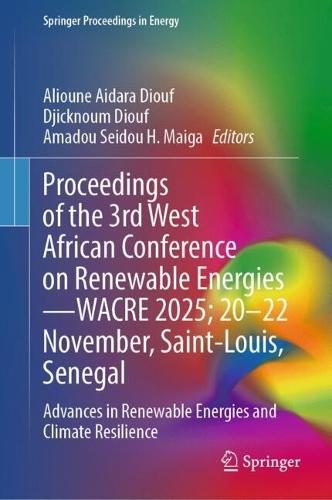
This book presents peer-reviewed contributions from the 3rd West African Conference on Renewable Energies (WACRE) held in Saint-Louis, Senegal, November 20-22, 2025. This timely volume brings together cutting-edge research, real-world case studies, and visionary strategies from across the globe. It covers technologies and innovations in the renewable energy sector, energy sovereignty, production, storage and transport, Artificial Intelligence (AI) and Renewable energy, local resources, potential and sustainable development, water, environment and climate resilience. The book illustrates how clean energy solutions are playing a pivotal role in building climate-resilient futures. Whether you are a policy maker, researcher, practitioner, or concerned citizen, this book offers critical insights into the intersection of sustainability, innovation, and climate adaptation. It is both a call to action and a roadmap for harnessing the power of renewables to protect our planet and ensure energy equity for generations to come.
Full Product Details
Author: Alioune Aidara Diouf ,
Djicknoum Diouf ,
Amadou Seidou H. Maiga
Publisher: Springer Nature Switzerland AG
Imprint: Springer Nature Switzerland AG
ISBN: 9783032171283
ISBN 10: 3032171288
Pages: 516
Publication Date: 21 May 2026
Audience:
Professional and scholarly
,
College/higher education
,
Professional & Vocational
,
Postgraduate, Research & Scholarly
Format: Hardback
Publisher's Status: Forthcoming
Availability: Not yet available

This item is yet to be released. You can pre-order this item and we will dispatch it to you upon its release.
Author Information
Alioune Aidara Diouf is an Associate Professor and Coordinator of the Laboratories in the Department of Applied Physics at Gaston Berger University in Saint-Louis, Senegal. He holds a PhD in Physics from Cheikh Anta Diop University (2017) and specializes in nanomaterials, computational physics, and renewable energy applications. His research focuses on developing energy-efficient devices by leveraging biomass-derived materials, such as activated carbon nanostructures, for sustainable energy storage solutions like supercapacitors. Prof. Diouf has contributed to projects involving graphene, carbon nanotubes, and perovskite-based solar cells, aiming to enhance energy conversion and storage efficiency. His work emphasizes eco-friendly approaches to energy challenges, particularly in rural and off-grid contexts, aligning with global sustainability goals. Djicknoum Diouf is a leading solar energy expert and head of the applied physics department at Gaston Berger University (UGB) in Saint-Louis, Senegal. He specializes in the design, dimensioning and optimization of solar power plants and hybrid energy systems including mini-grids and solar/biogas solutions adapted to rural applications. Pr. Diouf also ensures compliance with current standards through careful control of materials, equipment and technical inspections. He coordinated the STAIRE project, which focuses on renewable energies in aquaculture, and played a central role in the implementation of photovoltaic systems at the UGB, improving energy self-sufficiency and serving as practical training tools for students. It also contributes to international renewable energy initiatives, such as the IEE-NRE summer school, which promotes excellence in this area. Amadou Seidou H. Maiga is a Professor at the Gaston Berger University of Saint-Louis, Senegal. He is currently the Director of the Laboratory Environment, Engineering, Telecommunications and Renewable Energies (LEITER) at Gaston Berger University. He graduated from the University of Rennes, France, with a master’s degree and a doctorate in microelectronics. He has 30 years of experience in the field of applied sciences and technology as a teacher and researcher, first at the Faculty of Science (Abdou Moumouni University of Niamey, NIGER) and since 2004 at the Faculty of Applied Sciences and Technology, Gaston Berger University, Senegal. Its research activities have since focused on the characterization, modelling and simulation of the behaviour of electronic components and devices as well as photovoltaic cells and systems. In recent years, he has conducted various studies on silicon solar cells to help improve their performance, which is heavily dependent on, among other things, phenomenological parameters that influence electrical parameters. Also works on the influence of climatic parameters on the behavior of solar panels. The main objective is to understand the behaviour of photovoltaic panels in Sahelian environments and to contribute to the definition of appropriate qualification standards.