Overview
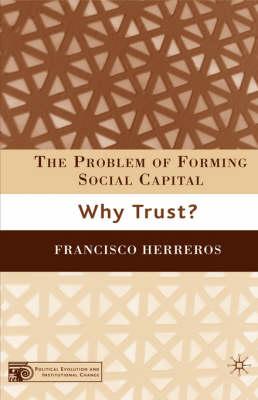
Social capital is a concept which has only recently been incorporated into the social sciences. It has been used to explain a series of phenomena ranging from the creation of human capital and the effectiveness of democratic institutions to the reduction of crime or the eradication of poverty. However, there is not a general explanation about how to create social capital. That is the aim of this book. More concretely, it answers the following questions: How to create social capital? and what accounts for the different stocks of social capital between states? These questions are answered both theoretically and empirically, using quantitative and qualitative analysis as well as game theoretic models.
Full Product Details
Author: F. Herreros
Publisher: Palgrave Macmillan
Imprint: Palgrave Macmillan
Dimensions:
Width: 14.00cm
, Height: 0.90cm
, Length: 21.60cm
Weight: 0.211kg
ISBN: 9780230602236
ISBN 10: 0230602231
Pages: 151
Publication Date: 14 December 2007
Audience:
Professional and scholarly
,
Professional & Vocational
Format: Paperback
Publisher's Status: Active
Availability: In Print

This item will be ordered in for you from one of our suppliers. Upon receipt, we will promptly dispatch it out to you. For in store availability, please contact us.
Reviews
Herreros, far more than anyone else to date, gives the concept social capital both theoretical and empirical standing. He clarifies the questions that matter, shows how we can answer them, and even answers some. This is a truly cross-national study, informed by sophisticated analytics and imaginative tests of plausible hypotheses. His most important finding is that the state fosters social capital directly through its efficacy in enforcing agreements and indirectly through its subsidies of associations. Herreros thus counters many earlier analyses of social capital and provides the basis for further theoretical and policy advance. --Margaret Levi, Jere L. Bacharach Professor of International Studies, University of Washington <br> Herreros's Problem of Forming Social Capital is a well-argued analysis of the importance of trust and voluntary associations in civic life. His argument is not mine, but this is an engaging book that will make an important contribution to debates on social
Herreros, far more than anyone else to date, gives the concept social capital both theoretical and empirical standing. He clarifies the questions that matter, shows how we can answer them, and even answers some. This is a truly cross-national study, informed by sophisticated analytics and imaginative tests of plausible hypotheses. His most important finding is that the state fosters social capital directly through its efficacy in enforcing agreements and indirectly through its subsidies of associations. Herreros thus counters many earlier analyses of social capital and provides the basis for further theoretical and policy advance. --Margaret Levi, Jere L. Bacharach Professor of International Studies, University of Washington <br> Herreros's Problem of Forming Social Capital is a well-argued analysis of the importance of trust and voluntary associations in civic life. His argument is not mine, but this is an engaging book that will make an important contribution to debates on soci
Author Information
FRANCISCO HERREROS holds a Ph.D. in Sociology and is a member of the Juan March Institute, Madrid, Spain. Currently, he is a visiting scholar at the New York University, USA.