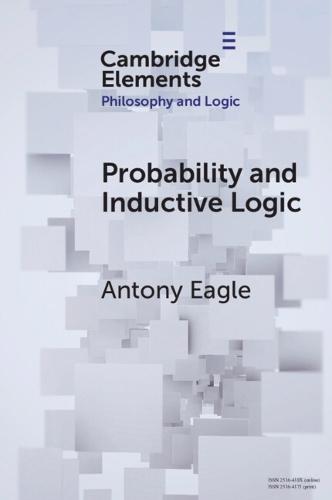
Probability and Inductive Logic

Author:   Antony Eagle (University of Adelaide)
Publisher:   Cambridge University Press
ISBN:  

9781009210195


Pages:   102
Publication Date:   30 January 2025
Format:   Paperback
Availability:   Manufactured on demand   Availability explained
We will order this item for you from a manufactured on demand supplier.

Our Price $46.58 Quantity:  
Add to Cart

Share |

Probability and Inductive Logic


Overview

Reasoning from inconclusive evidence, or 'induction', is central to science and any applications we make of it. For that reason alone it demands the attention of philosophers of science. This element explores the prospects of using probability theory to provide an inductive logic: a framework for representing evidential support. Constraints on the ideal evaluation of hypotheses suggest that the overall standing of a hypothesis is represented by its probability in light of the total evidence, and incremental support, or confirmation, indicated by the hypothesis having a higher probability conditional on some evidence than it does unconditionally. This proposal is shown to have the capacity to reconstruct many canons of the scientific method and inductive inference. Along the way, significant objections are discussed, such as the challenge of inductive scepticism, and the objection that the probabilistic approach makes evidential support arbitrary.

Full Product Details

Author:   Antony Eagle (University of Adelaide)
Publisher:   Cambridge University Press
Imprint:   Cambridge University Press
Dimensions:   Width: 15.20cm , Height: 0.50cm , Length: 22.90cm
Weight:   0.161kg
ISBN:  

9781009210195


ISBN 10:   100921019
Pages:   102
Publication Date:   30 January 2025
Audience:   General/trade ,  General
Format:   Paperback
Publisher's Status:   Active
Availability:   Manufactured on demand   Availability explained
We will order this item for you from a manufactured on demand supplier.

Table of Contents

Introduction and overview; 1. Induction and inductive logic; 2. Probability and evidential support; 3. Bayesian confirmation theory; 4. Uniqueness and the problem of the priors; References.

Reviews

Author Information

Tab Content 6

Author Website:  

Countries Available

All regions
Latest Reading Guide

NOV RG 20252


Shopping Cart
Your cart is empty
Shopping cart
Mailing List