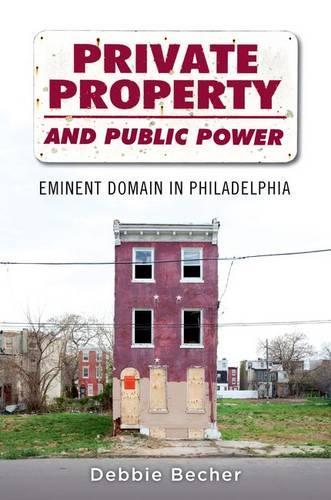
Full Product Details
Author: Debbie Becher (Assistant Professor of Sociology, Assistant Professor of Sociology, Barnard College, Columbia University)
Publisher: Oxford University Press Inc
Imprint: Oxford University Press Inc
Dimensions:
Width: 15.50cm
, Height: 2.30cm
, Length: 23.40cm
Weight: 0.522kg
ISBN: 9780199322558
ISBN 10: 0199322554
Pages: 360
Publication Date: 02 October 2014
Audience:
Professional and scholarly
,
Professional & Vocational
Format: Paperback
Publisher's Status: Active
Availability: To order

Stock availability from the supplier is unknown. We will order it for you and ship this item to you once it is received by us.
Reviews
Property matters a great deal and getting it right is crucial. Debbie Becher nails it. Eschewing abstractions and the fulminations of libertarians and leftists alike, her excellent book captures how real people understand and evaluate government taking. The concept of investment that she develops offers important and challenging insights for policy makers and property theorists alike. --Nicholas Blomley, Professor of Geography, Simon Fraser University A powerful challenge to the conventional view of property in social science, Becher shows that people see property in a complex and social manner. This pioneering study demonstrates how -- rather than treat property solely as a container for economic value or as a bundle of rights -- people also invest their hopes, cares and emotions into it. --Richard Swedberg, Professor of Sociology, Cornell University How to respond to the problems posed by derelict lots and vacant buildings is a question with which almost every city government grapples. Becher's analysis cuts through the familiar ideological slogans about government and private property to provide a deeper understanding of the political, economic and social forces driving urban redevelopment efforts. The result is a challenging and unexpectedly hopeful story with lessons that extend well beyond Philadelphia. --Eduardo M. Penalver, Allan R. Tessler Dean of the Cornell Law School
Becher attempts to help the reader navigate the public-private dilemma raised by the use of eminent domain by highlighting the multiple ways in which public and private actions influence the value of private property... [Becher provides] practical insight on how to improve the implementation of eminent domain. Kesha S. Moore, Social Forces Property matters a great deal and getting it right is crucial. Debbie Becher nails it. Eschewing abstractions and the fulminations of libertarians and leftists alike, her excellent book captures how real people understand and evaluate government taking. The concept of investment that she develops offers important and challenging insights for policy makers and property theorists alike. Nicholas Blomley, Professor of Geography, Simon Fraser University A powerful challenge to the conventional view of property in social science, Becher shows that people see property in a complex and social manner. This pioneering study demonstrates how- rather than treat property solely as a container for economic value or as a bundle of rights - people also invest their hopes, cares and emotions into it. Richard Swedberg, Professor of Sociology, Cornell University How to respond to the problems posed by derelict lots and vacant buildings is a question with which almost every city government grapples. Becher's analysis cuts through the familiar ideological slogans about government and private property to provide a deeper understanding of the political, economic and social forces driving urban redevelopment efforts. The result is a challenging and unexpectedly hopeful story with lessons that extend well beyond Philadelphia. Eduardo M. Penalver, Allan R. Tessler Dean of the Cornell Law School
Property matters a great deal and getting it right is crucial. Debbie Becher nails it. Eschewing abstractions and the fulminations of libertarians and leftists alike, her excellent book captures how real people understand and evaluate government taking. The concept of investment that she develops offers important and challenging insights for policy makers and property theorists alike. -Nicholas Blomley, Professor of Geography, Simon Fraser University A powerful challenge to the conventional view of property in social science, Becher shows that people see property in a complex and social manner. This pioneering study demonstrates how -- rather than treat property solely as a container for economic value or as a bundle of rights -- people also invest their hopes, cares and emotions into it. -Richard Swedberg, Professor of Sociology, Cornell University How to respond to the problems posed by derelict lots and vacant buildings is a question with which almost every city government grapples. Becher's analysis cuts through the familiar ideological slogans about government and private property to provide a deeper understanding of the political, economic and social forces driving urban redevelopment efforts. The result is a challenging and unexpectedly hopeful story with lessons that extend well beyond Philadelphia. -Eduardo M. Penalver, Allan R. Tessler Dean of the Cornell Law School Becher's research is substantial, and a wonderful combination of quantitative and qualitative. Though she does offer a pretty solid set of recommendations for predicting when there's going to be conflict about the use of eminent domain and crafting policy to avoid it, this analysis has implications far beyond that. Really, this novel understanding of property and investment and what the government's legitimate role is understood to be in relationship to that investment could inform, and probably improve, any kind of redevelopment or revitalization effort, especially one that might involve some displacement. For that reason, I suggest that everyone in the community development field could benefit from learning the broader lessons Becher has teased out of a couple decades of Philadelphia eminent domain cases for us. -Shelterforce, National Housing Institute The book leaves one with much to think about... Perhaps most thought provoking is the simple demonstration of the fact that behind talk of economic development, growth, and all the rest of it sit public representatives who are motivated by the political imperative of treating their constituents fairly while maximizing public goods within their communities. In this respect, Private Property and Public Power is an eminently hopeful book. --American Journal of Sociology Despite the prominence of eminent domain as a real estate, municipal, and political tool there has been a serious gap in our understanding of how and why it works beyond partisan polemics. In Private Property and Public Power, Becher begins the necessary work of addressing this gap, offering a thoroughgoing and rigorously researched book. This book is a great addition to undergraduate and graduate courses in sociology, urban studies, real estate, policy, political science, and would interest urban residents and civic leaders near and far. --City and Community Becher attempts to help the reader navigate the public-private dilemma raised by the use of eminent domain by highlighting the multiple ways in which public and private actions influence the value of private property... [Becher provides] practical insight on how to improve the implementation of eminent domain. Kesha S. Moore, Social Forces
Property matters a great deal and getting it right is crucial. Debbie Becher nails it. Eschewing abstractions and the fulminations of libertarians and leftists alike, her excellent book captures how real people understand and evaluate government taking. The concept of investment that she develops offers important and challenging insights for policy makers and property theorists alike. Nicholas Blomley, Professor of Geography, Simon Fraser University A powerful challenge to the conventional view of property in social science, Becher shows that people see property in a complex and social manner. This pioneering study demonstrates how- rather than treat property solely as a container for economic value or as a bundle of rights - people also invest their hopes, cares and emotions into it. Richard Swedberg, Professor of Sociology, Cornell University How to respond to the problems posed by derelict lots and vacant buildings is a question with which almost every city government grapples. Becher's analysis cuts through the familiar ideological slogans about government and private property to provide a deeper understanding of the political, economic and social forces driving urban redevelopment efforts. The result is a challenging and unexpectedly hopeful story with lessons that extend well beyond Philadelphia. Eduardo M. Penalver, Allan R. Tessler Dean of the Cornell Law School
Author Information
Debbie Becher is Assistant Professor of Sociology at Barnard College, Columbia University.