Awards
- Nominated for Albert J. Beveridge Award in American History 2024
- Nominated for Philip S. Klein Book Prize 2024
- Nominated for SHEAR Broussard Best First Book Prize 2024
Overview
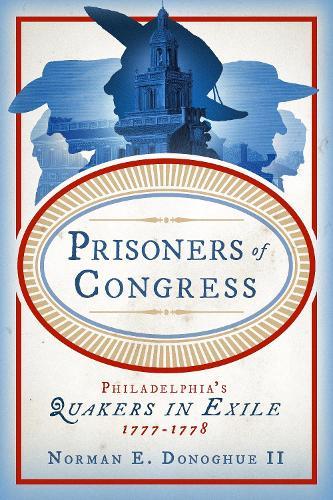
In 1777, Congress labeled Quakers who would not take up arms in support of the War of Independence as “the most Dangerous Enemies America knows” and ordered Pennsylvania and Delaware to apprehend them. In response, Keystone State officials sent twenty men—seventeen of whom were Quakers—into exile, banishing them to Virginia, where they were held for a year. Prisoners of Congress reconstructs this moment in American history through the experiences of four families: the Drinkers, the Fishers, the Pembertons, and the Gilpins. Identifying them as the new nation’s first political prisoners, Norman E. Donoghue II relates how the Quakers, once the preeminent power in Pennsylvania and an integral constituency of the colonies and early republic, came to be reviled by patriots who saw refusal to fight the English as borderline sedition. Surprising, vital, and vividly told, this narrative of political and literal warfare waged by the United States against a pacifist religious group during the Revolutionary War era sheds new light on an essential aspect of American history. It will appeal to anyone interested in learning more about the nation’s founding.
Full Product Details
Author: Norman E. Donoghue II (n/a)
Publisher: Pennsylvania State University Press
Imprint: Pennsylvania State University Press
Dimensions:
Width: 15.20cm
, Height: 2.00cm
, Length: 22.90cm
Weight: 0.501kg
ISBN: 9780271103303
ISBN 10: 0271103302
Pages: 288
Publication Date: 07 July 2026
Audience:
Professional and scholarly
,
Professional & Vocational
Format: Paperback
Publisher's Status: Forthcoming
Availability: Not yet available

This item is yet to be released. You can pre-order this item and we will dispatch it to you upon its release.
Reviews
“[N]ever have the struggles of this early group of American political prisoners been so thoroughly documented, with extensive use of primary material. Donoghue argues persuasively that the then provisional government’s exile of the Quakers set a worrisome example for religious, racial, and political minorities, just as the young republic was being born.” —Cameron McWhirter Friends Journal “Author Norman Donohue is a fine historian who brings life to this little-known story. . . . Prisoners of Congress brings to life an important and compelling event of the American Revolution. Read it. You’ll like it!” —Kim Burdick Journal of the American Revolution “Norman E. Donoghue II’s exceptionally readable and richly sourced Prisoners of Congress is a long-needed scholarly treatment of the case of the “Virginia Exiles”. . . . Donoghue, an attorney-turned-historian, is especially well qualified to make the Exiles’ case, as he explores constitutional issues over freedom of conscience and the power of the state—which historians of the Revolution have largely ignored—with clarity and verve.” —Dee E. Andrews Pennsylvania Heritage “[Prisoners of Congress] provides crucial information about a relatively unknown incident that took place in the early years of the Revolutionary War.” —Al Holliday Pennsylvania Magazine “[A] detailed investigation of a little-known event in the history of both the Philadelphia Friends (Quakers) and the American Revolution.” —M. R. Pukkila Choice “Donoghue has made a welcome contribution to Quaker history and broader studies of American politics during the Revolution.” —Daniel Gorman, Jr. Journal of the Early Republic “Donoghue’s work is a truly comprehensive study of the experience of Pennsylvanian, particularly Philadelphian, Quakers during the American War of Independence. From the extraordinary and mundane experiences of Quakers in the occupied capital to the emotional and physical hardships of the exiled men in Virginia, Prisoners of Congress gives the reader insight into the experiences of a minority population at war.” —Larry D. Herrold, Jr. Pennsylvania History “This book is full of intrigue, anguish and steadfastness to individuals’ beliefs. It is a study of careful observations, with a precisely controlled narrative of events, detailed references and an abundant bibliography. I would recommend it to any reader with an interest in colonial/revolutionary American history and those who simply enjoy a good page-turner.” —Richard C. Allen Journal of the Friends Historical Society “For readers interested in Quaker history, the American Revolution, or the perennial struggle to maintain legal integrity during times of upheaval, Donoghue presents an evocative story that speaks to both historical conflicts and contemporary challenges. His work reminds us that even revolutions founded on noble principles must confront fundamental questions of pragmatism, principle, and power.” —Nathaniel Shaw Hay Quaker History “Prisoners of Congress is one of the best books I’ve read in ages. If history is traditionally dry, this book is an atmospheric river. The factual telling and interpreting of this little-known history is so vivid and character-based that it feels cinematic. It captures how our social values at the time history was made directed the actions of our ancestors—and in so doing set the foundations for so much of what was to come. This book is so cinematic I would not be surprised to see it on Netflix sooner rather than later.” —Senator John Hickenlooper “Norman Donoghue's Prisoners of Congress brings to life one of the most important and compelling events of the American Revolution in Philadelphia. It is an untold story of national significance.” —Patrick Spero, author of Frontier Rebels: The Fight for Independence in the American West, 1765–1776 “Anybody interested in the tensions between politics and religion, a matter so urgent to us today, should read Donoghue’s account of the Quaker exiles. Almost novelistic in its compelling narrative, this study marshals familiar and unfamiliar sources to recover the story of America’s first political prisoners.” —Scott Paul Gordon, author of The Letters of Mary Penry: A Single Moravian Woman in Early America “Far from a niche story, Prisoners of Congress is a meticulously researched book with enormous present-day relevance. It reveals important truths about American political and religious institutions before, during, and after the Revolution and shines a startlingly new and important light on familiar people, places, and themes.” —Sarah Crabtree, author of Holy Nation: The Transatlantic Quaker Ministry in an Age of Revolution “Norman Donoghue has given us what is likely to be the definitive account of a largely forgotten but significant episode of the American Revolution. Elegantly written and based on exhaustive research, Prisoners of Congress illustrates the tensions between religious liberty and dissent, on one hand, and fears of invasion and subversion, on the other, that have been present from the founding of the American republic.” —Thomas Hamm, Earlham College “Donoghue's book is not only an exceptional examination of a little-known episode during the War of Independence, but also a cautionary tale for our divided times.” —Max L. Carter, William R. Rogers Director of Friends Center and Quaker Studies (emeritus), Guilford College “Prisoners of Congress illustrates how the national debate over individual rights versus national security regarding habeas corpus in wartime began not during the Civil War but during the very founding of our nation. . . . An excellent read as well as an educational one for a debate that continues to this day.” —Philip Wasielewski, Senior Fellow, Foreign Policy Research Institute “Prisoners of Congress is a fascinating tale recounting a little-known roundup of Quaker leaders during the Revolution, to tell us in spare, elegant prose, the story of their history in Philadelphia and what made them tick.” —John Lehman, 65th Secretary of the Navy, member of the 9/11 Commission, and author of Oceans Ventured: Winning the Cold War at Sea
Author Information
Norman E. Donoghue II is an independent historian of American Quakerism based in Philadelphia. His website is prisonersofcongress.com.