Overview
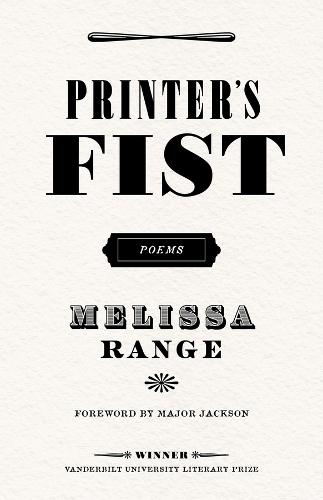
Melissa Range's Printer's Fist, awarded the 2025 Vanderbilt University Literary Prize, is a collection that tells the story of a political movement-its strides and setbacks, its unity and fractures-with a particular emphasis on print culture. Drawing upon more than a decade's worth of archival research into nineteenth-century antislavery newspapers, pamphlets, broadsides, and more, Range highlights the expansiveness of the movement by focusing not on one, but a chorus of abolitionist voices. Her investment in celebrating Black and women's histories, in particular, offers an inclusive account of American history, informed not only by thorough research but through a formal, poetic engagement with the past. In exploring how enslaved people's self-emancipation was a form of resistance that preceded, operated alongside, and intertwined with organized networks of antislavery activists, Printer's Fist will help facilitate discussions surrounding race, gender, and activism that are grounded in historical fact and emotional truth.
Full Product Details
Author: Melissa Range , Major Jackson
Publisher: Vanderbilt University Press
Imprint: Vanderbilt University Press
Dimensions:
Width: 14.00cm
, Height: 1.80cm
, Length: 21.60cm
Weight: 0.227kg
ISBN: 9780826500090
ISBN 10: 0826500099
Pages: 190
Publication Date: 15 March 2026
Audience:
General/trade
,
General
Format: Paperback
Publisher's Status: Active
Availability: In Print 
This item will be ordered in for you from one of our suppliers. Upon receipt, we will promptly dispatch it out to you. For in store availability, please contact us.
Table of Contents
To the Public Juno Righteousness Exalteth a Nation In the Years Before the Antislavery Societies Formed Fort Mose From the Subscriber Index: Gabriel’s Conspiracy Thomas Branagan Sends His Poem The PenitentialTyrant to Thomas Jefferson The Gradualists Wait William Lloyd Garrison Apprentices as a Printer’s Devil at the Newburyport Herald Winny v. Whitesides, Decided for the Plaintiff At Denmark Vesey’s Church Our Country Is the World—Our Countrymen Are All Mankind Benjamin Lundy Relocates the Genius of Universal Emancipation John B. Russwurm, Editor of Freedom’s Journal, Reverses his Position David Walker’s Appeal to the Coloured Citizens of the World Goes South Angelina Grimké Ruins Her Clothes Another Southern Manumission Society Disbands James Forten, Sailmaker, Sends William Lloyd Garrison Twenty-Seven Paid Subscriptions for the First Issue of the Liberator Elizabeth Margaret Chandler Passes on Dessert Garrison Issues the Call in the Liberator Liberty is the Word for Me—Above All, Liberty Noyes Academy James G. Birney, Editor of the Philanthropist, is Fairly Egged Off the Ground The Philadelphia Female Antislavery Society’s Third Annual Petition Drive The House of Representatives Passes the “Gag Rule” Reverend Elijah P. Lovejoy, Editor of the Alton Observer Sarah Louisa Forten Does Not Speak from the Archives Abby Kelley Lectures Against Slavery in a One-Room Schoolhouse The Grimké Sisters at Work on American Slavery As It Is The American Antislavery Society Splits after Abby Kelley is Elected to the Business Committee Right Is of No Sex—Truth Is of No Color Come-Outers After the Split, The National Antislavery Standard Publishes Its First Issue Black Women Split Off Julia Williams Garnet Collaborates with Reverend Henry Highland Garnet on an Address to the Slaves of the United States of America The National Colored Convention Subcommittee Votes 19-18 Not to Endorse An Address to the Slaves of the United States of America Frederick Douglass Publishes the First Issue of the North Star Black and White Women Continue Working Together Preparations for Another Antislavery Bazaar Continue Minutes Without Concealment, Without Compromise Minty, Moses William Wells Brown Performs from The Antislavery Harp Cottonocracy The Train from Macon Public Opinion Shifts After the Passing of the Fugitive Slave Law Clementine Averill Writes to Senator Jeremiah Clemens Harriet Beecher Stowe Writes Chapter Nine of Uncle Tom’s Cabin Mary Ann Shadd Advocates Emigration in Notes of Canada West Frederick Douglass and William Lloyd Garrison Officially Split No Union with Slaveholders William Still, General Vigilance Committee Secretary, Takes Notes Martin R. Delany Writes in to Frederick Douglass’ Paper about Uncle Tom’s Cabin Fourth of July with the Massachusetts Antislavery Society Colporteur Frances Ellen Watkins Lodges Two Weeks with Mary Brown To the Slave Power Enter the Wide-Awakes “Written by Herself” (I) Devoted to the Rights of All Mankind John Greenleaf Whittier Argues with Himself about the Use of Force First South Harriet Jacobs Writes in to the Liberator about the Condition of the Freed People Special Edition: Lincoln’s Proclamation of Emancipation Black Teachers Mobilize, All Parts South Quartermaster Sergeant James H. Payne, 27th U.S.C.T., Ohio, Writes in to the Christian Recorder George Moses Horton, Poet Levy Done Places an “Information Wanted” Ad in the Colored Tennessean “Written by Herself” (II) For the Abolitionist Dead Notes
Reviews
""Melissa Range's Printer's Fist flies squarely in the face of exclusionary American history to counter efforts to privilege a particular perspective. Part of the play and, ironically, joy of this book is the way Range uses the archive as poetic form. This is probably what I find most astonishing about this collection, that while it remains fervently committed to its ethical assertions, the play of this poet's mind across its subject matter points us toward further discovery and reflection."" --Gregory Pardlo, Vanderbilt University Literary Prize jurist
“Melissa Range’s Printer’s Fist flies squarely in the face of exclusionary American history to counter efforts to privilege a particular perspective. Part of the play and, ironically, joy of this book is the way Range uses the archive as poetic form. This is probably what I find most astonishing about this collection, that while it remains fervently committed to its ethical assertions, the play of this poet’s mind across its subject matter points us toward further discovery and reflection.” —Gregory Pardlo, Vanderbilt University Literary Prize jurist
Author Information
Melissa Range is the author of Scriptorium, winner of the 2015 National Poetry Series competition, and Horse and Rider, a finalist for the Kate Tufts Discovery Prize. Her recent poems have appeared in Ecotone, The Hopkins Review, Michigan Quarterly Review, The Nation, and Ploughshares. Range has received awards and fellowships from the National Endowment for the Arts, the Rona Jaffe Foundation, the American Antiquarian Society, the Fine Arts Work Center, and MacDowell. Originally from East Tennessee, she teaches creative writing and American literature at Lawrence University in Wisconsin.
Tab Content 6
Author Website:
Countries Available
All regions
|