Overview
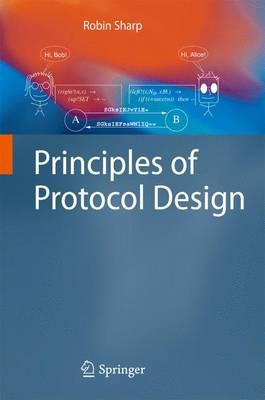
This book introduces the reader to the principles used in a broad selection of modern data communication protocols and basic algorithms for use in distributed applications, including not only simple point-to-point data transfer protocols but also multi-party protocols and protocols for ensuring data security. The presentation uses CSP notation to give a concise description of the protocols considered and to provide a basis for analysis of their properties. Relating theory to practice, with a strong focus on currently important Internet protocols, the book clearly explains how the principles are exploited in real-life protocol designs. Principles of Protocol Design is aimed at third-year students and graduates who are studying computer networks/distributed systems or data communications, as well as professional system designers who are looking for the broad view of the area.
Full Product Details
Author: Robin Sharp
Publisher: Springer-Verlag Berlin and Heidelberg GmbH & Co. KG
Imprint: Springer-Verlag Berlin and Heidelberg GmbH & Co. K
Edition: Softcover reprint of hardcover 1st ed. 2008
Dimensions:
Width: 15.50cm
, Height: 2.10cm
, Length: 23.50cm
Weight: 0.635kg
ISBN: 9783642096280
ISBN 10: 364209628
Pages: 402
Publication Date: 19 October 2010
Audience:
Professional and scholarly
,
Professional & Vocational
Format: Paperback
Publisher's Status: Active
Availability: Out of print, replaced by POD

We will order this item for you from a manufatured on demand supplier.
Reviews
"From the reviews: ""This book takes an unusual path to describe computer network protocols. … Robin Sharp starts from formal description techniques. More precisely, he chooses the Communicating Sequential Processes (CSP) notation proposed by Hoare. … could be of interest to readers who are more interested in the application of formal description techniques to network protocols."" (IEEE Network, September/October, 2008) ""The book particularly reflects the recent developments in computer networks and distributed systems with special reference to applications. A number of new protocols are introduced with a focus on their current application, what is good stuff for students and researchers in the area. … The book could be used for undergraduate third and fourth year courses in computer science and the network area. I am sure that this book will be a valuable asset in the educational and scientific community at large."" (Aniket Mahanti, Zentralblatt MATH, Vol. 1142, 2008)"
From the reviews: This book takes an unusual path to describe computer network protocols. ... Robin Sharp starts from formal description techniques. More precisely, he chooses the Communicating Sequential Processes (CSP) notation proposed by Hoare. ... could be of interest to readers who are more interested in the application of formal description techniques to network protocols. (IEEE Network, September/October, 2008) The book particularly reflects the recent developments in computer networks and distributed systems with special reference to applications. A number of new protocols are introduced with a focus on their current application, what is good stuff for students and researchers in the area. ... The book could be used for undergraduate third and fourth year courses in computer science and the network area. I am sure that this book will be a valuable asset in the educational and scientific community at large. (Aniket Mahanti, Zentralblatt MATH, Vol. 1142, 2008)
From the reviews: This book takes an unusual path to describe computer network protocols. ! Robin Sharp starts from formal description techniques. More precisely, he chooses the Communicating Sequential Processes (CSP) notation proposed by Hoare. ! could be of interest to readers who are more interested in the application of formal description techniques to network protocols. (IEEE Network, September/October, 2008) The book particularly reflects the recent developments in computer networks and distributed systems with special reference to applications. A number of new protocols are introduced with a focus on their current application, what is good stuff for students and researchers in the area. ! The book could be used for undergraduate third and fourth year courses in computer science and the network area. I am sure that this book will be a valuable asset in the educational and scientific community at large. (Aniket Mahanti, Zentralblatt MATH, Vol. 1142, 2008)