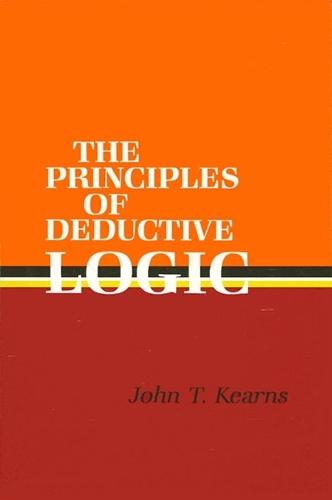
Principles of Deductive Logic

Author:   John T. Kearns
Publisher:   State University of New York Press
ISBN:  

9780887064791


Pages:   471
Publication Date:   15 November 1987
Format:   Paperback
Availability:   In Print   Availability explained
This item will be ordered in for you from one of our suppliers. Upon receipt, we will promptly dispatch it out to you. For in store availability, please contact us.

Our Price $84.35 Quantity:  
Add to Cart

Share |

Principles of Deductive Logic


Overview

Full Product Details

Author:   John T. Kearns
Publisher:   State University of New York Press
Imprint:   State University of New York Press
Dimensions:   Width: 15.20cm , Height: 2.50cm , Length: 22.90cm
Weight:   0.862kg
ISBN:  

9780887064791


ISBN 10:   0887064795
Pages:   471
Publication Date:   15 November 1987
Audience:   Professional and scholarly ,  Professional and scholarly ,  Professional & Vocational ,  Postgraduate, Research & Scholarly
Format:   Paperback
Publisher's Status:   Active
Availability:   In Print   Availability explained
This item will be ordered in for you from one of our suppliers. Upon receipt, we will promptly dispatch it out to you. For in store availability, please contact us.

Table of Contents

PREFACE 1. APPLIED LOGIC: WHAT WE HOPE TO ACCOMPLISH 1-0 Summary 1-1 The Nature of Logic 1-2 Talking About Words 1-3 Speech Acts 1-4 A Language is a Complex System 1-5 Logically Important Semantic Features 1-6 Applied Logic 1-7 Philosophy of Logic 2. SOME PRELIMINARY MATTERS 2-0 Summary 2-1 Definitions (Opt) 2-2 Inferences and Arguments 2-3 Informal Fallacies (Opt) 3. SENTENCES ABOUT INDIVIDUALS 3-0 Summary 3-1 Looking Ahead 3-2 Individuals 3-3 Quantified Phrases 3-4 Universal Sentences 3-5 Some Other Universal Sentences 3-6 Singular Sentences 4. THE ARTIFICIAL-LANGUAGE STRATEGY 4-0 Summary 4-1 Artificial Languages 4-2 Logical Form 4-3 Evaluation 4-4 The Languages to be Developed 5. THE CATEGORICAL LANGUAGE 5-0 Summary 5-1 Categorical Sentences 5-2 Semantics 5-3 Logical Form 5-4 The Complement of an Expression 5-5 Some Syntactic Relations 5-6 Implication and Equivalence 5-7 Logical Truth 5-8 Venn Diagrams 5-9 Incompatibility 5-10 Syllogisms 5-11 The Categorical Deductive System 5-12 Proving Incompatibility 5-13 Venn Diagrams for Many-Place Relations 5-14 Formal Fallacies (Opt) 6. APPLYING AN ARTIFICIAL LANGUAGE 6-0 Summary 6-1 What We Want in a Translation 6-2 The Features We Test for 6-3 Negative Outcomes 7. APPLYING THE CATEGORICAL LANGUAGE TO ENGLISH 7-0 Summary 7-1 Translating English Sentences 7-2 Expressing Existential Force 7-3 Detecting Semantic Features of Existence Claims 7-4 Evaluating English Sentences and Arguments 7-5 Achieving Comparable Translations 7-6 Incorporating Semantic Features in Logical Form 7-7 Enthymemes 7-8 What Comes Next 8. THE EXTENDED CATEGORICAL LANGUAGE 8-0 Summary 8-1 The Changes We Want 8-2 What We Will Keep 8-3 Small Change 8-4 The Sign of Negation 8-5 Reasoning with Negative Sentences 8-6 Translating Negated Sentences 8-7 Singular Sentences 8-8 Reasoning with Singular Sentences 9. THE PROPOSITIONAL CONNECTIVE LANGUAGE 9-0 Summary 9-1 A Mixed Language 9-2 The Syntax and Semantics of the PC Language 9-3 Variables and Formulas 9-4 Evaluating Sentences of the PC Languge 9-5 Two-Place Relations 9-6 Many-Place Relations 9-7 Indirect Tests 9-8 The Quick Method of Determining if a Formula is a Tautology 10. THE PC DEDUCTIVE SYSTEM 10-0 Summary 10-1 A Deductive System 10-2 Proofs from Hypotheses 10-3 The Easy Rules 10-4 More Rules 10-5 Proofs within Proofs 10-6 Properties of the PC System 10-7 Proofs without Hypotheses 10-8 Metatheorems and Derived Rules 10-9 Our First Metatheorems (Opt) 10-10 More Metatheorems (Opt) 10-11 Still More Metatheorems (Opt) 10-12 Rules to Shorten Proofs 10-13 Proving Incompatibility 10-14 Refutation 10-15 What to do Next THE ORIGINAL AND DERIVED RULES OF THE PC DEDUCTIVE SYSTEM 11. APPLYING THE PC LANGUAGE TO ENGLISH 11-0 Summary 11-1 Translating within a Single Language 11-2 Translating with the Negation Sign 11-3 Translating with '&' 11-4 Translations with 'v' 11-5 Translations with the Horseshoe 11-6 Some Additional Translations 11-7 The Scope of a Connective 11-8 Identifying Sentences 11-9 A Further Look at the Difference Between Ordinary Conditional Sentences and Horseshoe Sentences (Opt) 11-10 Testing for Analyticity 11-11 Incompatibility 11-12 Entailment and Validity 11-13 An Important Exception 11-14 Incorporating Semantic Features in Logical Form 11-15 Enthymemes 12. THE FIRST-ORDER LANGUAGE 12-0 Summary 12-1 A Purely Artificial Language 12-2 The Truth Conditions of Atomic Sentences 12-3 New Varieties of Variables 12-4 Quantifiers 12-5 Multiple Quantification 12-6 Restricted Domains 12-7 A More Careful Description of the First-Order Language 13. THE FIRST-ORDER DEDUCTIVE SYSTEM 13-0 Summary 13-1 Adapting the PC System 13-2 Some Derived Rules 13-3 A Notation for Substitution 13-4 An Additional Notation 13-5 Change of Bound Variables 13-6 Universal Quantifier Elimination 13-7 Universal Quantifier Introduction 13-8 Existential Quantifier Introduction 13-9 Existential Quantifier Elimination 13-10 Identity Rules 13-11 More Derived Rules 13-12 Refutation 13-13 Incompatibilty RULES AND DERIVED RULES OF THE FIRST-ORDER DEDUCTIVE SYSTEM 14. APPLYING THE FIRST-ORDER LANGUAGE TO ENGLISH 14-0 Summary 14-1 The Expressive Power of the First-Order Language 14-2 Predicates and Singular Terms 14-3 Quantified Phrases in English 14-4 Indefinite Sentences 14-5 Universal Sentences 14-6 Only 14-7 Another Use of 'Any' 14-8 Generalized Conditionals 14-9 Analytic Sentences 14-10 Incompatibility 14-11 Entailment and Validity 14-12 Comparable Translations 14-13 Supplementing Our Translations AFTERWORD: REFLECTIONS ON LOGIC ANSWERS TO STARRED QUESTIONS INDEX

Reviews

It is hard to say what I like most about the book because there are so many things I like. One of the things is that it incorporates so much of what has been happening in logic recently. It does not attempt to rewrite or copy Copi, and it is beautifully written. - S. Jack Odell, University of Maryland The discussion of translation is especially good. Examples are well chosen, the pace is excellent, and there are lots of illustrations to support the text. The book is also very well organized. - Paolo Dau, University of California, San Diego


"""It is hard to say what I like most about the book because there are so many things I like. One of the things is that it incorporates so much of what has been happening in logic recently. It does not attempt to rewrite or copy Copi, and it is beautifully written."" - S. Jack Odell, University of Maryland ""The discussion of translation is especially good. Examples are well chosen, the pace is excellent, and there are lots of illustrations to support the text. The book is also very well organized."" - Paolo Dau, University of California, San Diego"


Author Information

John T. Kearns is Professor of Philosophy at State University of New York at Buffalo. He is author of Using Language: The Structures of Speech Acts, also published by SUNY Press.

Tab Content 6

Author Website:  

Countries Available

All regions
Latest Reading Guide

NOV RG 20252


Shopping Cart
Your cart is empty
Shopping cart
Mailing List