Overview
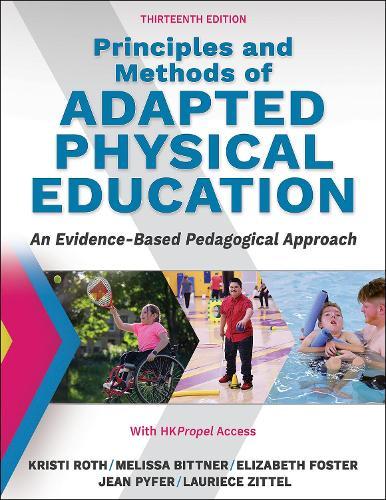
Principles and Methods of Adapted Physical Education, 13th Edition With HKPropel Access, continues its legacy as an evidence-based resource for undergraduate- and graduate-level students training to work with individuals with disabilities in a physical education setting. The content and strategies presented help educators dive deeply into how to build a successful program for the teaching of adapted physical education. This edition incorporates the Adapted Physical Education National Standards and addresses contemporary issues confronted by teachers today: Culturally responsive teaching strategies to help educators build learning environments where all students feel a sense of belonging Social-emotional learning and trauma-sensitive teaching, in alignment with the Collaborative for Academic, Social, and Emotional Learning (CASEL) framework Technology use in adapted physical education to assist in daily planning, teaching, and assessment strategies Positive behavioral interventions and supports within an adapted physical education context Authored by experienced adapted physical education practitioners and teacher trainers, Principles and Methods of Adapted Physical Education emphasizes understanding teaching methods and applying those methods when teaching students with disabilities. Practical instruction is offered for completing comprehensive evaluations, developing individualized education programs (IEPs), facilitating least restrictive learning environments, incorporating universal design for learning, understanding legal requirements, understanding safety considerations for specific disabilities, and determining core elements of a successful adapted physical education program. After establishing the methodology for teaching, chapters are devoted to specific populations, including those with intellectual and developmental disabilities, autism spectrum disorder, specific learning disabilities, emotional disturbance, physically disabling conditions, deafness and hard of hearing, and visual impairments, including deafblindness. To further support student learning, related online materials include video clips of teachers and students in action to demonstrate how activities work in real adapted physical education settings. Also included are reproducible forms from the book, which can be used for online courses or in a flipped learning format, as well as audio lectures that review key concepts from each chapter of the book. Principles and Methods of Adapted Physical Education, 13th Edition, is the premier resource for anyone teaching in an adapted physical education setting or planning to do so. Note: A code for accessing HKPropel is included with this ebook.
Full Product Details
Author: Kristi Roth ,
Melissa Bittner ,
Elizabeth Foster ,
Jean Pyfer
Publisher: Human Kinetics Publishers
Imprint: Human Kinetics
Edition: 13th Edition
ISBN: 9781718221291
ISBN 10: 1718221290
Pages: 408
Publication Date: 13 October 2025
Audience:
College/higher education
,
Tertiary & Higher Education
Format: Paperback
Publisher's Status: Active
Availability: Available To Order

We have confirmation that this item is in stock with the supplier. It will be ordered in for you and dispatched immediately.
Author Information
Kristi Roth, PhD, CAPE, is a professor in the School of Education at the University of Wisconsin (UW) at Stevens Point. She spent 10 years as a general and adapted physical education teacher in the preK-12 environment prior to moving into higher education. She has served in a combination of administrative and teaching roles at UW since 2004. She currently teaches graduate courses in resilience and self-care, equity in education, social justice, research methods, trauma-sensitive classrooms, and issues and trends in education, as well as undergraduate courses in adapted physical education. She was the lead developer of a certificate in trauma and resilience. She has written numerous publications and presentations focusing on technology and teaching students with severe disabilities. She holds the CAPE (certified adapted physical educator) credential. Melissa Bittner, PhD, CAPE, is an associate professor in the department of kinesiology at California State University, Long Beach. She is the coordinator of the adapted physical education program and of the graduate program for curriculum and instruction in physical education. Her primary responsibility is to prepare university students to teach physical education to individuals with disabilities. She directs several on-campus service learning programs designed to offer positive physical education experiences to young people with disabilities. Dr. Bittner serves on the board for the National Consortium for Physical Education for Individuals with Disabilities (NCPEID), California Association for Health, Physical Education, Recreation, and Dance (CAHPERD), and State Council on Adapted Physical Education (SCAPE). Her primary scholarly interests are evidence-based teaching practices for autistic youth and adapted physical education assessment. She has given many scholarly presentations and workshops at the international, national, and state levels. Elizabeth Foster, PhD, CAPE, is an associate professor of adapted physical activity and adapted physical education (APA/APE) at West Chester University. She is the APA/APE program coordinator, graduate coordinator of the APE graduate certificate program, program coordinator for health and physical education majors, and director of the adapted physical activity minor. Dr. Foster was named the 2012 APE Teacher of the Year by the Pennsylvania State Association for Health, Physical Education, Recreation, and Dance. She is a member of the Pennsylvania Deaf-Blind Advisory Committee, is a special advisor for the Pennsylvania Partnership for the Deafblind, and is the research chair for the National Consortium for Physical Education for Individuals With Disabilities. She is also certified in English as a secondary language. In addition, Foster has been involved with various adapted sport organizations and disability organizations promoting physical activities, fitness, adapted sports, and aquatics for all individuals with disabilities. Jean Pyfer, PNP, CAPE, is an emeritus faculty professor of Texas Woman's University and retired dean. She earned her bachelor's degree in physical education and biology from Bradley University, her master's degree in physical education from Indiana University (IU), and her doctorate in physical education and educational psychology from IU. Her professional specializations include adapted physical education, movement assessment, programming to alleviate sensory motor development delays, and motor development during growth. Lauriece Zittel, PhD, CAPE, is a professor of adapted physical activity in the kinesiology and physical education department of Northern Illinois University. Her research interests include early childhood physical activity and movement skill assessment, curriculum design, and instruction for children with disabilities and those at risk for developmental delay. She earned her doctoral degree in movement studies in disability from Oregon State University, her MSEd degree in physical education from the University of Maine, and her BS degree in physical education from Valparaiso University.