Overview
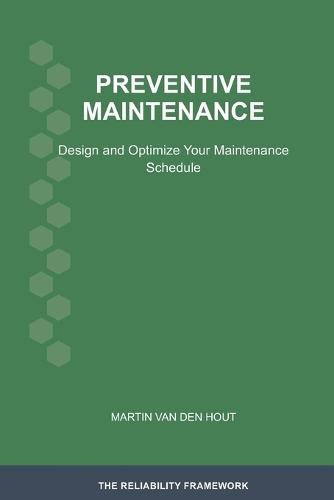
Stop paying for failures that could have been prevented Machines fail without warning, production lines go down, technicians replace parts under pressure. This reactive approach costs hundreds of thousands of dollars every year, undermines delivery reliability, increases energy consumption, and makes compliance impossible. But how do you design a preventive maintenance program that works for your entire organization? A systematic approach in eight concrete steps This practical handbook guides you through the complete process of effective preventive maintenance. Sarah Shoemaker's transformation of TechPro Manufacturing - from 70% reactive to 70% preventive in six months - runs as a thread through the entire book. What you will learn: Define requirements - translate vague expectations into measurable targets for availability and risk Asset inventory - systematically map all assets with logical coding Criticality ranking - determine which assets deserve priority using a scoring matrix for safety, environment, production, and cost Methodology selection - RCM for critical assets, Industrial RCM for important assets, a pragmatic approach for standard assets Failure mode analysis - the six failure patterns according to Nowlan & Heap, technical aging, and lifespan distribution Maintenance types - time-based, condition-based, inspection techniques, NDT methods, IoT and digital monitoring Economic optimization - cost-benefit analysis, optimal intervals, investment decisions Implementation - from analysis to executable schedule with a 6-month roadmap for rapid results Proven results 30-50% reduction in unplanned downtime 20-30% lower total maintenance costs 15-25% improvement in Overall Equipment Effectiveness ROI of 150-300% within 18 months 5-15% energy savings Automatic compliance with ISO 9001, ISO 55000, and regulatory requirements Who is this book for? For technical managers and engineers in maintenance, reliability, and asset management. From maintenance managers to reliability engineers and plant managers - everyone who wants to transform from reactive to preventive. Universally applicable in manufacturing, process plants, facility management, infrastructure, hospitals, utilities, offshore, and data centers. Practical and immediately applicable Each chapter contains step-by-step procedures, scoring models, decision trees, practical examples, and checklists. Unlike theoretical handbooks or conceptual consultancy frameworks, this book gives you concrete tools to get started without external help. Part of a larger whole This is the fifth volume of The Reliability Framework, a nine-book series covering maintenance and reliability. Each book covers one subject systematically and in depth. Pairs well with Volume 4 (Root Cause Analysis in Maintenance), Volume 7 (Precision Maintenance), and Volume 8 (Engineering for Reliability). About the author Martin Van den Hout has 35 years of experience in maintenance and reliability, including 24 years as a consultant for organizations worldwide. He worked in Japanese production plants where TPM was developed and in British chemical companies implementing RCM. He wrote a leading university-level textbook on maintenance management and delivers in-company training programs. His pragmatic approach combines international methodologies with hands-on industrial experience.
Full Product Details
Author: Martin Van Den Hout
Publisher: Vulcanus Press
Imprint: Vulcanus Press
Volume: 5
Dimensions:
Width: 15.20cm
, Height: 0.80cm
, Length: 22.90cm
Weight: 0.209kg
ISBN: 9789083643168
ISBN 10: 9083643166
Pages: 148
Publication Date: 18 May 2026
Audience:
General/trade
,
General
Format: Paperback
Publisher's Status: Active
Availability: Available To Order

We have confirmation that this item is in stock with the supplier. It will be ordered in for you and dispatched immediately.