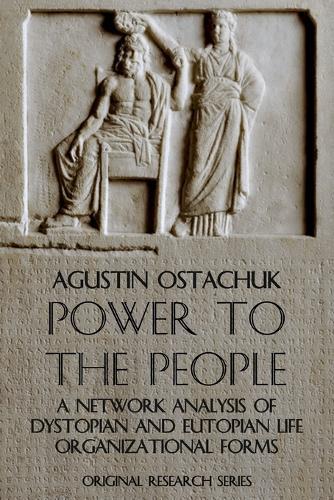
Power to the People: A Network Analysis of Dystopian and Eutopian Life Organizational Forms

Author:   Agustín Ostachuk
Publisher:   Independently Published
ISBN:  

9798343998276


Pages:   112
Publication Date:   21 October 2024
Format:   Paperback
Availability:   Available To Order   Availability explained
We have confirmation that this item is in stock with the supplier. It will be ordered in for you and dispatched immediately.

Our Price $60.72 Quantity:  
Add to Cart

Share |

Power to the People: A Network Analysis of Dystopian and Eutopian Life Organizational Forms


Overview

The human race has been socially organizing itself for probably about 1.8 million years. The first form of human organization was the hunter-gatherer, which was the form of organization in which man lived for about 99 % of his history. This mode of life caused humans to organize themselves into small groups and lead a nomadic life. The nomadic life ensured that these groups had no possessions and no wealth could be accumulated. In this manner, this form of human organization ensured egalitarianism, a form of primitive communism. This changed dramatically with the development of agriculture in the so-called Neolithic Revolution in 10,000 BC. With the development of agriculture and the consequent development of technology, man became sedentary, the first towns were formed, and the class system made its appearance, that is, the separation between an administrative class and a productive class. The egalitarian and communist primitive society gave way to an increasingly centralized and hierarchical society. From network theory, they have been insisting for years on the benefits of the so-called scale-free networks, networks governed by certain privileged nodes called hubs. These networks are said to be slightly vulnerable and highly robust to errors. In this work, we perform a deep network analysis of a group of centralized-hierarchical networks and a group of decentralized-distributed networks. This work provides clear and compelling evidence that, contrary to what is maintained, decentralized-distributed networks are the least vulnerable and most robust networks, and are the networks that ensure an equitable and equal distribution of power and influence among their members. These results are analyzed in the context of network theory, and are discussed in relation to the theories of Jeremy Rifkin, Ernst Schumacher, Alexander Bogdanov and Aldous Huxley.

Full Product Details

Author:   Agustín Ostachuk
Publisher:   Independently Published
Imprint:   Independently Published
Dimensions:   Width: 15.20cm , Height: 0.60cm , Length: 22.90cm
Weight:   0.159kg
ISBN:  

9798343998276


Pages:   112
Publication Date:   21 October 2024
Audience:   General/trade ,  General
Format:   Paperback
Publisher's Status:   Active
Availability:   Available To Order   Availability explained
We have confirmation that this item is in stock with the supplier. It will be ordered in for you and dispatched immediately.

Table of Contents

Reviews

Author Information

Tab Content 6

Author Website:  

Countries Available

All regions
Latest Reading Guide

April RG 26_2


Shopping Cart
Your cart is empty
Shopping cart
Mailing List