Awards
- Short-listed for Aventis General Prize for Science Books 2006
- Shortlisted for Aventis General Prize for Science Books 2006.
Overview
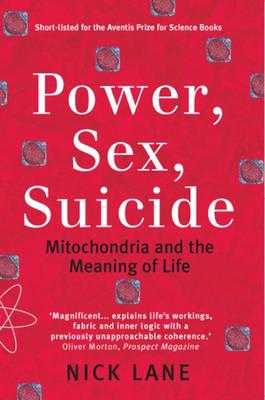
Mitochondria are tiny structures located inside our cells that carry out the essential task of producing energy for the cell. They are found in all complex living things, and in that sense, they are fundamental for driving complex life on the planet. But there is much more to them than that. Mitochondria have their own DNA, with their own small collection of genes, separate from those in the cell nucleus. It is thought that they were once bacteria living independent lives. Their enslavement within the larger cell was a turning point in the evolution of life, enabling the development of complex organisms and, closely related, the origin of two sexes. Unlike the DNA in the nucleus, mitochondrial DNA is passed down exclusively (or almost exclusively) via the female line. That's why it has been used by some researchers to trace human ancestry daughter-to-mother, to 'Mitochondrial Eve'. Mitochondria give us important information about our evolutionary history. And that's not all. Mitochondrial genes mutate much faster than those in the nucleus because of the free radicals produced in their energy-generating role. This high mutation rate lies behind our ageing and certain congenital diseases. The latest research suggests that mitochondria play a key role in degenerative diseases such as cancer, through their involvement in precipitating cell suicide. Mitochondria, then, are pivotal in power, sex, and suicide. In this fascinating and thought-provoking book, Nick Lane brings together the latest research findings in this exciting field to show how our growing understanding of mitochondria is shedding light on how complex life evolved, why sex arose (why don't we just bud?), and why we age and die. This understanding is of fundamental importance, both in understanding how we and all other complex life came to be, but also in order to be able to control our own illnesses, and delay our degeneration and death. 'An extraordinary account of groundbreaking modern science... The book abounds with interesting and important ideas.'Mark Ridley, Department of Zoology, University of Oxford
Full Product Details
Author: Nick Lane (Professor of Evolutionary Biochemistry, University College London)
Publisher: Oxford University Press
Imprint: Oxford University Press
Edition: 2nd Revised edition
Dimensions:
Width: 13.00cm
, Height: 2.00cm
, Length: 19.00cm
Weight: 0.271kg
ISBN: 9780199205646
ISBN 10: 0199205647
Pages: 368
Publication Date: 26 October 2006
Audience:
General/trade
,
Professional and scholarly
,
General
,
Professional & Vocational
Format: Paperback
Publisher's Status: Out of Print
Availability: In Print

Limited stock is available. It will be ordered for you and shipped pending supplier's limited stock.
Reviews
"`Review from previous edition The books was written for anyone interested in some of the most profound questions of twenty-first century science. The central proposals of 'Power, Sex, Suicide' are clearly and forcefully propounded... This is a new take on why we are here. Do, please, read this book.' John F. Allen, Nature `I defy anyone (who doesn't know about mitochondria in detail already) to read this book and not come out amazed by the incredible subtlty, complexity and downright unlikeliness of the mechanisms of biological consideration. This book opens up the secrets with an obvious delight from Lane that the readers are likely to share. Recommended.' Popular Science Review `One of the most interesting stories modern biology has to tell' Steven Rose, The Guardian `Nick Lane's magnificent new book... bracingly and convincingly revisionist... Explains life's workings, fabric and inner logic with a previously unapproachable coherence.' Oliver Morton, Prospect Magazine `Full of startling insights into the nature and evolution of life as we know it.' The Economist, Books of the Year 2005 `A good tale. This is a ""popular science"" book, aimed at the non-specialist with the admirable goal of making the topic more accessible.' John Alcolado, bmj.com `Full of startling insights into the nature and evolution of life as we know it.' Economist Best Books of the Year, 2005 `This is an especially interesting and worthwhile science book...Lane's next book is eagerly awaited.' London Book Review"
`Review from previous edition The books was written for anyone interested in some of the most profound questions of twenty-first century science. The central proposals of 'Power, Sex, Suicide' are clearly and forcefully propounded... This is a new take on why we are here. Do, please, read this book.' John F. Allen, Nature `I defy anyone (who doesn't know about mitochondria in detail already) to read this book and not come out amazed by the incredible subtlty, complexity and downright unlikeliness of the mechanisms of biological consideration. This book opens up the secrets with an obvious delight from Lane that the readers are likely to share. Recommended.' Popular Science Review `One of the most interesting stories modern biology has to tell' Steven Rose, The Guardian `Nick Lane's magnificent new book... bracingly and convincingly revisionist... Explains life's workings, fabric and inner logic with a previously unapproachable coherence.' Oliver Morton, Prospect Magazine `Full of startling insights into the nature and evolution of life as we know it.' The Economist, Books of the Year 2005 `A good tale. This is a popular science book, aimed at the non-specialist with the admirable goal of making the topic more accessible.' John Alcolado, bmj.com `Full of startling insights into the nature and evolution of life as we know it.' Economist Best Books of the Year, 2005 `This is an especially interesting and worthwhile science book...Lane's next book is eagerly awaited.' London Book Review
Challenging, but rewarding. Vanessa Thorpe, Observer Its the most interesting and significant addendum to Darwin's theory I think I've come across since Richard Dawkins explained how genes are the mechanism for evolution. Independent on Sunday, An enthralling account...The author has accomplished something quite breathtaking... Moreover, he brings the science alive...he is always accessible lively , thought provoking and informative. Every Biologist should read this book
Author Information
Dr Nick Lane is Honorary Reader at University College London and formerly strategic director at Adelphi Medi Cine, a medical multimedia company based in London. His first book, Oxygen: the Molecule that made the World, was published to critical acclaim by Oxford University Press in 2002. He is co-editor of the academic text Life in the Frozen State, and his articles have been published in numerous international scientific journals, including Scientific American, New Scientist, The Lancet and the British Medical Journal. Nick Lane has also spent many years clinging to rock faces in search of fossils and thrills, but his practical interest in palaeontology is rarely rewarded with more than a devil's toenail.