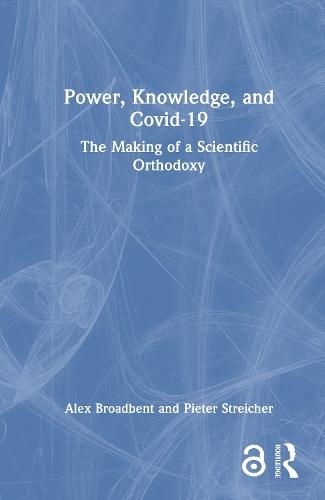
Full Product Details
Author: Alex Broadbent (Durham University) ,
Pieter Streicher (University of Johannesburg and Durham University)
Publisher: Taylor & Francis Ltd
Imprint: Routledge
Weight: 0.650kg
ISBN: 9781041224853
ISBN 10: 1041224850
Pages: 248
Publication Date: 16 March 2026
Audience:
College/higher education
,
Professional and scholarly
,
Professional and scholarly
,
Tertiary & Higher Education
,
Professional & Vocational
Format: Hardback
Publisher's Status: Active
Availability: Manufactured on demand

We will order this item for you from a manufactured on demand supplier.
Reviews
“Broadbent and Streicher here present in impressive detail a gloomy account of things that happened in the COVID pandemic that, they argue, contributed to bad decisions and some very harmful outcomes. They gather them together under the label ‘scientific orthodoxy’, which involves, as they elaborate it, much that is antithetical to good scientific practice – dogmatism, suppression of dissent, rigidity with respect to methods, and illegitimate political authority. The book advances strong claims in strong language. Whether you are predisposed to agree with them or predisposed to disagree, if you are seriously interested in these issues, you should read this book and critically engage with its arguments.” – Nancy Cartwright, UC San Diego and Durham University “Broadbent and Streicher offer an original and lucid critique of how the COVID-19 scientific orthodoxy was constructed and enforced. It offers an indispensable perspective on the intersection of science, authority, and policy during one of the most consequential moments in recent human history.” – Sandro Galea, Washington University in St. Louis ""This book is a very welcome challenge to the scientific orthodoxy that grew around the COVID-19 pandemic. Its findings are a serious challenge to the global community. And we would do well to listen to them before the next pandemic strikes."" – Richard Sullivan, King’s College London “Alex Broadbent and Piet Streicher’s book is much the best philosophical analysis of the Covid pandemic that I have read. Philosophically rigorous and original, highly relevant to scientific practice, and very well informed regarding that practice. The book is courageous in how it tackles sacred cows and controversy, but throughout it maintains a fair-minded tone, respect for science, and a strong moral purpose.” – Robert Northcott, Birkbeck College, University of London “This is the most important critique yet of the intellectual failings governmental responses to the Covid pandemic—from their scientific myopia to their ineffective or even harmful policies. Power, Knowledge, and Covid-19 is essential reading for anyone who wishes to learn the lessons of the pandemic for future science-informed policy making.” -- Alexander Bird, University of Cambridge “This authoritative account forensically dismantles the science-led case for lockdowns during the Covid pandemic, setting out what went wrong and why. The authors provide copious evidence to back up their claim that the scientific advice proffered in the UK and globally was error-prone, dogmatic and neglected the interests of many of the public – damning charges that the science advisory community has yet to properly address. I recommend that anyone inclined to support lockdowns in the future should read this book first, and think again.” -- Mark Woolhouse, University of Edinburgh
“Broadbent and Streicher offer an original and lucid critique of how the COVID-19 scientific orthodoxy was constructed and enforced. It offers an indispensable perspective on the intersection of science, authority, and policy during one of the most consequential moments in recent human history.” – Sandro Galea, Washington University in St. Louis ""This book is a very welcome challenge to the scientific orthodoxy that grew around the COVID-19 pandemic. Its findings are a serious challenge to the global community. And we would do well to listen to them before the next pandemic strikes."" – Richard Sullivan, King’s College London
“Broadbent and Streicher offer an original and lucid critique of how the COVID-19 scientific orthodoxy was constructed and enforced. It offers an indispensable perspective on the intersection of science, authority, and policy during one of the most consequential moments in recent human history.” – Sandro Galea, Washington University in St. Louis ""This book is a very welcome challenge to the scientific orthodoxy that grew around the COVID-19 pandemic. Its findings are a serious challenge to the global community. And we would do well to listen to them before the next pandemic strikes."" – Richard Sullivan, King’s College London “Alex Broadbent and Piet Streicher’s book is much the best philosophical analysis of the Covid pandemic that I have read. Philosophically rigorous and original, highly relevant to scientific practice, and very well informed regarding that practice. The book is courageous in how it tackles sacred cows and controversy, but throughout it maintains a fair-minded tone, respect for science, and a strong moral purpose.” – Robert Northcott, Birkbeck College, University of London “This is the most important critique yet of the intellectual failings governmental responses to the Covid pandemic—from their scientific myopia to their ineffective or even harmful policies. Power, Knowledge, and Covid-19 is essential reading for anyone who wishes to learn the lessons of the pandemic for future science-informed policy making.” -- Alexander Bird, University of Cambridge
Author Information
Alex Broadbent is Professor of Philosophy at Durham University, Visiting Professor at the University of Johannesburg, and Director of the Centre for Philosophy of Epidemiology, Medicine, and Public Health. His previous books include Philosophy of Epidemiology (2013), Philosophy for Graduate Students (2016), and Philosophy of Medicine (2019), and he has also edited The Routledge Handbook of Philosophy of Public Health (2023, with Sridhar Venkatapuram) and The Oxford Handbook of Philosophy of Medicine (2025). Pieter Streicher is Research Associate at the Centre for Philosophy of Epidemiology, Medicine, and Public Health, at the University of Johannesburg and Durham University.