Overview
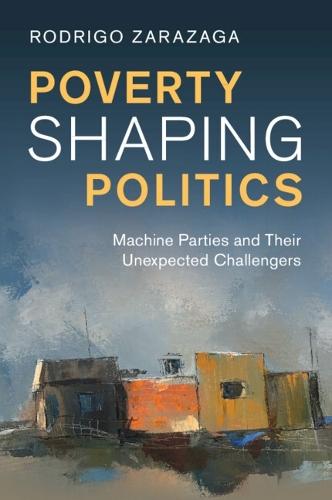
Drawing on substantial original interviews and fieldwork data from Argentina's marginalized urban areas, Poverty Shaping Politics reveals how the spatial segregation of slums and vulnerable neighborhoods compels the poor to seek out local political brokers to access resources, while politicians depend on these brokers to navigate poor areas and garner political support. Rodrigo Zarazaga uniquely demonstrates that the establishment of broker networks is driven more by the conditions of segregated poverty and vulnerability than by the inherent capabilities of 'machine-like' parties. Using the case of Cambiemos challenging Peronism in poor districts, Zarazaga provides the first account of a party building broker networks to contest a dominant machine party. While existing literature suggests that sustained economic development can weaken machine parties, this book shows that entrenched and widespread poverty can also threaten their hegemony.
Full Product Details
Author: Rodrigo Zarazaga (Instituto Universitario CIAS)
Publisher: Cambridge University Press
Imprint: Cambridge University Press
ISBN: 9781009632942
ISBN 10: 1009632949
Pages: 281
Publication Date: 22 May 2025
Audience:
General/trade
,
General
Format: Paperback
Publisher's Status: Active
Availability: Manufactured on demand

We will order this item for you from a manufactured on demand supplier.
Reviews
'Challenging much of the established thinking about politics at the urban margins, this book offers invaluable and novel insights about the practices of grassroots politicians and their dynamic networks. Bravo Zarazaga for his clear prose and illuminating analysis. This book will be widely discussed in the years to come.' Javier Auyero, Author of Squatter Life. Persistence at the Urban Margins of Buenos Aires 'Zarazaga's pathbreaking book is a must-read for scholars of distributive politics, political representation, and Latin American politics. Its deep ethnographic work generated a novel theory about how the commodification of political brokers induces shifts in partisan loyalties when seeking access to scarce resources for poor voters. Zarazaga's critical study will redefine the study of politics in contexts of segregated vulnerability.' María Victoria Murillo, Professor of Political Science and International and Public Affairs, and Director of the Institute of Latin American Studies, Columbia University in the City of New York 'No scholar understands grassroots Peronism or Argentine clientelism like Rodrigo Zarazaga. This meticulously-researched book provides a rich understanding of how Peronist clientelism works, shows how it has evolved over time, and, crucially, explains why it weakened in the early twenty-first century. This transformation is essential to understanding the rise of Javier Milei-and contemporary Argentine politics more broadly. Anyone interested in Latin American clientelism should read this extraordinary book.' Steven Levitsky, David Rockefeller Professor of Latin American Studies, Professor of Government and Director of the David Rockefeller Center for Latin American Studies, Harvard University
Author Information
Rodrigo Zarazaga is a full-time professor and senior researcher at the Instituto Universitario CIAS and at the National Council for Science and Technology from Argentina. He is a Jesuit priest, and his research has been published in journals such as Latin American Politics and Society, Journal of Theoretical Politics, World Development, Journal of Democracy, and Governance.