Overview
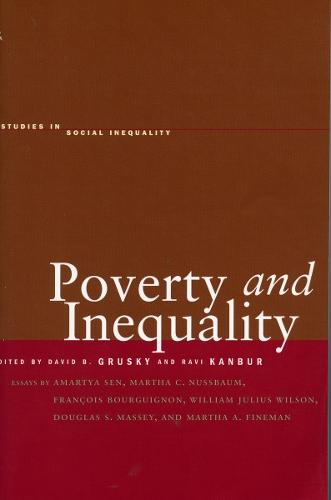
This volume brings together leading public intellectuals - Amartya Sen, Martha C. Nussbaum, Francois Bourguignon, William J. Wilson, Douglas S. Massey, and Martha A. Fineman - to take stock of current analytic understandings of poverty and inequality. Contemporary research on inequality has largely relied on conceptual advances several decades old, even though the basic structure of global inequality is changing in fundamental ways. The reliance on conventional poverty indices, rights-based approaches to poverty reduction, and traditional modeling of social mobility has left scholars and policymakers poorly equipped to address modern challenges. The contributors show how contemporary poverty is forged in neighborhoods, argue that discrimination in housing markets is a profound source of poverty, suggest that gender inequalities in the family and in the social evaluation of the caretaking role remain a hidden dimension of inequality, and develop the argument that contemporary inequality is best understood as art inequality in fundamental human capabilities. This book demonstrates in manifold ways how contemporary scholarship and policy must be recast to make sense of new and emerging forms of poverty and social exclusion.
Full Product Details
Author: David B. Grusky ,
Ravi Kanbur
Publisher: Stanford University Press
Imprint: Stanford University Press
Edition: annotated edition
Dimensions:
Width: 15.50cm
, Height: 1.40cm
, Length: 23.50cm
Weight: 0.290kg
ISBN: 9780804748438
ISBN 10: 0804748438
Pages: 200
Publication Date: 24 January 2006
Audience:
College/higher education
,
Professional and scholarly
,
Undergraduate
,
Postgraduate, Research & Scholarly
Format: Paperback
Publisher's Status: Active
Availability: In Print

This item will be ordered in for you from one of our suppliers. Upon receipt, we will promptly dispatch it out to you. For in store availability, please contact us.
Reviews
...I highly recommend this book. It is essential reading for anyone studying occupational segregation, and valuable for scholars in a range of fields including gender studies, work, social inequality, and comparative-historical sociology. --Canadian Journal of Sociology Online This slim volume offers ample food for thought to scholars with a serious interest in social or economic inequality. The star contributors- economists, sociologists, political scientists, and philosophers-present concepts, theories, and proposals that will stimulate those outside as well as within their home disciplines. While avoiding the circular reasoning characteristic of the 1960's 'culture of poverty,' these accessible essays enlarge the concept of poverty-and, I hope, of poverty research and policy-by elaborating the idea that social justice requires measurable equality of capabilities or opportunities, and not merely of economic resources. -- Robert M. Hauser University of Wisconsin-Madison This impressive collection of essays brings together well-known economists, sociologists, and philosophers to discuss the pressing problems of inequality and poverty. Kanbur and Grusky recognize that these timely and difficult issues can only be dealt with by marshalling the intellectual power of our best minds, looking at poverty through the lens of multiple disciplines.
“...I highly recommend this book. It is essential reading for anyone studying occupational segregation, and valuable for scholars in a range of fields including gender studies, work, social inequality, and comparative-historical sociology.”-- Canadian Journal of Sociology Online
0;...I highly recommend this book. It is essential reading for anyone studying occupational segregation, and valuable for scholars in a range of fields including gender studies, work, social inequality, and comparative-historical sociology.1;-- Canadian Journal of Sociology Online
Author Information
David B. Grusky is Professor of Sociology and incoming Director of the Program on Inequality at Stanford University. His recent books include Occupational Ghettos: The Worldwide Segregation of Women and Men (Stanford 2004) and Mobility and Inequality (Stanford 2005). Ravi Kanbur is T.H. Lee Professor of World Affairs, International Professor of Applied Economics and Management, and Professor of Economics at Cornell University.