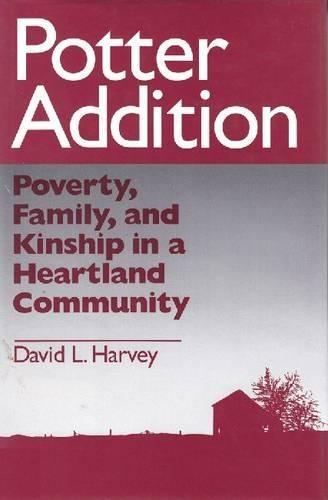
Full Product Details
Author: David L. Harvey
Publisher: Taylor & Francis Inc
Imprint: AldineTransaction
Dimensions:
Width: 15.00cm
, Height: 1.80cm
, Length: 22.70cm
Weight: 0.454kg
ISBN: 9780202304427
ISBN 10: 0202304426
Pages: 326
Publication Date: 01 March 1993
Audience:
Professional and scholarly
,
Professional & Vocational
Format: Paperback
Publisher's Status: Unknown
Availability: Out of stock

Reviews
<p> Harvey states that the purpose of his book is to record the particular experience of a lower-class fraction that has been relatively neglected by sociologists: poor, nonethnic whites who within the last two generations or so have been driven from the land. In addition to providing rich ethnographic detail, Harvey, who spent 15 months as a participant observer and 20 years reflecting on this experience, demonstrates that poverty has remained the same over time, despite its new source--deindustrialization--and its new consequence--feminization... The book is well written... Throughout, however, one feels the deep respect of the author for the people he has studied... Graduate; faculty; professional. <p> --S. Reinharz, Choice
-Harvey states that the purpose of his book is to -record the particular experience of a lower-class fraction that has been relatively neglected by sociologists: poor, nonethnic whites who within the last two generations or so have been driven from the land.- In addition to providing rich ethnographic detail, Harvey, who spent 15 months as a participant observer and 20 years reflecting on this experience, demonstrates that poverty has remained the same over time, despite its new source--deindustrialization--and its new consequence--feminization... The book is well written... Throughout, however, one feels the deep respect of the author for the people he has studied... Graduate; faculty; professional.- --S. Reinharz, Choice -[P]rovide[s] substantial empirical evidence for theoretically exploring the structure of poverty and its subculture. I... recommend it.- --Bennett M. Judkins, Social Forces -This book is a lively and thought-provoking account of a much maligned social group, and there is much to engage scholars from a variety of areas and perspectives. It is an impressive undertaking which is to be commended for both the breadth and the depth of its analysis. It can be read at a number of levels and should prove useful for both upper-level undergraduate and graduate courses as well as for scholars of poverty, community, the family, and stratification.- --Ann R. Tickamyer, American Journal of Sociology ""Harvey states that the purpose of his book is to ""record the particular experience of a lower-class fraction that has been relatively neglected by sociologists: poor, nonethnic whites who within the last two generations or so have been driven from the land."" In addition to providing rich ethnographic detail, Harvey, who spent 15 months as a participant observer and 20 years reflecting on this experience, demonstrates that poverty has remained the same over time, despite its new source--deindustrialization--and its new consequence--feminization... The book is well written... Throughout, however, one feels the deep respect of the author for the people he has studied... Graduate; faculty; professional."" --S. Reinharz, Choice ""[P]rovide[s] substantial empirical evidence for theoretically exploring the structure of poverty and its subculture. I... recommend it."" --Bennett M. Judkins, Social Forces ""This book is a lively and thought-provoking account of a much maligned social group, and there is much to engage scholars from a variety of areas and perspectives. It is an impressive undertaking which is to be commended for both the breadth and the depth of its analysis. It can be read at a number of levels and should prove useful for both upper-level undergraduate and graduate courses as well as for scholars of poverty, community, the family, and stratification."" --Ann R. Tickamyer, American Journal of Sociology ""Harvey states that the purpose of his book is to ""record the particular experience of a lower-class fraction that has been relatively neglected by sociologists: poor, nonethnic whites who within the last two generations or so have been driven from the land."" In addition to providing rich ethnographic detail, Harvey, who spent 15 months as a participant observer and 20 years reflecting on this experience, demonstrates that poverty has remained the same over time, despite its new source--deindustrialization--and its new consequence--feminization... The book is well written... Throughout, however, one feels the deep respect of the author for the people he has studied... Graduate; faculty; professional."" --S. Reinharz, Choice ""[P]rovide[s] substantial empirical evidence for theoretically exploring the structure of poverty and its subculture. I... recommend it."" --Bennett M. Judkins, Social Forces ""This book is a lively and thought-provoking account of a much maligned social group, and there is much to engage scholars from a variety of areas and perspectives. It is an impressive undertaking which is to be commended for both the breadth and the depth of its analysis. It can be read at a number of levels and should prove useful for both upper-level undergraduate and graduate courses as well as for scholars of poverty, community, the family, and stratification."" --Ann R. Tickamyer, American Journal of Sociology
-Harvey states that the purpose of his book is to -record the particular experience of a lower-class fraction that has been relatively neglected by sociologists: poor, nonethnic whites who within the last two generations or so have been driven from the land.- In addition to providing rich ethnographic detail, Harvey, who spent 15 months as a participant observer and 20 years reflecting on this experience, demonstrates that poverty has remained the same over time, despite its new source--deindustrialization--and its new consequence--feminization... The book is well written... Throughout, however, one feels the deep respect of the author for the people he has studied... Graduate; faculty; professional.- --S. Reinharz, Choice -[P]rovide[s] substantial empirical evidence for theoretically exploring the structure of poverty and its subculture. I... recommend it.- --Bennett M. Judkins, Social Forces -This book is a lively and thought-provoking account of a much maligned social group, and there is much to engage scholars from a variety of areas and perspectives. It is an impressive undertaking which is to be commended for both the breadth and the depth of its analysis. It can be read at a number of levels and should prove useful for both upper-level undergraduate and graduate courses as well as for scholars of poverty, community, the family, and stratification.- --Ann R. Tickamyer, American Journal of Sociology
Author Information
David L. Harvey is professor of sociology at the University of Nevada, Reno. He is interested in the fields of chaos theory and social revolution and what they mean for sociological research. He has written many articles on chaos theory and its application in the social sciences.