Overview
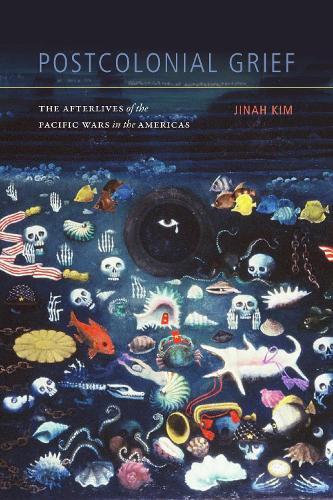
In Postcolonial Grief Jinah Kim explores the relationship of mourning to transpacific subjectivities, aesthetics, and decolonial politics since World War II. Kim argues that Asian diasporic subjectivity exists in relation to afterlives because the deaths of those killed by U.S. imperialism and militarism in the Pacific remain unresolved and unaddressed. Kim shows how primarily U.S.-based Korean and Japanese diasporic writers, artists, and filmmakers negotiate the necropolitics of Asia and how their creative refusal to heal from imperial violence may generate transformative antiracist and decolonial politics. She contests prevalent interpretations of melancholia by engaging with Frantz Fanon's and Hisaye Yamamoto's decolonial writings; uncovering the noir genre's relationship to the U.S. war in Korea; discussing the emergence of silenced colonial histories during the 1992 Los Angeles riots; and analyzing the 1996 hostage takeover of the Japanese ambassador's home in Peru. Kim highlights how the aesthetic and creative work of the Japanese and Korean diasporas offers new insights into twenty-first-century concerns surrounding the state's erasure of military violence and colonialism and the difficult work of remembering histories of war across the transpacific.
Full Product Details
Author: Jinah Kim
Publisher: Duke University Press
Imprint: Duke University Press
Weight: 0.408kg
ISBN: 9781478001355
ISBN 10: 1478001356
Pages: 200
Publication Date: 01 February 2019
Audience:
Professional and scholarly
,
Professional & Vocational
Format: Hardback
Publisher's Status: Active
Availability: In Print

This item will be ordered in for you from one of our suppliers. Upon receipt, we will promptly dispatch it out to you. For in store availability, please contact us.
Reviews
Postcolonial Grief offers a promising glimpse into what it might look like to pursue comparative or relational area studies through an anticolonial orientation. -- Emily Mitchell-Eaton * Society & Space * Postcolonial Grief powerfully uncovers overlapping histories of violence across the Pacific and carefully considers the relationship between grief, silencing, and reconciliation. Kim convincingly demonstrates the way that melancholia and loss constitute powerful forces in the Pacific as wounds that refuse to heal yet open up new (im)possibilities for relating to violence outside of liberal humanist frameworks of reconciliation. Postcolonial Grief is thus invaluable for those interested in affect studies, settler colonial studies, cultural studies, communication, and Asian-American history. -- Corinne Mitsuye Sugino * Lateral * The book is a powerful exploration of how unmourned and unresolved deaths across the transpacific haunt the present, offering possibilities for political transformations. Analyzing the ghostly and capturing them into words is a challenging academic endeavor, which this book accomplishes robustly, making interventions across diasporic studies, critical race theories, feminist studies, cultural studies, and Asian American studies and Latinx studies. -- Hayana Kim * Situations * In this provocative book, Jinah Kim explores the ways in which trans-Pacific victims of imperial colonial politics and militarism have navigated their relationships with decolonial politics since World War II, and the ensuing psychological transformations.... This is an important contribution, and should be read by not only students and scholars of literature and history, but also those from Asian American and East Asian studies, anthropology, sociology, and political science. -- Nobuko Adachi * Pacific Affairs *
Postcolonial Grief offers a promising glimpse into what it might look like to pursue comparative or relational area studies through an anticolonial orientation. -- Emily Mitchell-Eaton * Society & Space *
Postcolonial Grief powerfully uncovers overlapping histories of violence across the Pacific and carefully considers the relationship between grief, silencing, and reconciliation. Kim convincingly demonstrates the way that melancholia and loss constitute powerful forces in the Pacific as wounds that refuse to heal yet open up new (im)possibilities for relating to violence outside of liberal humanist frameworks of reconciliation. Postcolonial Grief is thus invaluable for those interested in affect studies, settler colonial studies, cultural studies, communication, and Asian-American history. -- Corinne Mitsuye Sugino * Lateral * Postcolonial Grief offers a promising glimpse into what it might look like to pursue comparative or relational area studies through an anticolonial orientation. -- Emily Mitchell-Eaton * Society & Space *
Author Information
Jinah Kim is Assistant Professor of Communication Studies at California State University, Northridge.