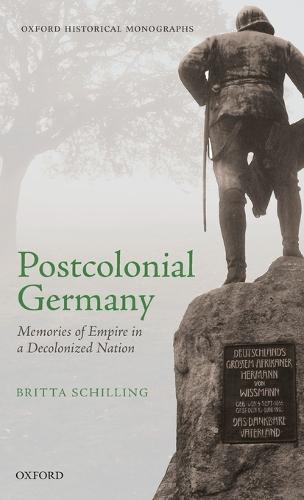
Full Product Details
Author: Britta Schilling (Leverhulme Early Career Fellow, Leverhulme Early Career Fellow, University of Cambridge)
Publisher: Oxford University Press
Imprint: Oxford University Press
Dimensions:
Width: 16.00cm
, Height: 2.30cm
, Length: 22.70cm
Weight: 0.470kg
ISBN: 9780198703464
ISBN 10: 0198703465
Pages: 274
Publication Date: 06 March 2014
Audience:
College/higher education
,
Professional and scholarly
,
Tertiary & Higher Education
,
Professional & Vocational
Format: Hardback
Publisher's Status: Active
Availability: To order

Stock availability from the supplier is unknown. We will order it for you and ship this item to you once it is received by us.
Reviews
Britta Schilling has produced a highly readable and informative study, which is at once breathtaking in scope and swift in style, especially for a doctoral thesis. Effortlessly, she takes the reader through almost a century of German history and memory production without succumbing to superficiality or truisms. Instead, she carefully evaluates the evidence at her disposal and provides a fresh approach to historical memory studies by focusing on material culture and the complicated interplay of public and private memory. Her combination of historical scholarship with insights from anthropology and cultural studies ... deserves great merit. Fabian Krautwald, H-Soz-u-Kult
Britta Schilling has produced a highly readable and informative study, which is at once breathtaking in scope and swift in style, especially for a doctoral thesis. Effortlessly, she takes the reader through almost a century of German history and memory production without succumbing to superficiality or truisms. Instead, she carefully evaluates the evidence at her disposal and provides a fresh approach to historical memory studies by focusing on material culture and the complicated interplay of public and private memory. Her combination of historical scholarship with insights from anthropology and cultural studies ... deserves great merit. Fabian Krautwald, H-Soz-u-Kult Her [Schilling's] in-depth study is a most valuable contribution to the development of the vital field of the memory of German colonialism and will doubtless trigger further research. Dr Monika Albrecht, Reviews in History Schilling's book reflects scholars' growing interest in Germany's colonial history. The book is clear and concise in its argument and includes interesting illustrations such as German advertisements and family photos of everyday life in the colonies. It is ideal for the professional historian, student or anyone with an interest in colonial history and memory. It draws on original source material and provides the reader with stimulating and persuasive analysis. Rachel O'Sullivan, History an important and timely study ... It has the great merit of reminding many readers, or perhaps even informing them for the first time, that Germany had a colonial past and that its legacy lives on in many different forms and material shapes, even if contemporary decision-makers would often like to ignore this fact. Marie Muschalek, Bulletin: German Historical Institute an excellent study ... Historians of twentieth-century Germany, as well as International Relations scholars focusing on Germany's relationship with the wider world, will find much to reflect on in this book. Britta Schilling's work will, one hopes, mark the beginning of a wider reassessment of the historical legacy of Germany's colonial adventure as well as its relationship with countries which were once intended to be stepping-stones to a global empire. Alexander Clarkson, English Historical Review Schilling's work will appeal to scholars interested in the evolution of memory studies as well as those focusing on how the colonial question was answered in Europe after the age of empire. It is easy, when thinking about how to integrate this scholarship into one's teaching, to imagine lectures about the Cold War being enriched by her insights into the public relations maneuvers of the German states as they sought to win the affections of former colonies. Jared Poley, American Historical Review
Author Information
Britta Schilling is a Leverhulme Early Career Fellow in History at the University of Cambridge and Fellow of Wolfson College, Cambridge. She has previously published articles on German women, colonialism, and visual culture in the interwar era. She is a graduate of Rutgers University and the University of Oxford.