Overview
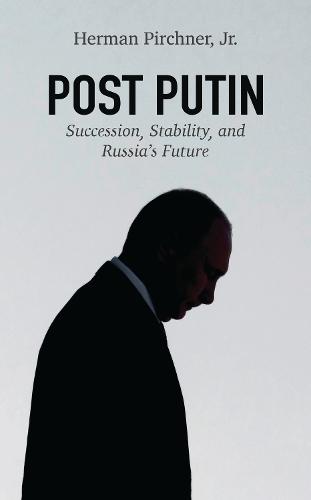
Now in apparent robust health, Russian President Vladimir Putin (age 66) could remain in power for another decade or even longer. But he will not keep power forever. From declining health to forced retirement to assassination, a multitude of factors could force Putin to leave the political scene and bring new leadership to Moscow. If so, who might come to power, and what policy changes can be expected during, and after, what may well be a protracted power struggle? Post Putin is a prescient examination of the variables that could contribute to Putin’s departure from political power, and the competing forces with which any potential successor will need to contend.
Full Product Details
Author: Herman Pirchner Jr.
Publisher: Bloomsbury Publishing Plc
Imprint: Rowman & Littlefield
Dimensions:
Width: 15.90cm
, Height: 1.40cm
, Length: 23.90cm
Weight: 0.381kg
ISBN: 9781538131398
ISBN 10: 1538131390
Pages: 122
Publication Date: 15 May 2019
Audience:
Professional and scholarly
,
Professional & Vocational
Format: Hardback
Publisher's Status: Active
Availability: Manufactured on demand

We will order this item for you from a manufactured on demand supplier.
Reviews
[T]his study should be regarded as a first step towards a strategic discussion on the topic. . . . Even though the main focus is on domestic politics, Pirchner offers interesting considerations of the potential foreign policy ramifications of a power transfer in Russia.--Europe-Asia Studies
"[T]his study should be regarded as a first step towards a strategic discussion on the topic. . . . Even though the main focus is on domestic politics, Pirchner offers interesting considerations of the potential foreign policy ramifications of a power transfer in Russia. -- ""Europe-Asia Studies"" From the Eurasia Daily Monitor: 'Pirchner's book... is really about the Russian political system as a whole and recalls in its approach the works of Nathan Leites like The Operational Code of the Politburo, which helped to define how an entire generation of Western Sovietologists understood and approached the issue of relations with the leadership of the Union of Soviet Socialist Republics (USSR) during the last four generations of its existence. Pirchner's book is set to play a similar role for the last years of the Putin era and the first years after his departure from power.... Pirchner concludes by reiterating that ""it is not possible to know when or how Russia's leadership will change. Nor is it possible to know what their policies will be or how competently these policies will be executed. However, at some point, and perhaps with little notice, the United States will have to decide how to engage a new Russian leadership."" The American foreign policy expert expresses the hope his new study ""can provide an ongoing context by which government analysts can formulate appropriate responses to such possible changes."" Both his overarching arguments and the details he provides about the Russian political system justify that hope.' -- ""Jamestown Foundation"" [T]his study should be regarded as a first step towards a strategic discussion on the topic. . . . Even though the main focus is on domestic politics, Pirchner offers interesting considerations of the potential foreign policy ramifications of a power transfer in Russia. From the Eurasia Daily Monitor: 'Pirchner's book... is really about the Russian political system as a whole and recalls in its approach the works of Nathan Leites like The Operational Code of the Politburo, which helped to define how an entire generation of Western Sovietologists understood and approached the issue of relations with the leadership of the Union of Soviet Socialist Republics (USSR) during the last four generations of its existence. Pirchner's book is set to play a similar role for the last years of the Putin era and the first years after his departure from power.... Pirchner concludes by reiterating that ""it is not possible to know when or how Russia's leadership will change. Nor is it possible to know what their policies will be or how competently these policies will be executed. However, at some point, and perhaps with little notice, the United States will have to decide how to engage a new Russian leadership."" The American foreign policy expert expresses the hope his new study ""can provide an ongoing context by which government analysts can formulate appropriate responses to such possible changes."" Both his overarching arguments and the details he provides about the Russian political system justify that hope.'"
"[T]his study should be regarded as a first step towards a strategic discussion on the topic. . . . Even though the main focus is on domestic politics, Pirchner offers interesting considerations of the potential foreign policy ramifications of a power transfer in Russia. From the Eurasia Daily Monitor: 'Pirchner's book... is really about the Russian political system as a whole and recalls in its approach the works of Nathan Leites like The Operational Code of the Politburo, which helped to define how an entire generation of Western Sovietologists understood and approached the issue of relations with the leadership of the Union of Soviet Socialist Republics (USSR) during the last four generations of its existence. Pirchner's book is set to play a similar role for the last years of the Putin era and the first years after his departure from power.... Pirchner concludes by reiterating that ""it is not possible to know when or how Russia's leadership will change. Nor is it possible to know what their policies will be or how competently these policies will be executed. However, at some point, and perhaps with little notice, the United States will have to decide how to engage a new Russian leadership."" The American foreign policy expert expresses the hope his new study ""can provide an ongoing context by which government analysts can formulate appropriate responses to such possible changes."" Both his overarching arguments and the details he provides about the Russian political system justify that hope.'"
From the Eurasia Daily Monitor: 'Pirchner's book... is really about the Russian political system as a whole and recalls in its approach the works of Nathan Leites like The Operational Code of the Politburo, which helped to define how an entire generation of Western Sovietologists understood and approached the issue of relations with the leadership of the Union of Soviet Socialist Republics (USSR) during the last four generations of its existence. Pirchner's book is set to play a similar role for the last years of the Putin era and the first years after his departure from power.... Pirchner concludes by reiterating that it is not possible to know when or how Russia's leadership will change. Nor is it possible to know what their policies will be or how competently these policies will be executed. However, at some point, and perhaps with little notice, the United States will have to decide how to engage a new Russian leadership. The American foreign policy expert expresses the hope his new study can provide an ongoing context by which government analysts can formulate appropriate responses to such possible changes. Both his overarching arguments and the details he provides about the Russian political system justify that hope.'--Jamestown Foundation [T]his study should be regarded as a first step towards a strategic discussion on the topic. . . . Even though the main focus is on domestic politics, Pirchner offers interesting considerations of the potential foreign policy ramifications of a power transfer in Russia.--Europe-Asia Studies
[T]his study should be regarded as a first step towards a strategic discussion on the topic. . . . Even though the main focus is on domestic politics, Pirchner offers interesting considerations of the potential foreign policy ramifications of a power transfer in Russia. From the Eurasia Daily Monitor: 'Pirchner's book... is really about the Russian political system as a whole and recalls in its approach the works of Nathan Leites like The Operational Code of the Politburo, which helped to define how an entire generation of Western Sovietologists understood and approached the issue of relations with the leadership of the Union of Soviet Socialist Republics (USSR) during the last four generations of its existence. Pirchner's book is set to play a similar role for the last years of the Putin era and the first years after his departure from power.... Pirchner concludes by reiterating that ""it is not possible to know when or how Russia's leadership will change. Nor is it possible to know what their policies will be or how competently these policies will be executed. However, at some point, and perhaps with little notice, the United States will have to decide how to engage a new Russian leadership."" The American foreign policy expert expresses the hope his new study ""can provide an ongoing context by which government analysts can formulate appropriate responses to such possible changes."" Both his overarching arguments and the details he provides about the Russian political system justify that hope.'
Author Information
Herman Pirchner, Jr. is president of the American Foreign Policy Council in Washington, DC, and a noted expert on Russian politics and foreign policy.