Overview
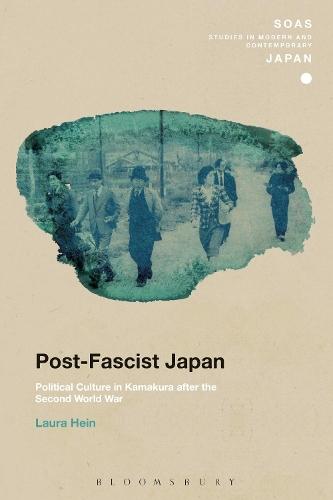
In late 1945 local Japanese turned their energies toward creating new behaviors and institutions that would give young people better skills to combat repression at home and coercion abroad. They rapidly transformed their political culture—policies, institutions, and public opinion—to create a more equitable, democratic and peaceful society. Post-Fascist Japan explores this phenomenon, focusing on a group of highly educated Japanese based in the city of Kamakura, where the new political culture was particularly visible. The book argues that these leftist elites, many of whom had been seen as ‘the enemy’ during the war, saw the problem as one of fascism, an ideology that had succeeded because it had addressed real problems. They turned their efforts to overtly political-legal systems but also to ostensibly non-political and community institutions such as universities, art museums, local tourism, and environmental policies, aiming not only for reconciliation over the past but also to reduce the anxieties that had drawn so many towards fascism. By focusing on people who had an outsized influence on Japan's political culture, Hein’s study is local, national, and transnational. She grounds her discussion using specific personalities, showing their ideas about ‘post-fascism’, how they implemented them and how they interacted with the American occupiers.
Full Product Details
Author: Laura Hein (Northwestern University, USA)
Publisher: Bloomsbury Publishing PLC
Imprint: Bloomsbury Academic
Weight: 0.558kg
ISBN: 9781350025806
ISBN 10: 1350025801
Pages: 272
Publication Date: 22 February 2018
Audience:
College/higher education
,
Tertiary & Higher Education
Format: Hardback
Publisher's Status: Active
Availability: Manufactured on demand

We will order this item for you from a manufactured on demand supplier.
Reviews
In this elegantly written study, Hein (Northwestern Univ.) looks at how, after the defeat of Japan in August 1945, Japanese intellectuals and political leaders in the city of Kamakura focused their energies on creating political, cultural, and educational institutions and behavior pathways that would counter the appeal that Fascism had in pre-war Japan and lead to a more democratic, egalitarian, and peaceful society ... The lead-off chapter, Kamakura: The Place, is a model of urban history and deserves a wide audience ... Summing Up: Essential. Lower-division undergraduates through faculty and professionals; general readers. * CHOICE * Meticulously researched and elegantly written, this fascinating study explores what it means to reconstruct an entirely new postwar civic culture out of the ruins of Japan's imperial adventurism--this time, notably based in the storied seaside town of Kamakura, outside of the now-tainted political and cultural capital of Tokyo. Hein captures the heady emotions of an era where self-reflection and institution-building by formerly leftwing Japanese intellectuals supposedly led to increasing levels of humanistic freedom to atone and make amends for a wartime fascist political culture. * Annika A. Culver, Associate Professor of East Asian History, Florida State University, USA * In the wake of Japan's defeat in the Pacific War, a wide ranging network of intellectuals based in and around the town of Kamakura shared hopes for new democratic society, and attempted to put those hopes into practice. In rediscovering the wartime experiences and postwar ideals and actions of this network, Post-Fascist Japan casts vital new light on the history of Japan's postwar democratization. This fascinating book is not only essential reading for all those with an interest in Japan's intellectual history, but also conveys a powerful message about dilemmas of war memory and democracy in Japan today. * Tessa Morris-Suzuki, Professor of Japanese History, The Australian National University, Australia *
Meticulously researched and elegantly written, this fascinating study explores what it means to reconstruct an entirely new postwar civic culture out of the ruins of Japan's imperial adventurism--this time, notably based in the storied seaside town of Kamakura, outside of the now-tainted political and cultural capital of Tokyo. Hein captures the heady emotions of an era where self-reflection and institution-building by formerly leftwing Japanese intellectuals supposedly led to increasing levels of humanistic freedom to atone and make amends for a wartime fascist political culture. * Annika A. Culver, Associate Professor of East Asian History, Florida State University, USA * In the wake of Japan's defeat in the Pacific War, a wide ranging network of intellectuals based in and around the town of Kamakura shared hopes for new democratic society, and attempted to put those hopes into practice. In rediscovering the wartime experiences and postwar ideals and actions of this network, Post-Fascist Japan casts vital new light on the history of Japan's postwar democratization. This fascinating book is not only essential reading for all those with an interest in Japan's intellectual history, but also conveys a powerful message about dilemmas of war memory and democracy in Japan today. * Tessa Morris-Suzuki, Professor of Japanese History, The Australian National University *
Meticulously researched and elegantly written, this fascinating study explores what it means to reconstruct an entirely new postwar civic culture out of the ruins of Japan's imperial adventurism--this time, notably based in the storied seaside town of Kamakura, outside of the now-tainted political and cultural capital of Tokyo. Hein captures the heady emotions of an era where self-reflection and institution-building by formerly leftwing Japanese intellectuals supposedly led to increasing levels of humanistic freedom to atone and make amends for a wartime fascist political culture. * Annika A. Culver, Associate Professor of East Asian History, Florida State University, USA * In the wake of Japan's defeat in the Pacific War, a wide ranging network of intellectuals based in and around the town of Kamakura shared hopes for new democratic society, and attempted to put those hopes into practice. In rediscovering the wartime experiences and postwar ideals and actions of this network, Post-Fascist Japan casts vital new light on the history of Japan's postwar democratization. This fascinating book is not only essential reading for all those with an interest in Japan's intellectual history, but also conveys a powerful message about dilemmas of war memory and democracy in Japan today. * Tessa Morris-Suzuki, Professor of Japanese History, The Australian National University, Australia *
Meticulously researched and elegantly written, this fascinating study explores what it means to reconstruct an entirely new postwar civic culture out of the ruins of Japan's imperial adventurism--this time, notably based in the storied seaside town of Kamakura, outside of the now-tainted political and cultural capital of Tokyo. Hein captures the heady emotions of an era where self-reflection and institution-building by formerly leftwing Japanese intellectuals supposedly led to increasing levels of humanistic freedom to atone and make amends for a wartime fascist political culture. * Annika A. Culver, Associate Professor of East Asian History, Florida State University, USA *
Author Information
Laura Hein is Professor of History at Northwestern University, USA. She is the author of Reasonable Men, Powerful Words: Political Culture and Expertise in 20th Century Japan (2004) and co-editor of Imagination Without Borders: Visual Artist Tomiyama Taeko and Social Responsibility (2010).