Overview
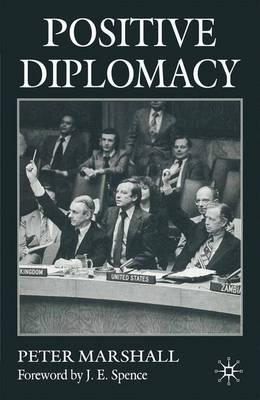
""Positive Diplomacy"" draws on the author's experience from his diplomatic career in the Foreign Service and his lectures at the Diplomatic Academy of London for those contemplating, or at the outset of, a diplomatic career. Its focus is practical. It concentrates on how junior diplomats can assist in making and carrying out foreign policy. It also analyzes what diplomats have to deal with and the skills they need to operate effectively as individuals and as members of a diplomatic service.
Full Product Details
Author: Sir Peter Marshall ,
J. E. Spence
Publisher: Palgrave Macmillan
Imprint: Palgrave Macmillan
Dimensions:
Width: 14.00cm
, Height: 1.40cm
, Length: 21.60cm
Weight: 0.454kg
ISBN: 9780333710982
ISBN 10: 0333710983
Pages: 234
Publication Date: 18 June 1999
Audience:
College/higher education
,
Professional and scholarly
,
Undergraduate
,
Postgraduate, Research & Scholarly
Format: Paperback
Publisher's Status: Active
Availability: In Print

This item will be ordered in for you from one of our suppliers. Upon receipt, we will promptly dispatch it out to you. For in store availability, please contact us.
Reviews
'Positive Diplomacy is far more than a manual of instruction: wit and elegance happily inform a superb analysis. Aspiring diplomats, current practitioners and their political masters and those who seek to understand international relations will read it with profit and pleasure.' - J. E. Spence, Associate Fellow and former Director of Studies, Royal Institute of International Affairs 'This excellent book ... Earlier classics such as Nicolson's Diplomacy are now hopelessly out of date and new authoritative guidance to the subject was badly needed. Positive Diplomacy, which draws on a lifetime of diplomatic experience, fills the gap admirably.' - Margaret Doxey, International Journal of Canadian Institute of International Affairs 'Marshall's discussion of the place of the United Nations in international diplomacy is a characteristic mixture of common sense, penetrating insight and humour ... the central message is serious: diplomacy can be a force for good, and has in some respects changed for the better in this century.' - Adam Roberts, The Times Literary Supplement 'Its great merit is that it combines a detailed exposition of the work of a diplomat with an explanation of how the world has changed and what is required for diplomatic theory and practice to accommodate successfully to these changes. Positive Diplomacy is far more than a manual of instruction: wit and elegance happily inform a superb analysis. Aspiring diplomats, current practitioners and their political masters and those who seek to understand international relations will read it with profit and pleasure.' - J.E. Spence, Associate Fellow and former Director of Studies, Royal Institute of International Affairs 'This excellent book...Earlier 'classics' such as Nicolson's Diplomacy are now hopelessly out of date and new authoritative guidance to the subject was badly needed. Positive Diplomacy, which draws on a lifetime of diplomatic experience, fills the gap admirably. It is written in elegant prose, combines scholarship with common sense and flashes of wit and can be warmly recommended not only to men and women entering the profession (and those already in it) but to a wider readership embracing those who seek a better understanding of the key role of diplomacy in the contemporary world.' - Margaret Doxey, International Journal of Canadian Institute of International Affairs 'Marshall's aim is simply to encourage 'a professional approach to the handling of international relations'... Marshall's discussion of the place of the United Nations in international diplomacy is a characteristic mixture of common sense, penetrating insight and humour...the central message is serious: diplomacy can be a force for good, and has in some respects changed for the better in this century. This approach is in the tradition of Harold Nicolson, whose book Diplomacy (1939) Peter Marshall reveres, and who did much to promote the idea that a regrettable old diplomacy is being supplanted by a better new one. Marshall's vision of the diplomat's role, with its emphasis on development and human rights, adds plausibility to his claim that the diplomatic profession may be becoming almost respectable.' - Adam Roberts, Times Literary Supplement
'Positive Diplomacy is far more than a manual of instruction: wit and elegance happily inform a superb analysis. Aspiring diplomats, current practitioners and their political masters and those who seek to understand international relations will read it with profit and pleasure.' - J. E. Spence, Associate Fellow and former Director of Studies, Royal Institute of International Affairs 'This excellent book ... Earlier classics such as Nicolson's Diplomacy are now hopelessly out of date and new authoritative guidance to the subject was badly needed. Positive Diplomacy, which draws on a lifetime of diplomatic experience, fills the gap admirably.' - Margaret Doxey, International Journal of Canadian Institute of International Affairs 'Marshall's discussion of the place of the United Nations in international diplomacy is a characteristic mixture of common sense, penetrating insight and humour ... the central message is serious: diplomacy can be a force for good, and has in some respects changed for the better in this century.' - Adam Roberts, The Times Literary Supplement 'Its great merit is that it combines a detailed exposition of the work of a diplomat with an explanation of how the world has changed and what is required for diplomatic theory and practice to accommodate successfully to these changes. Positive Diplomacy is far more than a manual of instruction: wit and elegance happily inform a superb analysis. Aspiring diplomats, current practitioners and their political masters and those who seek to understand international relations will read it with profit and pleasure.' - J.E. Spence, Associate Fellow and former Director of Studies, Royal Institute of International Affairs 'This excellent book...Earlier 'classics' such as Nicolson's Diplomacy are now hopelessly out of date and new authoritative guidance to the subject was badly needed. Positive Diplomacy, which draws on a lifetime of diplomatic experience, fills the gap admirably. It is written in elegant prose, combines scholarship with common sense and flashes of wit and can be warmly recommended not only to men and women entering the profession (and those already in it) but to a wider readership embracing those who seek a better understanding of the key role of diplomacy in the contemporary world.' - Margaret Doxey, International Journal of Canadian Institute of International Affairs 'Marshall's aim is simply to encourage 'a professional approach to the handling of international relations'... Marshall's discussion of the place of the United Nations in international diplomacy is a characteristic mixture of common sense, penetrating insight and humour...the central message is serious: diplomacy can be a force for good, and has in some respects changed for the better in this century. This approach is in the tradition of Harold Nicolson, whose book Diplomacy (1939) Peter Marshall reveres, and who did much to promote the idea that a regrettable old diplomacy is being supplanted by a better new one. Marshall's vision of the diplomat's role, with its emphasis on development and human rights, adds plausibility to his claim that the diplomatic profession may be becoming almost respectable.' - Adam Roberts, Times Literary Supplement
`Positive Diplomacy is far more than a manual of instruction: wit and elegance happily inform a superb analysis. Aspiring diplomats, current practitioners and their political masters and those who seek to understand international relations will read it with profit and pleasure.' - J. E. Spence, Associate Fellow and former Director of Studies, Royal Institute of International Affairs `This excellent book . . . Earlier classics such as Nicolson's Diplomacy are now hopelessly out of date and new authoritative guidance to the subject was badly needed. Positive Diplomacy, which draws on a lifetime of diplomatic experience, fills the gap admirably.' - Margaret Doxey, International Journal of Canadian Institute of International Affairs `Marshall's discussion of the place of the United Nations in international diplomacy is a characteristic mixture of common sense, penetrating insight and humour . . . the central message is serious: diplomacy can be a force for good, and has in some respects changed for the better in this century.' - Adam Roberts, The Times Literary Supplement 'Its great merit is that it combines a detailed exposition of the work of a diplomat with an explanation of how the world has changed and what is required for diplomatic theory and practice to accommodate successfully to these changes. Positive Diplomacy is far more than a manual of instruction: wit and elegance happily inform a superb analysis. Aspiring diplomats, current practitioners and their political masters and those who seek to understand international relations will read it with profit and pleasure.' - J.E. Spence, Associate Fellow and former Director of Studies, Royal Institute of International Affairs 'This excellent book...Earlier 'classics' such as Nicolson's Diplomacy are now hopelessly out of date and new authoritative guidance to the subject was badly needed. Positive Diplomacy, which draws on a lifetime of diplomatic experience, fills the gap admirably. It is written in elegant prose, combines scholarship with common sense and flashes of wit and can be warmly recommended not only to men and women entering the profession (and those already in it) but to a wider readership embracing those who seek a better understanding of the key role of diplomacy in the contemporary world.' - Margaret Doxey, International Journal of Canadian Institute of International Affairs 'Marshall's aim is simply to encourage 'a professional approach to the handling of international relations'... Marshall's discussion of the place of the United Nations in international diplomacy is a characteristic mixture of common sense, penetrating insight and humour...the central message is serious: diplomacy can be a force for good, and has in some respects changed for the better in this century. This approach is in the tradition of Harold Nicolson, whose book Diplomacy (1939) Peter Marshall reveres, and who did much to promote the idea that a regrettable old diplomacy is being supplanted by a better new one. Marshall's vision of the diplomat's role, with its emphasis on development and human rights, adds plausibility to his claim that the diplomatic profession may be becoming almost respectable.' - Adam Roberts, Times Literary Supplement
Author Information
SIR PETER MARSHALL served as a Navigator in the RAF from 1943-46 before embarking on a career in the British Foreign Service from 1949-83 where he served in Washington, Baghdad, Bangkok, Geneva, Paris and New York. He was Commonwealth Deputy Secretary General (Economic) from 1983-88 and Chairman of the Royal Commonwealth Society and Commonwealth Trust from 1988-92. Since 1989, he has been Visiting Lecturer at the Diplomatic Academy of London at the University of Westminster. He is an Honorary Fellow of Corpus Christi College, Cambridge and the University of Westminster. He is the author of The Dynamics of Diplomacy.