Awards
- Joint winner for Brazilian Studies Association Roberto Reis Prize 2014.
- Winner of Brazilian Studies Association Roberto Reis Prize 2014
- Winner of Brazilian Studies Association Roberto Reis Prize 2014.
- Winner of Roberto Reis Prize of the Brazilian Studies Association 2014 (United States)
Overview
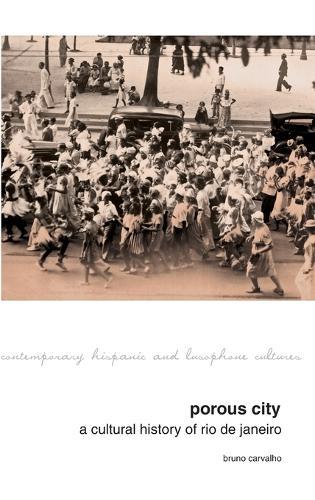
During the 1990s Rio de Janeiro earned the epithet of ‘divided city', an image underscored by the contrast between its upper-class buildings and nearby hillside ‘favelas.’ The city’s cultural production, however, has been shaped by porous boundaries and multi-ethnic encounters. Drawing on a broad range of historical, theoretical and literary sources, Porous City generates new ways of understanding Rio’s past, its role in the making of Brazilian culture, and its significance to key global debates about modernity and urban practices. This book offers an original perspective on Rio de Janeiro that focuses on the New City, one of the most compelling spaces in the history of modern cities. Once known as both a ‘Little Africa’ and as a ‘Jewish Neighborhood,’ the New City was an important reference for prominent writers, artists, pioneering social scientists and foreign visitors (from Christian missionaries to Orson Welles). It played a crucial role in foundational narratives of Brazil as ‘the country of carnival’ and as a ‘racial democracy.’ Going back to the neighborhood’s creation by royal decree in 1811, this study sheds light on how initially marginalized practices –like samba music– became emblematic of national identity. A critical crossroads of Rio, the New City was largely razed for the construction of a monumental avenue during World War II. Popular musicians protested, but ‘progress’ in the automobile age had a price. The area is now being rediscovered due to developments spurred by the 2016 Olympics. At another moment of transition, Porous City revisits this fascinating metropolis.
Full Product Details
Author: Bruno Carvalho (Department of Spanish and Portuguese Languages and Cultures, Princeton University (United States))
Publisher: Liverpool University Press
Imprint: Liverpool University Press
Volume: 9
Dimensions:
Width: 16.30cm
, Height: 2.30cm
, Length: 23.90cm
Weight: 0.567kg
ISBN: 9781846319754
ISBN 10: 1846319757
Pages: 240
Publication Date: 22 October 2013
Audience:
College/higher education
,
Undergraduate
,
Postgraduate, Research & Scholarly
Format: Hardback
Publisher's Status: Active
Availability: In Print

This item will be ordered in for you from one of our suppliers. Upon receipt, we will promptly dispatch it out to you. For in store availability, please contact us.
Reviews
Every page bursts with insights... This is a wonderfully erudite but also congenial work, inviting the reader to a deeper understanding of Rio de Janeiro's history over the past centuries through close investigation of the neighborhood of Cidade Nova, its changing population and architecture, and the many works of literature, visual arts, and popular song connected to those histories. A groundbreaking perspective on Rio's history. -- Professor Bryan McCann This brilliant cultural history of Rio de Janeiro, while focusing on the specific neighborhood of Cidade Nova, is anything but insular in its methodology and scope. Drawing on a dazzling array of sources-- urban theories, literature, painting, popular music and film, but also city plans, censuses, oral testimonies, memoirs, letters and travel accounts--Bruno Carvalho offers incisive readings of texts, including canonical ones. His argument for Rio de Janeiro as a porous city, defined by social and racial mixtures and cultural inclusions, proposes the concept of porosity over others, such as syncretism or miscegenation, the better to keep in sight ways in which those mixtures can coexist and even abet other forms of discrimination and exclusion. Lively, judicious, and erudite, Porous City makes a fundamental contribution to debates about urban modernism and cultural formations, of interest to both beginning and seasoned scholars of Brazil and Latin America. It asks a still open question, pertinent since the nineteenth century: How does a culture and self-image defined by mixture coexist with stark socio-economic disparity? -- Professor Marta Peixoto Through what he genially calls spatial porosity Carvalho engages a highly informed and inspiring treatment of a great city's throbbing geology. Readers will learn much about Rio in its development and what a gamut of inhabitants have made of it. Porous City is a vital and lasting contribution to urban and cultural studies -- Tom Conley
Author Information
Bruno Carvalho is Assistant Professor of Spanish and Portuguese Languages and Cultures and George H. and Mildred F. Whitfield University Preceptor in the Humanities at Princeton University.