|
|
|||
|
||||
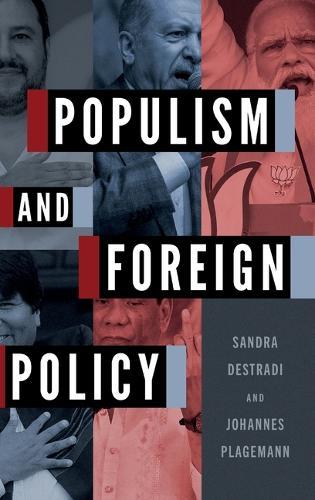
OverviewHow and why does the formation of populist governments lead to changes in foreign policy? This book theorizes and empirically analyzes how populism, understood as a thin-centred ideology, impacts foreign policy. It argues that two common features of populists' foreign policy, the use of foreign policy issues for domestic political mobilization and the personalization of decision making, are key to explain different intensities of foreign policy change. The strongest change can be expected if both mobilization and personalization in a specific issue area are strong. More moderate changes are a result of a combination of strong mobilization and weak personalization, or weak mobilization and strong personalization. The empirical analysis focuses on transitions from non-populist to populist governments in Bolivia, India, the Philippines, and Turkey. It addresses foreign policy change in four fields: the escalation of international disputes, the provision of global public goods, the engagement in multilateral institutions, and the reorientation of each country's international partnerships. As a part of an abductive research process, the theory of populism and foreign policy initially applied to cases from the Global South is then also used to analyze populist governments' foreign policies in Hungary, the UK, and Italy. Full Product DetailsAuthor: Sandra Destradi (Chair of International Relations, Chair of International Relations, University of Freiburg) , Johannes Plagemann (Senior Research Fellow, Senior Research Fellow, German Institute for Global and Area Studies)Publisher: Oxford University Press Inc Imprint: Oxford University Press Inc Weight: 0.579kg ISBN: 9780197694978ISBN 10: 0197694977 Pages: 344 Publication Date: 29 December 2025 Audience: Professional and scholarly , Professional & Vocational Format: Hardback Publisher's Status: Forthcoming Availability: To order Table of ContentsReviewsAuthor InformationSandra Destradi holds the Chair of International Relations at the University of Freiburg, Germany, and she is currently serving as a DAAD long- term Guest Professor at Reichman University in Herzliya, Israel. Johannes Plagemann is Senior Research Fellow at the GIGA Institute for Asian Studies in Hamburg, Germany, where he is speaker of the Research Team 'Ideas, Actors, and Global Politics'. Tab Content 6Author Website:Countries AvailableAll regions |
||||