Overview
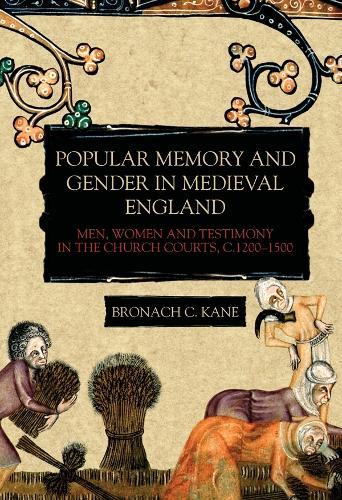
An exploration of the influence of gender on the workings of memory in the Middle Ages, focussing on the non-elite. WINNER of the Women's History Network 2020 Book Prize Church court records offer the most detailed records of everyday life in medieval England for people below the level of the elite. Vivid testimony in cases of marriage, insult, and debt, as well as tithes, testaments and ecclesiastical rights, show how men and women thought about the past and presented their own histories. While previous studies of memory in this period have tended to explore formal memory techniques in the schools and monasteries, this book turns to lay contexts instead, considering for the first time how gender influenced the ways that ""ordinary"" men and women remembered past events in the centuries leading up to the Reformations. Drawing on legal depositions, supplemented by pastoralia, literature and lyrics, the author argues that despite the many constraints upon their actions, lower-status men and women could use the law to communicate complex and varied pasts. She addresses the legal and religious developments that generated these memories, charting how gender shaped depictions of courtship, sexuality and childbirth, marriage and widowhood,as well as custom and the landscape. The book analyses these themes through the lens of gender and subjectivity, challenging conventional narratives that have aligned female remembrance with domesticity while embedding male memory in the public sphere. This approach offers precious evidence of the gendered, moral, and emotional worlds of lower-status people in medieval England. BRONACH C. KANE is Lecturer in Medieval History at Cardiff University.
Full Product Details
Author: Bronach Kane
Publisher: Boydell & Brewer Ltd
Imprint: The Boydell Press
Volume: v. 13
Dimensions:
Width: 15.60cm
, Height: 2.20cm
, Length: 23.40cm
Weight: 0.576kg
ISBN: 9781783273522
ISBN 10: 1783273526
Pages: 309
Publication Date: 24 May 2019
Audience:
Professional and scholarly
,
College/higher education
,
Professional and scholarly
,
Professional & Vocational
,
Tertiary & Higher Education
Format: Hardback
Publisher's Status: Active
Availability: In Print

This item will be ordered in for you from one of our suppliers. Upon receipt, we will promptly dispatch it out to you. For in store availability, please contact us.
Reviews
The book's rich contents outline a multilayered vision of the period, in which memory became increasingly important for the sacrament of confession, with penitents urged to remember their sins and the circumstances surrounding them. Recommended. CHOICE
A fascinating subject, deftly handled. * JOURNAL OF BRITISH STUDIES * The book's rich contents outline a multilayered vision of the period, in which memory became increasingly important for the sacrament of confession, with penitents urged to remember their sins and the circumstances surrounding them. Recommended. * CHOICE * [Terrific . . . Drawing on legal, medical, social, and gender studies, Kane looks not at theories of how memory was supposed to work but how memories were put into practice. In exploring how ordinary people applied the memory practices they were taught, Kane deftly demonstrates how they operated in the world. -- Katherine L. French * Speculum *
Author Information
BRONACH C. KANE is Lecturer in Medieval History at Cardiff University.