Overview
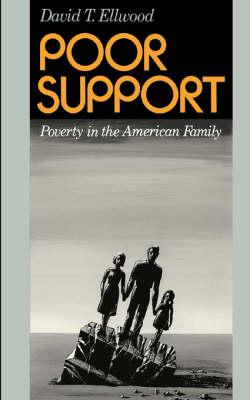
The subject of a New York Times Magazine cover story of December 8, 1996, David Ellwood is one of the country's leading experts on poverty. In this book he describes who the poor are, explains why they are poor, and suggests new policies for helping them. Poor Support is a major reinterpretation of the various forms that poverty takes in American families and what can be done to alleviate the problem.
Full Product Details
Author: David Ellwood
Publisher: Basic Books
Imprint: Basic Books
Edition: New edition
Dimensions:
Width: 13.70cm
, Height: 2.00cm
, Length: 20.30cm
Weight: 0.314kg
ISBN: 9780465059959
ISBN 10: 0465059953
Pages: 288
Publication Date: 02 October 1989
Audience:
College/higher education
,
Professional and scholarly
,
Undergraduate
,
Postgraduate, Research & Scholarly
Format: Paperback
Publisher's Status: Active
Availability: Manufactured on demand

We will order this item for you from a manufactured on demand supplier.
Reviews
A sociological look, with policy implications, at the problem of welfare; by Ellwood (Public Policy/JFK School of Government, Harvard U.). In this incisive work, Ellwood admits the failures of the welfare state while looking to even more imaginative government panaceas to cure poverty in America. The crux of the problem, he insists, is that poverty is tied to our values and expectations. There is not one type of poor, but three: families in which adults are doing a good deal for themselves, those suffering temporary setbacks, and those who require long-term support. Currently, all three are treated basically the same by the welfare bureaucracy. Ellwood argues that support policies should mirror the tripartite breakdown, offering supplemental or transitional support, or jobs as a last resort. He believes that such policy changes as doubling the Earned Income Tax Credit (EITC) - which would avoid administrative or targeting complications - would help the poor to lift themselves out of poverty in a way that doesn't destroy the autonomy of the individual, the virtue of work, the primacy of the family, or the desire for community: the four cornerstones of a policy that he says would help to integrate, rather than isolate, the poor. Ellwood proposes a few variations on his overall plan, depending on whether he's tackling the problems of two-parent families, one-parent families (where his emphasis is on better child-support enforcement policies), or the underclass, where education is the key to replacing welfare. Ellwood's solutions stumble at times - for instance, in failing to take into account the economic complications of doubling the EITC - but, overall, this is one of the most original recent approaches to draining the welfare swamp. (Kirkus Reviews)
Author Information
David T. Ellwood is professor of public policy at the John F. Kennedy School of Government, Harvard University.