Overview
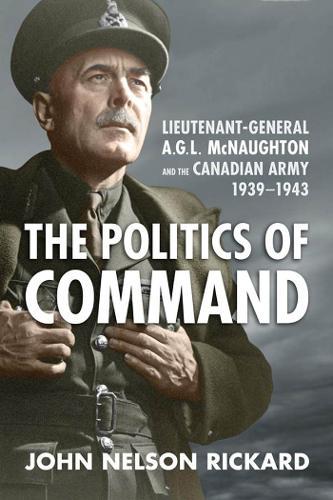
In December 1943, Lieutenant-General A.G.L. McNaughton resigned from command of the 1st Canadian Army amidst criticism of his poor generalship and of his abrasive personality. Despite McNaughton's importance to the Canadian Army during the first four years of the Second World War, little has been written about the man himself or the circumstances of his resignation. In The Politics of Command, the first full-length study of the subject since 1969, John Nelson Rickard analyses McNaughton's performance during Exercise SPARTAN in March 1943 and assesses his relationships with key figures such as Sir Alan F. Brooke, Bernard Paget, and Harry Crerar. This detailed re-examination of McNaughton's command argues that the long-accepted reasons for his relief of duty require extensive modification. Based on a wide range of sources, The Politics of Command will redefine how military historians and all Canadians look at not only ""Andy"" McNaughton but also the Canadian Army itself.
Full Product Details
Author: John Nelson Rickard
Publisher: University of Toronto Press
Imprint: University of Toronto Press
Dimensions:
Width: 15.20cm
, Height: 3.00cm
, Length: 22.90cm
Weight: 0.520kg
ISBN: 9781487541026
ISBN 10: 1487541023
Pages: 416
Publication Date: 11 February 2021
Audience:
College/higher education
,
Professional and scholarly
,
Tertiary & Higher Education
,
Professional & Vocational
Format: Paperback
Publisher's Status: Active
Availability: Temporarily unavailable

The supplier advises that this item is temporarily unavailable. It will be ordered for you and placed on backorder. Once it does come back in stock, we will ship it out to you.
Reviews
""Captain Rickard has provided a much-needed reassessment of Canada’s top general during the formative years of the Canadian Army in the Second World War. Giving weight to both the systemic challenges that came with the rapid expansion of the army and the personality conflicts – the ‘flame warfare’ – in which McNaughton became engaged, Rickard offers refreshing insight into ‘Andy.’"" - Christine E. Leppard, University of Calgary (Journal of Military and Strategic Studies) ""Through his nuanced analysis, Rickard’s argument provides a radically different historical interpretation of McNaughton as a senior national commander between 1939 and 1943. Moreover, Rickard convincingly demonstrates that judgements by McNaughton’s peers were greatly coloured by the effects of his dominant personality and by his earlier relationships … Rickard adds significant and relevant context to earlier historical interpretations of McNaughton’s obstinacy with keeping the Canadian Army intact for employment in a European invasion."" - Daniel Gosselin, Commander of the Canadian Defence Academy (Canadian Military Journal)
Captain Rickard has provided a much-needed reassessment of Canada's top general during the formative years of the Canadian Army in the Second World War. Giving weight to both the systemic challenges that came with the rapid expansion of the army and the personality conflicts - the 'flame warfare' - in which McNaughton became engaged, Rickard offers refreshing insight into 'Andy.' -- Christine E. Leppard, University of Calgary * <em>Journal of Military and Strategic Studies</em> * Through his nuanced analysis, Rickard's argument provides a radically different historical interpretation of McNaughton as a senior national commander between 1939 and 1943. Moreover, Rickard convincingly demonstrates that judgements by McNaughton's peers were greatly coloured by the effects of his dominant personality and by his earlier relationships ... Rickard adds significant and relevant context to earlier historical interpretations of McNaughton's obstinacy with keeping the Canadian Army intact for employment in a European invasion. -- Daniel Gosselin, Commander of the Canadian Defence Academy * <em>Canadian Military Journal</em> *
"""Captain Rickard has provided a much-needed reassessment of Canada’s top general during the formative years of the Canadian Army in the Second World War. Giving weight to both the systemic challenges that came with the rapid expansion of the army and the personality conflicts – the ‘flame warfare’ – in which McNaughton became engaged, Rickard offers refreshing insight into ‘Andy.’"" -- Christine E. Leppard, University of Calgary * <em>Journal of Military and Strategic Studies</em> * ""Through his nuanced analysis, Rickard’s argument provides a radically different historical interpretation of McNaughton as a senior national commander between 1939 and 1943. Moreover, Rickard convincingly demonstrates that judgements by McNaughton’s peers were greatly coloured by the effects of his dominant personality and by his earlier relationships … Rickard adds significant and relevant context to earlier historical interpretations of McNaughton’s obstinacy with keeping the Canadian Army intact for employment in a European invasion."" -- Daniel Gosselin, Commander of the Canadian Defence Academy * <em>Canadian Military Journal</em> *"
Author Information
John Nelson Rickard is a Captain in the Canadian Armed Forces and has a PhD in military history from the University of New Brunswick.