Overview
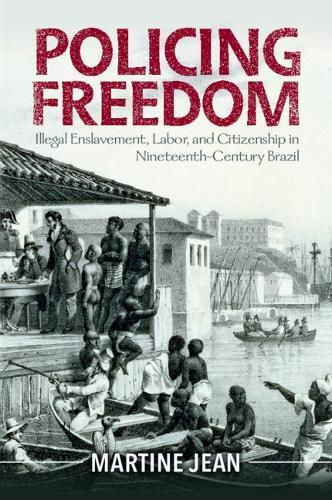
Policing Freedom uses the case study of Brazil's first penitentiary, the Casa de Correção, to explore how the Brazilian government used incarceration and enforced labor to control the prison population during the foundational period of Brazilian state formation and postcolonial nation building. Placing this penitentiary within the global debates about the disciplinary benefits of confinement and the evolution of free labor ideology, Martine Jean illustrates how Brazil's political elites envisioned the penitentiary as a way to discipline the free working class. While participating in the debates about the inhumanity of the slave trade, philanthropists and lawmakers, both conservative and liberal, articulated a nation-building discourse that focused on reforming Brazil's vagrants into workers in anticipation of slavery's eventual demise, laying the racialized foundations for policing and incarceration in the post-emancipation period.
Full Product Details
Author: Martine Jean
Publisher: Cambridge University Press
Imprint: Cambridge University Press
Weight: 0.593kg
ISBN: 9781009289153
ISBN 10: 1009289152
Pages: 366
Publication Date: 13 November 2025
Audience:
General/trade
,
General
Format: Paperback
Publisher's Status: Active
Availability: Manufactured on demand

We will order this item for you from a manufactured on demand supplier.
Reviews
'Brazil has one of the highest prison populations in the world -it comes third, after the US and China. Adopting a micro-global approach, Policing Freedom masterfully connects the history of prisons with the crisis of slavery and the transformations in labor regimes in the Atlantic world during the nineteenth century.' Sidney Chalhoub, Harvard University 'In this tenaciously researched and haunting study of 'slavery's afterlives in punishment,' Martine Jean tells the stories of those confined in Rio de Janeiro's first modern-style penitentiary. Rio's Casa de Correção was an urban construction site, a social experiment, a warehouse of people, and ultimately, Jean shows, a crucible for post-abolition society.' Amy Chazkel, Columbia University 'This book is an invaluable contribution to the study of police and political control of the popular classes, mainly but not only Africans and Afrodescendants, in the largest slaving city of the Atlantic basin, Rio de Janeiro. It combines with originality a discussion of the end of the transatlantic slave trade, the decline of slavery, and the formation of an immense, modern prison complex aimed at maintaining seignorial dominion.' João José Reis, Universidade Federal da Bahia 'This book offers a thought-provoking meditation on the continual reinvention of unfreedom, with chilling reverberations for today. … Recommended.' B. A. Lucero, Choice 'A meticulous study of a nineteenth-century history that continues to resonate strongly in the present. Jean's work reflects both an enormous command of relevant secondary literature in English and Portuguese as well as a detailed understanding of the official records documenting the politics, policies, and objectives that shaped the Casa de Correção and Rio's transition from home to the largest urban enslaved population in the Americas to a racialized republic.' Christina Proenza-Coles, H-Net '… the book is an essential read for scholars interested in the connection between punishment and work in the Brazilian legal experience of the 19th century …' Marjorie Carvalho de Souza, Rechtsgeschichte - Legal History
Author Information
Martine Jean is an independent scholar and historian of nineteenth-century Brazil, slavery, emancipation, race, and citizenship in the Atlantic World. Her work has been published in many journals including Atlantic Studies: Global Currents, The Journal of Social History and Slavery and Abolition. This is her first book.