Awards
- Winner of Winner of the Society for French Studies R. Gapper Book Prize 2016.
Overview
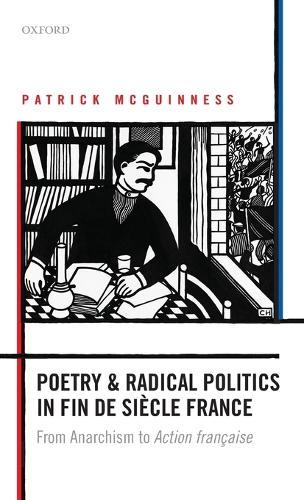
Poetry and Radical Politics in fin de siècle France explores the relations between poetry and politics in France in the last decade of the 19th century. The period covers perhaps the most important developments in modern French poetry: from the post-Commune climate that spawned the 'decadent' movement, through to the (allegedly) ivory-towered aestheticism of Mallarmé and the Symbolists. In terms of French politics, history and culture, the period was no less dramatic with the legacy of the Commune, the political and financial instability that followed, the anarchist campaigns, the Dreyfus affair, and the growth of 'Action française'. Patrick McGuinness argues that the anarchist politics of many Symbolist poets is a reaction to their own isolation, and to poetry's anxious relations with the public: too 'difficult' be be widely read, Symbolist poets react to the loss of poetry's centrality among the arts by delegating their radicalism to prose: they can call, in prose, for the overthrow of the state and support anarchist bombers, while at the same time writing poems about dribbling fountains and dazzling sunsets for each other. This study demonstrates the connections between the anti-Symbolist reaction of the école romane of 1891 (in which Charles Maurras first made his name), and the far-right cultural politics of Action française in the early 20th century. It also redefines many of the debates about late 19th-century French poetry by putting an argument forward for the political engagement(s) of the Symbolists while the French 'intellectuel' as a national icon was being forged. McGuinness insists on profound continuities between the end of the 19th century and the beginning of the 20th in terms of cultural politics, literary debate, and poetic theory, and shows how politics is to be found in unexpected ways in the least political-seeming literature of the period.The famous line by Péguy, that everything begins in mysticism and ends in politics, has an appealing sweep and grace. This book has its own more modest and specific version of a similar journey: it begins in Mallarmé and ends in Maurras.
Full Product Details
Author: Patrick McGuinness (Professor of French and Comparative Literature, Professor of French and Comparative Literature, University of Oxford)
Publisher: Oxford University Press
Imprint: Oxford University Press
Dimensions:
Width: 14.70cm
, Height: 2.50cm
, Length: 22.20cm
Weight: 0.488kg
ISBN: 9780198706106
ISBN 10: 0198706103
Pages: 300
Publication Date: 14 May 2015
Audience:
College/higher education
,
Undergraduate
,
Postgraduate, Research & Scholarly
Format: Hardback
Publisher's Status: Active
Availability: To order

Stock availability from the supplier is unknown. We will order it for you and ship this item to you once it is received by us.
Reviews
He [McGuinness] shows us how poets at the time grappled with these issues. Most failed to grasp them, Mallarme being a major exception. One of the revelations of the book is Pierre Quillard, who appears in this account to be the most lucid contemporary analyst of relations between Symbolism and politics. McGuinness emerges as a very worthy successor to Mallarme and Quillard in his unfolding of such relations. Like them, through analyses that somehow seem to go to the heart of what poetry is, he shows us how and why poetry and politics draw on each other, but resist being mapped on to each other. Forum of Modern Language Studies
Perhaps the greatest of the many strengths of this book is its author's clear exposition of the complicated nature of the poetic, cultural, and political scene of the fin de siecle. The style is lively, witty, and engaging - the novelist's hand is in evidence - but also accessible to those who are not specialists of poetry. Professor McGuinness's book thus makes an important contribution to the field and should be of great interest not only to literary specialists of French poetry and modernism, but also to historians who explore the intersection of culture and politics at the fin de siecle. Modernist Cultures He [McGuinness] shows us how poets at the time grappled with these issues. Most failed to grasp them, Mallarme being a major exception. One of the revelations of the book is Pierre Quillard, who appears in this account to be the most lucid contemporary analyst of relations between Symbolism and politics. McGuinness emerges as a very worthy successor to Mallarme and Quillard in his unfolding of such relations. Like them, through analyses that somehow seem to go to the heart of what poetry is, he shows us how and why poetry and politics draw on each other, but resist being mapped on to each other. Forum of Modern Language Studies
Author Information
Patrick McGuinness is the author or editor of several academic books, including Maurice Maeterlinck and the Making of Modern Theatre (OUP, 2000), Symbolism, Decadence and the fin de siècle (Exeter UP 2001), T. E. Hulme, Selected Writings (Carcanet, 1998). He is also the author of two books of poems (The Canals of Mars, 2004, and Jilted City 2010), a novel, The Last Hundred Days (Seren/Bloomsbury,2011, longlisted for the Man Booker Prize, winner of the Wales Book of the Year and the Author's Guild Award for fiction) and a memoir, Other People's Countries (Jonathan Cape, 2014), winner of the 2014 Pol Roger Duff Cooper Prize. The Last Hundred Days in its French translation (Grasset, 2013) won the Prix du premier roman étranger.