Overview
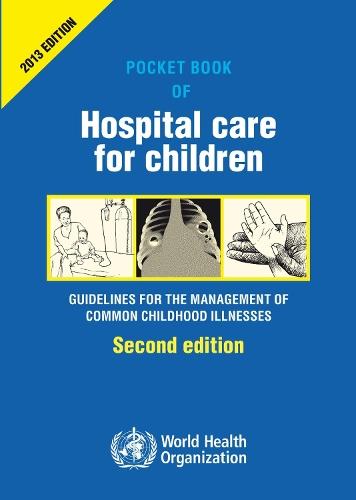
The Pocket Book is for use by doctors, nurses and other health workers who are responsible for the care of young children at the first level referral hospitals. This second edition is based on evidence from several WHO updated and published clinical guidelines. It is for use in both inpatient and outpatient care in small hospitals with basic laboratory facilities and essential medicines. In some settings, these guidelines can be used in any facilities where sick children are admitted for inpatient care. The Pocket Book is one of a series of documents and tools that support the Integrated Management of Childhood Illness (IMCI). The guidelines require the hospital to have (1) the capacity to carry out certain essential investigations, such as pulse oximetry, blood glucose, blood smear examinations for malaria parasites, estimation of haemoglobin, packed cell volume and full blood count, blood group and cross-match, and basic microscopy of cerebrospinal fluid and urine; and where possible blood and urine culture, ultrasound and basic x-rays; (2) essential medicines for the care of seriously ill children. Advanced and high care treatment options, such as intensive care or mechanical ventilation, are not described. These guidelines focus on the management of the major causes of childhood mortality in most developing countries, such as newborn problems, pneumonia, diarrhoea, malaria, meningitis, septicaemia, measles and related conditions, severe acute malnutrition and paediatric HIV/AIDS. It also covers some common surgical conditions that can be managed in small hospitals. Details of the evidence on which the Pocket Book is based can be found onWHO website from the published guidelines provided in the bibliography. These guidelines are applicable in most areas of the world and may be adapted to suit country specific circumstances.
Full Product Details
Author: World Health Organization
Publisher: World Health Organization
Imprint: World Health Organization
Edition: 2nd ed
Dimensions:
Width: 10.00cm
, Height: 2.00cm
, Length: 15.00cm
Weight: 0.350kg
ISBN: 9789241548373
ISBN 10: 9241548371
Pages: 435
Publication Date: 01 July 2013
Audience:
Professional and scholarly
,
Professional & Vocational
Format: Paperback
Publisher's Status: Active
Availability: Available To Order

We have confirmation that this item is in stock with the supplier. It will be ordered in for you and dispatched immediately.
Reviews
Pocket Book of Hospital Care for Children: Guidelines for the Management of Common Illnesses with Limited Resources provides a second edition of a classic covering common illnesses, packages it in a pocket-sized tote for easy take-along consultation, and provides the latest clinical guidelines based on a review of evidence for both inpatient and outpatient care. Guidelines for hospitals with basic labs and medicines focus on managing major causes of child mortality in most developing countries, covering common procedures, diagnosis, patient monitoring, and common surgeries. Anyone working with children in a hospital setting needs this updated reference! --James A. Cox, Editor-in-Dhief
. .. Wow! If only this book had been around when we were overseas in Namibia and India respectively.... This book is an absolute must for anyone caring for children in areas of the world where resources are limited. If you are toying with the idea of doing a stint overseas (VSO/RCPCH fellowship, for example) this book will convince you to go. It speaks of an overwhelmingly 'real' medicine where children are properly sick, where your skills count, where you can change lives, and where the banding of your rota pales into insignificance....It comes highly recommended.
Pocket Book of Hospital Care for Children: Guidelines for the Management of Common Illnesses with Limited Resources provides a second edition of a classic covering common illnesses, packages it in a pocket-sized tote for easy take-along consultation, and provides the latest clinical guidelines based on a review of evidence for both inpatient and outpatient care. Guidelines for hospitals with basic labs and medicines focus on managing major causes of child mortality in most developing countries, covering common procedures, diagnosis, patient monitoring, and common surgeries. Anyone working with children in a hospital setting needs this updated reference! --James A. Cox, Editor-in-Dhief (12/16/2013)
-Pocket Book of Hospital Care for Children: Guidelines for the Management of Common Illnesses with Limited Resources provides a second edition of a classic covering common illnesses, packages it in a pocket-sized tote for easy take-along consultation, and provides the latest clinical guidelines based on a review of evidence for both inpatient and outpatient care. Guidelines for hospitals with basic labs and medicines focus on managing major causes of child mortality in most developing countries, covering common procedures, diagnosis, patient monitoring, and common surgeries. Anyone working with children in a hospital setting needs this updated reference!---James A. Cox, Editor-in-Dhief
.. . Wow! If only this book had been around when we were overseas in Namibia and India respectively.... This book is an absolute must for anyone caring for children in areas of the world where resources are limited. If you are toying with the idea of doing a stint overseas (VSO/RCPCH fellowship, for example) this book will convince you to go. It speaks of an overwhelmingly 'real' medicine where children are properly sick, where your skills count, where you can change lives, and where the banding of your rota pales into insignificance....It comes highly recommended.
Author Information
World Health Organization is a Specialized Agency of the United Nations, charged to act as the world's directing and coordinating authority on questions of human health. It is responsible for providing leadership on global health matters, shaping the health research agenda, setting norms and standards, articulating evidence-based policy options, providing technical support to countries, and monitoring and assessing health trends.