Overview
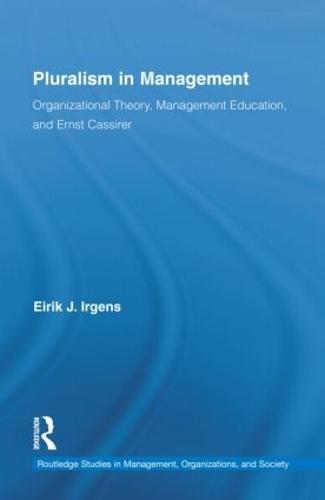
Analytic philosophy has come to dominate organizational theory and management education, despite criticism from several notable scholars. The European continental philosophical tradition, on the other hand, is seen by some as a counterpoint to US- and UK-dominated functionalistic organizational theories. These two very different schools of thought are now largely practiced in isolation from one another. Late nineteenth and early twentieth century philosopher Ernst Cassirer served as a mediating force and facilitated a fruitful dialogue between the two schools until he was forced to leave Germany when the Nazi party came to power. In Pluralism in Management, author Eirik J. Irgens utilizes Ernst Cassirer's pluralistic philosophy in order to investigate how different but connected forms of knowing, including art, myth, religion, science, and history may help us become better organizational scholars and management educators. With a special emphasis on the complementary qualities of art and science, Irgens builds on Cassirer to discuss how art and science represent two different but complementary channels to reality, in contrast with each other but not in conflict or contradiction, and the challenge of developing ""two-eyed"" managers. Revitalizing Cassirer's almost forgotten philosophy, the book illustrates the value of philosophical application to organizational study, and the need for bringing together the best of the humanities and the science based management traditions in order to improve management education.
Full Product Details
Author: Eirik Irgens (Norwegian University of Science and Technology)
Publisher: Taylor & Francis Ltd
Imprint: Routledge
Volume: 12
Dimensions:
Width: 15.20cm
, Height: 1.50cm
, Length: 22.90cm
Weight: 0.480kg
ISBN: 9780415886178
ISBN 10: 0415886171
Pages: 172
Publication Date: 23 March 2011
Audience:
College/higher education
,
Professional and scholarly
,
Tertiary & Higher Education
,
Professional & Vocational
Format: Hardback
Publisher's Status: Active
Availability: In Print

This item will be ordered in for you from one of our suppliers. Upon receipt, we will promptly dispatch it out to you. For in store availability, please contact us.
Reviews
`In this book Irgens offers a fresh take on organizational understanding by being among the first writers to transpose Cassirer's thinking to organization studies. The idea of consistently exploring organizational richness while not losing sight of the organizational surface is challenging and promising for management education as well as for consulting. The book adds to our understanding of organization as process.'- Tor Hernes, Copenhagen Business School, Denmark.
'In this book Irgens offers a fresh take on organizational understanding by being among the first writers to transpose Cassirer's thinking to organization studies. The idea of consistently exploring organizational richness while not losing sight of the organizational surface is challenging and promising for management education as well as for consulting. The book adds to our understanding of organization as process.'- Tor Hernes, Copenhagen Business School, Denmark.
Author Information
Eirik J. Irgens is Professor of Educational Leadership at NTNU (the Norwegian University of Science and Technology). Irgens has published within organizational theory and change, professional development, educational leadership, organizational learning, and knowledge management.