Overview
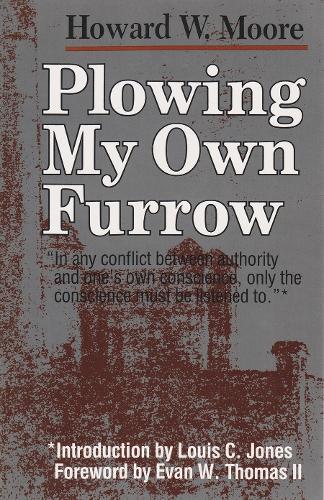
A memoir written at 95, by America's oldest living conscientious objector. It tells of the harsh treatment meted out to conscientious objectors during World War I, his upbringing in rural upstate New York, and the impact on his thinking by socialist leaders such as Eugene Dobs and Norman Thomas.
Full Product Details
Author: Howard W. Moore
Publisher: Syracuse University Press
Imprint: Syracuse University Press
Edition: Syracuse University ed.
Dimensions:
Width: 14.00cm
, Height: 1.70cm
, Length: 21.60cm
Weight: 0.284kg
ISBN: 9780815602767
ISBN 10: 0815602766
Pages: 228
Publication Date: 31 December 1993
Audience:
General/trade
,
General
Format: Paperback
Publisher's Status: Active
Availability: Temporarily unavailable

The supplier advises that this item is temporarily unavailable. It will be ordered for you and placed on backorder. Once it does come back in stock, we will ship it out to you.
Reviews
"Moore still recalls the price he paid for his convictions. Here are lessons on toleration, conviction, and this nation's ability--or inability in Moore's case--to accept people whose views differ from those of the majority.-- ""Choice"" Moore's narrative is quietly matter-of-fact: he refuses to paint himself as a martyr, and he straightforwardly rejects most of his country's economic and political system without launching into any tirades. Only the beauty of harvest time stirs his eloquence. A stalwart, sometimes moving witness.-- ""Kirkus Reviews"" Moore's remarkable memoir illustrates the harsh treatment meted out to conscientious objectors during World War I. He and others who opposed the war were court-martialed, sentenced to 25 years in prison, put in solitary confinement, manacled in their bedbug- and rat-infested cells, and held in prison until long after the war was over. While the focus of the work is on Moore's treatment as a conscientious objector, it also details the events of his upbringing in rural upstate New York and the impact on his thinking of socialist leaders like Eugene Debs and Norman Thomas. Recommended.-- ""Library journal"" Moore's resistance to the war is the central focus of this book, but it would not have the power and the eloquence that it does if Moore did not tell us something of his life before and after. . . . But the real lesson in integrity here, of course, is that non-violence does not stop at opposing world wars.-- ""San Francisco Chronicle"""
Patriarch is a dirty word these days, but what else to call this robust 96-year-old man, one of the great old-time pacifist-anarchists, still working on his farm north of Cherry Valley, N.Y., and, judging by this spirited memoir, as alert and independent as ever. Moore was born in Sing Sing (now Ossining), but moved at age 6 to Cherry Valley where he was trained as farmer by his uncle Rance. At 14 he went to New York, became a salesman, then a telephone operator and eventually an engineer-executive for the N.Y. Telephone Co. While his career in business flourished, Moore began thinking his way into a consistent radicalism. He listened to Margaret Sanger, Emma Goldman, and Alexander Berkman preaching in Madison Square Park; he heard Charles and Mary Beard, Scott Nearing, and Eugene Debs speak at the Rand School of Social Science. He witnessed the horrible Triangle Shirtwaist Company fire, and he designed the installation of ship-to-shore telephones on board the Lusitania. When America entered WW I, Moore showed up for induction, but thereafter refused to take orders from the military, for which he and his fellow CO's had to endure a series of minor trials and real tortures, some of them fatal. Imprisoned for over two years at Fort Riley, Fort Leavenworth, and Fort Douglas, Moore was put into solitary, chained to the bars of his cell, systematically beaten and harassed. One prison guard spat into every mess plate before serving it. Moore's weight dropped from 150 to 90, a loss not helped by periodic hunger strikes against the abominable treatment. Released at Thanksgiving, 1920, he met hostility all around, even from his own family; he went back into business, later became a WPA administrator, and finally returned to farm in Cherry Valley. Moore's narrative is quietly matter-of-fact: he refuses to paint himself as a martyr, and he straightforwardly rejects most of this country's economic and political system without launching into any tirades. Only the beauty of harvest time stirs his eloquence. A stalwart, sometimes moving witness. (Kirkus Reviews)
Author Information
Howard Moore was born in 1889 in Sing Sing (later Ossining), New York. He only finished the eighth grade, then went to Manhattan to work for the telephone company at the age of fourteen. Moore was self-educated, an agnostic, and had never been a member of any political party. He had been America's oldest living conscientious objector to World War I and wrote this book at the age of ninety-five.