Overview
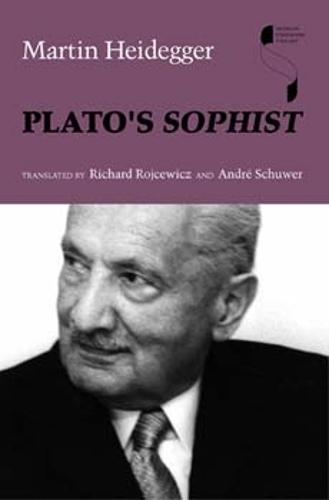
This volume reconstructs Martin Heidegger's lecture course at the University of Marburg in the winter semester of 1924-25, which was devoted to an interpretation of Plato and Aristotle. Published for the first time in German in 1992 as volume 19 of Heidegger's Collected Works, it is a major text not only because of its intrinsic importance as an interpretation of the Greek thinkers, but also because of its close, contemporary relationship to Being and Time. In Plato's Sophist, Heidegger approaches Plato through Aristotle, devoting the first part of the lectures to an extended commentary on Book VI of the Nichomachean Ethics. In a line-by-line interpretation of Plato's later dialogue, the Sophist, Heidegger takes up the relation of Being and non-being, the ontological problematic that forms the essential link between Greek philosophy and Heidegger's thought.
Full Product Details
Author: Martin Heidegger ,
Richard Rojcewicz ,
Andre Schuwer
Publisher: Indiana University Press
Imprint: Indiana University Press
Dimensions:
Width: 15.60cm
, Height: 2.90cm
, Length: 23.50cm
Weight: 0.703kg
ISBN: 9780253216298
ISBN 10: 025321629
Pages: 512
Publication Date: 09 July 2003
Audience:
Professional and scholarly
,
Professional & Vocational
Format: Paperback
Publisher's Status: Active
Availability: In Print

This item will be ordered in for you from one of our suppliers. Upon receipt, we will promptly dispatch it out to you. For in store availability, please contact us.
Reviews
A 'must' for any collection supporting graduate programs in philosophy, classics, and literary criticism. Choice ... thematic and methodological parallels render this volume a fine source for those interested in the archaeology of Being and Time... The text shows us a young Martin Heidegger at ease and passionate about his subject... -International Philosophical Quarterly Students and scholars alike can now see for themselves why Heidegger's lectures on the Greeks in the 1920s caused such a stir, and they can judge just what it means to read a Greek text with Heidegger... The English translation is excellent, managing to capture some of the vibrancy of the lectures while maintaining a high degree of accuracy and readability. --John Ellis, University of Memphis
"""A 'must' for any collection supporting graduate programs in philosophy, classics, and literary criticism."" Choice ""... thematic and methodological parallels render this volume a fine source for those interested in the archaeology of Being and Time... The text shows us a young Martin Heidegger at ease and passionate about his subject..."" -International Philosophical Quarterly ""Students and scholars alike can now see for themselves why Heidegger's lectures on the Greeks in the 1920s caused such a stir, and they can judge just what it means to read a Greek text with Heidegger... The English translation is excellent, managing to capture some of the vibrancy of the lectures while maintaining a high degree of accuracy and readability."" oJohn Ellis, University of Memphis"
A 'must' for any collection supporting graduate programs in philosophy, classics, and literary criticism. Choice ... thematic and methodological parallels render this volume a fine source for those interested in the archaeology of Being and Time... The text shows us a young Martin Heidegger at ease and passionate about his subject... -International Philosophical Quarterly Students and scholars alike can now see for themselves why Heidegger's lectures on the Greeks in the 1920s caused such a stir, and they can judge just what it means to read a Greek text with Heidegger... The English translation is excellent, managing to capture some of the vibrancy of the lectures while maintaining a high degree of accuracy and readability. oJohn Ellis, University of Memphis
Author Information
Richard Rojcewicz teaches philosophy at Point Park College in Pittsburgh. André Schuwer (1916–1995) was Professor Emeritus of Philosophy at Duquesne University.