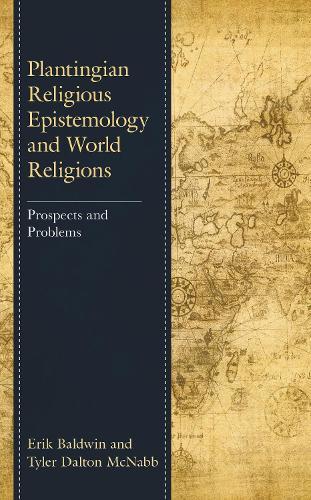
Full Product Details
Author: Erik Baldwin ,
Tyler Dalton McNabb
Publisher: Bloomsbury Publishing Plc
Imprint: Lexington Books
Dimensions:
Width: 16.50cm
, Height: 3.00cm
, Length: 23.10cm
Weight: 0.635kg
ISBN: 9781498552936
ISBN 10: 1498552935
Pages: 332
Publication Date: 29 November 2018
Audience:
Professional and scholarly
,
Professional & Vocational
Format: Hardback
Publisher's Status: Active
Availability: Manufactured on demand

We will order this item for you from a manufactured on demand supplier.
Reviews
Contrary to the pronouncements of a vocal few, the increasingly religiously plural nature of our world has not brought about the irrelevance of the questions of religious epistemology. Proposals about how to think about the epistemic status of religious belief remain crucially important, and Alvin Plantinga’s proposal stands out among those as uniquely valuable and powerful. What our religiously plural world does require is more of what Baldwin and McNabb do in this important volume — engage religious traditions in deep and substantive ways and then ask how those religious traditions might employ the resources of Plantinga’s work. This book is a valuable contribution to scholarship on Plantinga’s religious epistemology and on the broader question of religious epistemology within and among the world’s religious traditions. -- James Beilby, Bethel University Plantingian Religious Epistemology and World Religions is a substantial work that deserves a wide readership. This volume establishes Baldwin and McNabb as pioneers in the emerging field of comparative religious epistemology. While covering a wide selection of Asian and Western traditions and incorporating both historical and contemporary sources, Baldwin and McNabb present a sustained and engaging argument. This work should become required reading for all those interested in Plantingian religious epistemology and its potential applications. -- Victoria S. Harrison, University of Macau, China
Contrary to the pronouncements of a vocal few, the increasingly religiously plural nature of our world has not brought about the irrelevance of the questions of religious epistemology. Proposals about how to think about the epistemic status of religious belief remain crucially important, and Alvin Plantinga's proposal stands out among those as uniquely valuable and powerful. What our religiously plural world does require is more of what Baldwin and McNabb do in this important volume - engage religious traditions in deep and substantive ways and then ask how those religious traditions might employ the resources of Plantinga's work. This book is a valuable contribution to scholarship on Plantinga's religious epistemology and on the broader question of religious epistemology within and among the world's religious traditions. -- James Beilby, Bethel University
Contrary to the pronouncements of a vocal few, the increasingly religiously plural nature of our world has not brought about the irrelevance of the questions of religious epistemology. Proposals about how to think about the epistemic status of religious belief remain crucially important, and Alvin Plantinga's proposal stands out among those as uniquely valuable and powerful. What our religiously plural world does require is more of what Baldwin and McNabb do in this important volume - engage religious traditions in deep and substantive ways and then ask how those religious traditions might employ the resources of Plantinga's work. This book is a valuable contribution to scholarship on Plantinga's religious epistemology and on the broader question of religious epistemology within and among the world's religious traditions. -- James Beilby, Bethel University Plantingian Religious Epistemology and World Religions is a substantial work that deserves a wide readership. This volume establishes Baldwin and McNabb as pioneers in the emerging field of comparative religious epistemology. While covering a wide selection of Asian and Western traditions and incorporating both historical and contemporary sources, Baldwin and McNabb present a sustained and engaging argument. This work should become required reading for all those interested in Plantingian religious epistemology and its potential applications. -- Victoria S. Harrison, University of Macau, China
Author Information
Erik Baldwin teaches at Indiana University, Northwest. Tyler Dalton McNabb is assistant professor of philosophy at Houston Baptist University.