|
Overview
Full Product Details
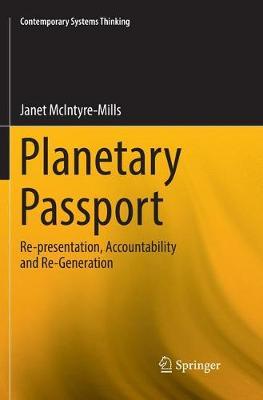
Author: Janet McIntyre-Mills
Publisher: Springer International Publishing AG
Imprint: Springer International Publishing AG
Edition: Softcover reprint of the original 1st ed. 2017
Weight: 6.438kg
ISBN: 9783319863030
ISBN 10: 3319863037
Pages: 371
Publication Date: 04 August 2018
Audience:
Professional and scholarly
,
Professional & Vocational
Format: Paperback
Publisher's Status: Active
Availability: Manufactured on demand 
We will order this item for you from a manufactured on demand supplier.
Table of Contents
Glossary.- Summary.- Focusing thoughts.- Foreword: Rationale for Planetary Passport: Knowing our place through recognizing our hybridity and interconnectedness.- • Consciousness is a continuum across all life.- <• Mindfulness and transformation.- Re-membering and re-connecting with Country.- Research as resistance and re-generation.- Prologue: Hunger and Thirst: learning from history, experience and place.- Ecological footprint: implications for systemic praxis and governance.- Critical responses to the concept of Ecological Footprint.- Ethics and the Anthropocene.- Interconnectedness, strings and multispecies entanglement.- Chapter 1: Beyond Anthropocentricism - Why ‘taming’ or ‘tackling’ wicked problems’ is problematic.- 1.1. Introduction: How can we achieve the values, will and conditions to govern the Anthropocene?.- 1.2. Accountability for the loss of human security ought to be the next step for social justice: the environment isbeing eroded to prop up a failing economy.- 1.3. Phronesis, ethics and designing a response.- 1.3.1. Putting it all together using critical systemic heuristics.- 1.4. Design for meaningful research.- 1.4.1. Community of practice approach.- 1.4.1.1. Praxis believing in students and empowering them to become leaders through enabling them to apply critical systemic thinking and practice to diverse complex transdisciplinary issues.- 1.5. Policy opportunity.- 1.6. The Horizon: Trans disciplinarity and cross cultural studies matter.- 1.6.1. Learning communities contribute to insight and foresight to narrow the gap between service users and providers.- 1.62. Participatory decision making on wellbeing and climate change to enhance representation, accountability and sustainability..- 1.7. Conclusion.- Chapter 2. People and the Planet: Consciousness is a continuum across all life.- 2.1. Introduction.- 2.1.1. Decentering anthropocentric and ethnocentric mindsets and learning from country.- 2.1.2. Consciousness of who we are and what we stand for.- 2.2.From working within boundaries to recognition of flows.- 2.2.1. Cultural transformation: How democratic is democracy if it does not foster human security?.- 2.2.2. From Ark of the Covenant to Global Covenant for Space Ship Earth.- 2.3. Protecting spaces for diversity and biodiversity.- 2.31. Ethical choices: competition, co-operation and interdependence based on recognizing our hybridity.- 2.3.2. Urban living shapes our view of the world.- 2.4. An Architecture for re-generation to maximize changes towards a more sustainable future.- 2.4.1. Reconnecting with environment through spirituality, oral history and law.- 2.4.2. Reflecting on ‘the case of the West and the self-fulfilling prophecy of the ‘clash of cultures’..- 2.5. Values and relationships: expanding solidarity.- 2.5.1. How can we achieve transformation on consumption patterns through balancing individual and collective needs?.- 2.5.2. Power of ethicalnarratives.- 2.5.3 How can participatory governance support the self-management of our Ecological Footprints?.- 2.6. Policy paradoxes.- 2.7. Debunking the Clash of Civilisations Approach.- 2.71. Vignette: Cartoonists at Charlie Hebdo.- 2.7.2. Vignette: ISIS.- 2.7. Debunking the clash of civilization approach.- 2.8. Recognizing our interconnectedness.- 2.8.1. Corporatism and education: the challenge of dualism.- 2.9. Beyond clash of world views towards leadership for re-generation.- Chapter 3: Planetary passport for social and environmental justice: the challenges posed by the global panopticon, penal states and disappearing states in an increasingly vulnerable and unequal world.- 3.1. Introduction.- 3.1.1. Aims and logic of the passport.- 3.2. The challenges for social and environmental justice.- 3.2.1. Climate change refugees and climate change displacement.- 3.2.2. States, boundaries and biospheres: redesigning governance and democracy.- 3.3. Collective co-determinism to protect human security: better forms of participatory democracy and distributive governance.- 3.3.1. Alternative architectures to enhance representation, accountability and sustainability.- 3.4. Case Study of engagement to address low carbon ethical living.- 3.4.1 Design.- 3.4.2. Enabling local communities through participatory design.- 3.4.3. Potential value of the case study.- 3.4.4. Options and potential for engagement.- 3.4.4.1. Engagement for those who prefer face to face engagement.- A. ‘Business as usual’ scenario.- B. ‘Small changes’ scenario.- C. ‘Sustainable future’ scenario.- 3.4.4.2. Exploratory focus groups.- 3.4.5. Cultural ambivalence.- 3.4.6. Critique of version 1 of the software and future directions for representation accountability and sustainability.- 3.5. Second case study: Planetary passport as a means to ensure the fair distribution of resources for locals and the displaced..- 3.5.1. Piloting a way to do things differently by translating theory into practice.- 3.5.2. Transformative research for re-generation.- 3.5.3. How the engagement process works.- 3.54. Data collection system.- 3.5.5 Questions for the survey and focus group.- 3.5.6. Interview Schedule.- 3.6. Policy context and options for stewardship.- 3.6.1. Purpose of the software.- 3.6.2. Specifications of the software.- 3.6.3. The potential and weaknesses of digital futures.- 3.6.4. Translating thinking into practice: stewardship conditions through extending the social contract.- 3.7. Systemic Governance for Stewardship.- 3.7.1. Pan Opticon: surveillance ‘from above’.- 3.7.2. Social justice for non-citizens and environmental protection of the planet.- 3.7.3. Australia needs to reconsider its relationships with others, the environment and the wider region.- 3.7.4. Valuing self, others, the environment and future generations of life: implications for socio-economic and environmental governance and democracy.- 3.7.4.1. Competition for scarce resources.- 3.7.5. Penal states, protection for the Displaced, Disappearing states, Obsolete states and Property law.- 3.8. Policy and governance praxis: a way forward for collective co-determinism.- 3.9. Accountability for the loss of food and loss of place could be the next step in law.- 3.9.1. The social contract is being eroded to prop up a failing economy.- 3.9.2. Intimidation and silence of the media: maintaining the status quo and business as usual.- 3.9.3. Held’s Global Covenant.- 3.9.4. Local agenda 21 and Aarhus Convention for scaling up the Principal of Subsidiarity and Testing out Ashby’s Rule of Requisite Variety.- 3.10. From stocks to flows as a synecdoche for planetary democracy and distributive governance.- 3.10.1. Water management as a synecdoche for global commons management.- Chapter 4: Political context: freedom versus democracy.- 4.1. Introduction.- 4.2. Representation and accountability in South Africa: freedom cannot exist at the expense of democracy or vice versa.- 4.3. Food insecurity and reflection on currentareas of concern in South Africa.- 4.3.1. Vignette: Food insecurity and the ‘bin pickers’ in suburban Cape Town.- 4.4. A case study of living hope: systemic, integrated care.- 4.4.1. Background.- 4.4.2. Rapid appraisal.- 4.4.2.1. Living right: prevention and life skills.- 4.4.2.2. Creating opportunities and caring for people.- 4.4.2.3. Analysis.- 4.5. Conclusion.- Chapter 5: Cross cultural learning community: Challenges and opportunities: from clash of cultures to co-creation and co-determination.- 5.1. Leadership for transformation requires gender mainstreaming and capacity building.- 5.1.1. Creating a learning organization and learning community approach.- 5.1.2. A learning organization within a learning community and post national region.- 5.1.3. Multilevel engagement through mindfulness and critical systemic praxis.- 5.1.4. Critical systemic praxis.- 5.1.5. Developing an alternative vision for public education and employment.- 5.1.6. Participatory policy research needs to support curriculum development and co-determination for social and environmental justice.- 5.1.7. Capacity building through scenarios at the personal, interpersonal and organizational level.- 5.2.Co-determination in regions –challenges for education: Policy proposal to develop learning organisations and learning communities.- 5.3. Representation, accountability, re-generation and sustainability are challenges for education.- 5.3.1. Co-learning and mindfulness that support building communities of practice.- 5.3.2. Learning organizations span sectors to support non-anthropocentric designs that do not commodify others or the environment.- 5.4. Summing up: co-determination within biospheres: rethinking architectures for teaching and learning based on the pillars of morality: empathy and reciprocity.- 5.4.1. Making policy recommendations on the basis of the research to create an appropriate curriculum that helps students and members of the public appreciate their interconnectedness.- 5.5. Conclusion: Transformational leadership from boundaries to flows.- Chapter 6: Executive Summary: new architecture for people and the planet
Reviews
Author Information
Janet McIntyre-Mills is an Associate Professor at Flinders University, Adjunct Professor at the University of Indonesia and Islamic National University in Indonesia, and Honorary Professor at the University of South Africa. Her research focuses on systemic representation, accountability and regeneration applied to social and environmental justice concerns such as health, housing and social inclusion and the mitigation and adaptation to climate change. She addresses complex needs by exploring the meanings and ‘what if’ questions with diverse stakeholders. Her books include: ‘Global Citizenship and social movements’ (Routledge), ‘Critical Systemic Praxis for social and environmental justice’ (Springer), ‘User-centric design to address complex needs’ (Nova Science). ‘Transformation From Wall Street to Wellbeing: Joining up the dots through Participatory Democracy and Governance to Mitigate the Causes and Adapt to the Effects of Climate Change’. (Springer) and ‘Systemic ethics and Non-anthropocentric Stewardship: Implications for Transdisciplinarity and Cosmopolitan politics’ (Springer).
Tab Content 6
Author Website:
Countries Available
All regions
|