Overview
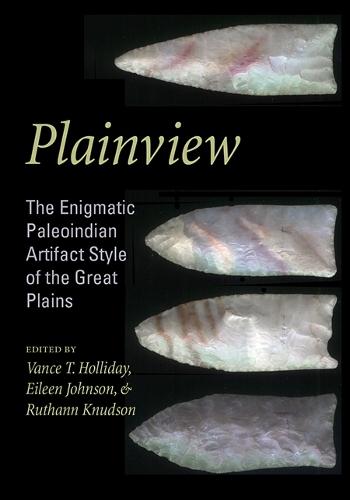
The Plainview Paleoindian artifact style was first recognised in 1947, after numerous projectile points were found during excavations of a bison kill site near Plainview, Texas. In the decades that followed, however, Plainview became something of a catch-all category with artifacts from across the continent being lumped together based merely on gross similarities. This volume unravels the meaning of Plainview, detailing what is known about this particular technology and time period. Contributing authors from the United States and Mexico present new data gleaned from the reinvestigation of past excavations, notes, maps, and materials from the original Plainview site as well as reports from other Plainview Paleoindian sites across the Great Plains, northern Mexico, and the southwestern United States.
Full Product Details
Author: Vance T. Holliday ,
Eileen Johnson ,
Ruthann Knudson
Publisher: University of Utah Press,U.S.
Imprint: University of Utah Press,U.S.
Dimensions:
Width: 18.00cm
, Height: 2.70cm
, Length: 25.60cm
Weight: 0.955kg
ISBN: 9781607815747
ISBN 10: 1607815745
Pages: 370
Publication Date: 30 October 2017
Audience:
Professional and scholarly
,
Professional & Vocational
Format: Hardback
Publisher's Status: Active
Availability: Out of stock

The supplier is temporarily out of stock of this item. It will be ordered for you on backorder and shipped when it becomes available.
Reviews
A must-have for anyone interested in the early hunter-gatherers in the Great Plains, Southwest, and/or Great Basin. It has everything one would hope for in a volume of this kind, including thorough descriptions of the Plainview type site, general chronology and paleoenvironmental records, and chapters addressing the challenge of defining Plainview. -Thomas A. Jennings, director of the Antonio J. Waring, Jr. Archaeological Laboratory, University of West Georgia More than just a survey of interesting sites and artifacts, this volume makes great strides in helping the discipline to understand why there is so much morphological and technological variation in lithic artifacts during the Late Paleoindian period. It is a collection of fantastic scholarship by some of the leading researchers in the field. -Matthew E. Hill Jr., associate professor of anthropology, University of Iowa In short, this volume contextualizes old excavations, defines the geoarchaeological and paleoenvironmental context for late Pleistocene cultural components on the southern Plains, summarizes data from new explorations, and approaches the eternal archaeological problem of typology through both traditional methods and new tactics, synthesizing what is known and what still needs to be investigated regarding the Plainview typology and Plainview peoples. The result is a nuanced discussion needed by any Paleoindian researcher or Great Plains archaeologist. -American Antiquity The authors have amassed, in one book, archaeological investigations that will be informative and educationally necessary for future researchers for some time....Clear photographs of the early excavations and artifact images, beautifully illustrated point type morphologies, and an array of tables, maps, and figures are integrated throughout and visually contribute to the shared knowledge. The authors of this book provide new in-depth analyses and elaborate on earlier understandings of this 'enigmatic' point type. -Great Plains Research
More than just a survey of interesting sites and artifacts, this volume makes great strides in helping the discipline to understand why there is so much morphological and technological variation in lithic artifacts during the Late Paleoindian period. It is a collection of fantastic scholarship by some of the leading researchers in the field. --Matthew E. Hill Jr., associate professor of anthropology, University of Iowa A must-have for anyone interested in the early hunter-gatherers in the Great Plains, Southwest, and/or Great Basin. It has everything one would hope for in a volume of this kind, including thorough descriptions of the Plainview type site, general chronology and paleoenvironmental records, and chapters addressing the challenge of defining Plainview. --Thomas A. Jennings, director of the Antonio J. Waring, Jr. Archaeological Laboratory, University of West Georgia
A must-have for anyone interested in the early hunter-gatherers in the Great Plains, Southwest, and/or Great Basin. It has everything one would hope for in a volume of this kind, including thorough descriptions of the Plainview type site, general chronology and paleoenvironmental records, and chapters addressing the challenge of defining Plainview. --Thomas A. Jennings, director of the Antonio J. Waring, Jr. Archaeological Laboratory, University of West Georgia More than just a survey of interesting sites and artifacts, this volume makes great strides in helping the discipline to understand why there is so much morphological and technological variation in lithic artifacts during the Late Paleoindian period. It is a collection of fantastic scholarship by some of the leading researchers in the field. --Matthew E. Hill Jr., associate professor of anthropology, University of Iowa In short, this volume contextualizes old excavations, defines the geoarchaeological and paleoenvironmental context for late Pleistocene cultural components on the southern Plains, summarizes data from new explorations, and approaches the eternal archaeological problem of typology through both traditional methods and new tactics, synthesizing what is known and what still needs to be investigated regarding the Plainview typology and Plainview peoples. The result is a nuanced discussion needed by any Paleoindian researcher or Great Plains archaeologist. --American Antiquity The authors have amassed, in one book, archaeological investigations that will be informative and educationally necessary for future researchers for some time....Clear photographs of the early excavations and artifact images, beautifully illustrated point type morphologies, and an array of tables, maps, and figures are integrated throughout and visually contribute to the shared knowledge. The authors of this book provide new in-depth analyses and elaborate on earlier understandings of this 'enigmatic' point type. --Great Plains Research
This book is an excellent example of what post-colonial criticism was intended to be: a serious historical engagement with the texts that emerged in the encounter between the colonizer and the colonized in the postcolonial world. Mufti makes a powerful statement on the relationship between colonial governmentality and the poetics of empire, and a clear and sustained connection between the discourses surrounding the idea of civil war, the civilization claims of colonial rule, and the imbrication of texts in this arena. --Simon E. Gikandi, author of Reading the African Novel and Slavery and the Culture of Taste
Author Information
Vance T. Holliday is a professor at the School of Anthropology and Department of Geosciences at the University of Arizona, where he is also executive director of the Argonaut Archaeological Research Fund. Ruthann Knudson is an archaeologist and the principal investigator and owner of Knudson Associates in Great Falls, Montana. Eileen Johnson is director of the Lubbock Lake Landmark, director of academic and curatorial programs at the Museum of Texas Tech University, and chair of the Museum Science Program.