Overview
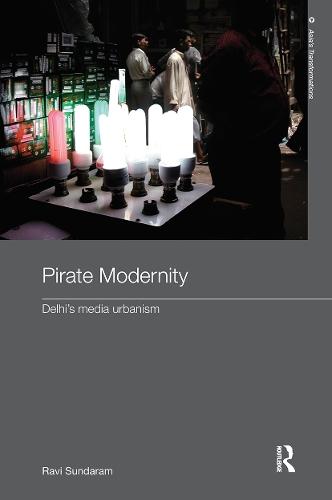
Using Delhi’s contemporary history as a site for reflection, Pirate Modernity moves from a detailed discussion of the technocratic design of the city by US planners in the 1950s, to the massive expansions after 1977, culminating in the urban crisis of the 1990s. As a practice, pirate modernity is an illicit form of urban globalization. Poorer urban populations increasingly inhabit non-legal spheres: unauthorized neighborhoods, squatter camps and bypass legal technological infrastructures (media, electricity). This pirate culture produces a significant enabling resource for subaltern populations unable to enter the legal city. Equally, this is an unstable world, bringing subaltern populations into the harsh glare of permanent technological visibility, and attacks by urban elites, courts and visceral media industries. The book examines contemporary Delhi from some of these sites: the unmaking of the citys modernist planning design, new technological urban networks that bypass states and corporations, and the tragic experience of the road accident terrifyingly enhanced by technological culture. Pirate Modernity moves between past and present, along with debates in Asia, Africa and Latin America on urbanism, media culture, and everyday life. This pioneering book suggests cities have to be revisited afresh after proliferating media culture. Pirate Modernity boldly draws from urban and cultural theory to open a new agenda for a world after media urbanism.
Full Product Details
Author: Ravi Sundaram (The Centre for the Study of Developing Societies, Delhi, India)
Publisher: Taylor & Francis Ltd
Imprint: Routledge
Weight: 0.362kg
ISBN: 9780415611749
ISBN 10: 0415611741
Pages: 244
Publication Date: 04 March 2011
Audience:
College/higher education
,
Tertiary & Higher Education
,
Undergraduate
Format: Paperback
Publisher's Status: Active
Availability: In Print

This item will be ordered in for you from one of our suppliers. Upon receipt, we will promptly dispatch it out to you. For in store availability, please contact us.
Reviews
Defining 'pirate modernity' as a non-legal form of digital life, Sundaram describes the web of social, political, and cultural circuits that circulate the new media in the urban landscape. Empirically rich and interpretively ambitious, Pirate Modernity sparkles with brilliant insights on postcolonial urbanism. There is no work like this. Gyan Prakash, Dayton-Stockton Professor of History at Princeton University, USA Ravi Sundaram is the one-stop theorist for uncompromised urban media theory. Ever since our 1996 encounter at 5CyberConf in Madrid, I was struck by his dry descriptions of India's hypermodernity. Beyond good and evil Sundaram theorizes the everyday life of our science fiction age. Follow Sundaram into a grey world, ready to be conceptualized. The dusty electronics of the Indian metropole painted out here prove that we have surpassed linear development models and are entering the age of messy politics. Pirate modernity is our integral reality. It is raw and digital. Vital and illegal. Poor and fast. Geert Lovink, Dutch-Australian media theorist Pirate Modernity is Ravi Sundaram's sparkling, ambivalent homage to the technological modernity that comes not from the high table of national policy makers and planners but from a new technopolis that now constitutes the underside of everyday life in a city. It is there that the 'visceral' presence of technology, often in the form of seductive technofragments, allows media to shape a whole range of urban experience--from violence, crime and displacement to protest, resistance and new forms of imagination and materiality. Ashis Nandy, Director of the Center for the Study of Developing Societies , Delhi.
""Defining 'pirate modernity' as a non-legal form of digital life, Sundaram describes the web of social, political, and cultural circuits that circulate the new media in the urban landscape. Empirically rich and interpretively ambitious, Pirate Modernity sparkles with brilliant insights on postcolonial urbanism. There is no work like this."" Gyan Prakash, Dayton-Stockton Professor of History at Princeton University, USA ""Ravi Sundaram is the one-stop theorist for uncompromised urban media theory. Ever since our 1996 encounter at 5CyberConf in Madrid, I was struck by his dry descriptions of India's hypermodernity. Beyond good and evil Sundaram theorizes the everyday life of our science fiction age. Follow Sundaram into a grey world, ready to be conceptualized. The dusty electronics of the Indian metropole painted out here prove that we have surpassed linear development models and are entering the age of messy politics. Pirate modernity is our integral reality. It is raw and digital. Vital and illegal. Poor and fast."" Geert Lovink, Dutch-Australian media theorist ""Pirate Modernity is Ravi Sundaram's sparkling, ambivalent homage to the technological modernity that comes not from the high table of national policy makers and planners but from a new technopolis that now constitutes the underside of everyday life in a city. It is there that the 'visceral' presence of technology, often in the form of seductive technofragments, allows media to shape a whole range of urban experience--from violence, crime and displacement to protest, resistance and new forms of imagination and materiality."" Ashis Nandy, Director of the Center for the Study of Developing Societies , Delhi.
Author Information
Ravi Sundaram is a Fellow at the Centre for the Study of Developing Societies (CSDS), Delhi. In 2000 he founded CSDS’ Sarai programme along with Ravi Vasudevan ,Monica Narula, Jeebesh Bagchi, and Shuddhabrata Sengupta. Sundaram has co-edited the critically acclaimed Sarai Reader series that includes The Cities of Everyday Life (2002) and Frontiers (2007).