Overview
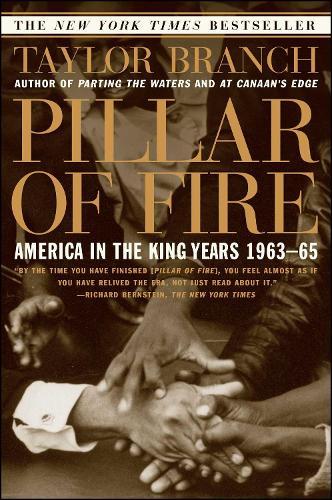
From Pulitzer Prize-winning author Taylor Branch, the second part of his epic trilogy on Martin Luther King, Jr. and the American Civil Rights Movement. In the second volume of his three-part history, a monumental trilogy that began with Parting the Waters, winner of the Pulitzer Prize and the National Book Critics Circle Award, Taylor Branch portrays the Civil Rights Movement at its zenith, recounting the climactic struggles as they commanded the national stage. Beginning with the Nation of Islam and conflict over racial separatism, Pillar of Fire takes the reader to Mississippi and Alabama: Birmingham, the murder of Medgar Evers, the ""March on Washington,"" the Civil Rights Act, and voter registration drives. In 1964, King is awarded the Nobel Peace Prize. Branch's magnificent trilogy makes clear why the Civil Rights Movement, and indeed King's leadership, are among the nation's enduring achievements. In bringing these decades alive, preserving the integrity of those who marched and died, Branch gives us a crucial part of our history and heritage.
Full Product Details
Author: Taylor Branch
Publisher: Simon & Schuster
Imprint: Simon & Schuster
Edition: New edition
Dimensions:
Width: 15.60cm
, Height: 5.30cm
, Length: 23.50cm
Weight: 0.987kg
ISBN: 9780684848099
ISBN 10: 0684848090
Pages: 768
Publication Date: 08 June 1999
Audience:
General/trade
,
General
,
Postgraduate, Research & Scholarly
Format: Paperback
Publisher's Status: No Longer Our Product
Availability: In Print

This item will be ordered in for you from one of our suppliers. Upon receipt, we will promptly dispatch it out to you. For in store availability, please contact us.
Reviews
Jon Meacham Newsweek Pillar of Fire is a magisterial history of one of the most tumultuous periods in postwar America. Branch's storytelling is strong, his storytelling colorful. Reading Branch, it is easier to see why even the most remarkable revolutions are never complete.
Bill Maxwell St. Petersburg Times Pillar of Fire, a history of symbiosis and epiphany, records King's vision and the disparate moral currents that forced America to redefine itslef in light of its failures to live up to its own principles of freedom.
Richard Bernstein The New York Times By the time you have finished [Pillar of Fire], you feel almost as if you have relieved the era, not just read about it. James Goodman The Boston Globe This is jet-propelled history. Jeff Shesol The Washington Post Politics and personalities, ambition and imagination, triumph and tragedy. David M. Shribman The Wall Street Journal One part biography, one part history, one part elegy...a vast panorama...powerful. Jon Meacham Newsweek Pillar of Fire is a magisterial history of one of the most tumultuous periods in postwar America. Branch's storytelling is strong, his storytelling colorful. Reading Branch, it is easier to see why even the most remarkable revolutions are never complete. Alan Wolfe The New York Times Book Review As he did in Parting the Waters, Branch brings to these events both a passion for their detail and a recognition of their larger historical significance. Scott Ellsworth The Oregonian Magnificent...the birth of a masterwork akin to Carl Sandburg's Lincoln or Shelby Foote's Civil War. Ray Jenkins The Baltimore Sun Branch has an uncanny ability to penetrate the most obscure nooks and crannies of the past to provide a whole new perpective on the Sixties... Bill Maxwell St. Petersburg Times Pillar of Fire, a history of symbiosis and epiphany, records King's vision and the disparate moral currents that forced America to redefine itslef in light of its failures to live up to its own principles of freedom. Trevor Coleman Detroit Free Press The strength of Pillar of Fire lies in Branch's unsurpassed ability to bring the reader into the moment, enabling one to almost feel the tension of the times.
In this stirring follow-up to his Pulitzer Prize-winning Parting the Waters (1988), Branch recalls the terror, dissension, and courage of the civil-rights movement at its zenith: the mid-1960s agitation leading to landmark integration and voting-rights legislation. With deft narrative skill, Branch shows how the lives of individuals and the nation as a whole were transformed in such diverse settings as Birmingham, Ala., where legendary protests occurred; the LBJ White House; and South-Central L.A., where a 1962 shooting involving police and Black Muslims signaled the start of a decade of urban tensions. Memoirs, oral histories, interviews, and recently revealed FBI wiretaps enable Branch to trace the inexorable momentum of change almost day by day. He also details the overlapping goals, tactical disputes, and petty jealousies among and within major movement organizations, including the Southern Christian Leadership Conference, the Student Nonviolent Coordinating Committee, and the NAACP. Straddling a narrative filled with a novel's-worth of fascinating real-life characters are two spellbinding, tormented figures epitomizing two poles of protest: Martin Luther King Jr., unnerved by FBI surveillance of his philandering, so resentful of Kennedy caution over civil-rights advocacy that he cracked an obscene joke while watching the president's funeral, yet winning a Nobel Peace Prize; and Malcolm X, shattered by his discovery that mentor Elijah Muhammad had impregnated several secretaries, attempting on the fly to plot a new course away from the Nation of Islam before his assassination. Finally, Branch foreshadows the forces and events that were to stall the movement in the next few years: a Republican Party making inroads in the South during Barry Goldwater's otherwise disastrous campaign, the alienation of white liberals from militant blacks, and the Vietnam War. With a third volume to come, this history is taking pride of place among the dozens of fine chronicles of this time of tumult and moral witness in American history. (Kirkus Reviews)
Author Information
Taylor Branch is the bestselling author of Parting the Waters: America in the King Years, 1954-63; Pillar of Fire: America in the King Years, 1963-65; At Canaan’s Edge: America in the King Years, 1965-1968; and The Clinton Tapes. He has won the Pulitzer Prize and the National Book Critics Circle Award.