Overview
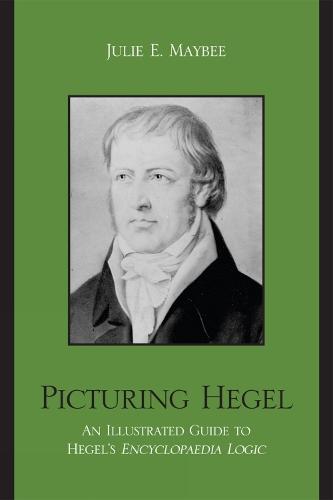
In her innovative take on G.W. F. Hegel's The Encyclopaedia Logic, Julie E. Maybee uses pictures and diagrams to cut through the philosopher's dense, difficult writing. Picturing Hegel: An Illustrated Guide to Hegel's Encyclopaedia Logic utilizes diagrams in order to rehabilitate Hegel's logic for serious consideration by showing how each stage develops step-by-step from earlier stages according to definite, logical patterns. This interpretation makes Hegel's work accessible and understandable for new and experienced readers alike. Because Hegel uses the same logic in all of his works, Maybee's analysis and defense of the logic will capture the attention of those readers interested in Hegel's ethics, politics, history, philosophy of religion, and phenomenology. Through the included diagrams, Maybee is able to define central Hegelian concepts such as ""being-in-itself,"" and ""being-in-and-for-itself"" with a new level of precision. Maybee argues that Hegel's logic does not include the one logistical pattern most often attributed to him; namely, the pattern ""thesis-antithesis-synthesis."" Rather, Hegel's model of logic was more scientific than formalistic in nature, as the philosopher himself pointed out. Hegel considered himself an encyclopedic culmination of Western philosophy in some ways, and indeed his work summarizes many of the presuppositions of Western philosophy. By picturing Hegel's logic, we can gain a greater understanding of ourselves.
Full Product Details
Author: Julie E. Maybee
Publisher: Bloomsbury Publishing Plc
Imprint: Lexington Books
Dimensions:
Width: 16.30cm
, Height: 4.00cm
, Length: 24.00cm
Weight: 0.998kg
ISBN: 9780739116159
ISBN 10: 0739116150
Pages: 668
Publication Date: 16 August 2009
Audience:
Professional and scholarly
,
Professional & Vocational
Format: Hardback
Publisher's Status: Out of Print
Availability: In Print

Limited stock is available. It will be ordered for you and shipped pending supplier's limited stock.
Reviews
To anyone who takes Hegel's own self-conception seriously, there is no way around studying his system of speculative logic, since this was, to him, the basis of his other philosophical accomplishments. Maybee's book is a remarkable achievement in making Hegel's logic accessible to students as well as specialists. -- Wood, Allen One of the chief merits of her detailed account is its balanced approach!.Maybee's account will provoke the reader to rethink what counts as logic. Even if we do not teach speculative logic in our introductory classes, Maybee's patient and persistent explanation of this difficult text is a rewarding read. Journal Of The History Of Philosophy
To anyone who takes Hegel's own self-conception seriously, there is no way around studying his system of speculative logic, since this was, to him, the basis of his other philosophical accomplishments. Maybee's book is a remarkable achievement in making Hegel's logic accessible to students as well as specialists.--Wood, Allen
To anyone who takes Hegel's own self-conception seriously, there is no way around studying his system of speculative logic, since this was, to him, the basis of his other philosophical accomplishments. Maybee's book is a remarkable achievement in making Hegel's logic accessible to students as well as specialists. -- Allen Wood, Indiana University, Bloomington One of the chief merits of her detailed account is its balanced approach...Maybee's account will provoke the reader to rethink what counts as logic. Even if we do not teach speculative logic in our introductory classes, Maybee's patient and persistent explanation of this difficult text is a rewarding read. Journal Of The History Of Philosophy
Author Information
Julie E. Maybee is assistant professor of philosophy at Lehman College, City University of New York.