Overview
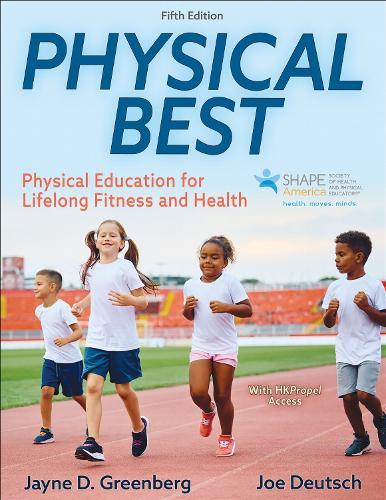
Promote health and fitness in the physical education classroom. Physical educators play a critical role in encouraging students to live healthy, active lifestyles. Physical Best: Physical Education for Lifelong Fitness and Health, Fifth Edition With HKPropel Access, equips preservice and in-service teachers with a comprehensive, functional approach to incorporating fitness education into physical education classes at the elementary, middle school, and high school levels. The 2024 National Physical Education Standards are integrated throughout the fifth edition, so teachers can use the material and be confident that it adheres to current SHAPE America standards. Developed by experts, the Physical Best approach is the gold standard to teach fitness education in K-12 physical education classes. It emphasizes the following: Promoting the benefits of fitness, health, and physical activity for all students Equipping students with the knowledge and skills to move confidently Individualizing goal setting, assessment, and self-monitoring Identifying movement opportunities that are personally enjoyable and meaningful Preparing students for assessments and giving them many opportunities to practice Updates to this edition include new sidebars called Teaching Tips that highlight practical ways to apply the content and a new chapter on comprehensive school physical activity programs (CSPAPs). Related downloadable and modifiable online resources include a collection of 250 ready-to-use activities developed and categorized according to the Grade-Span Learning Indicators from the National Physical Education Standards. Physical Best, Fifth Edition, assists current and future teachers in delivering quality physical education programming to their students. It discusses best practices, provides up-to-date content, and shows how to integrate health-related fitness education and assessment into an existing curriculum. With this approach, teachers can feel confident that their students will meet the National Physical Education Standards. Human Kinetics is proud to publish this book in association with SHAPE America, the national organization that defines excellence for school-based health and physical education professionals across the United States. Note: A code for accessing HKPropel is included with all new print books.
Full Product Details
Author: Jayne D. Greenberg ,
Joe Deutsch
Publisher: Human Kinetics Publishers
Imprint: Human Kinetics
Edition: Fifth Edition
ISBN: 9781718226043
ISBN 10: 1718226047
Pages: 400
Publication Date: 20 March 2026
Audience:
College/higher education
,
Tertiary & Higher Education
Format: Paperback
Publisher's Status: Active
Availability: Not yet available

This item is yet to be released. You can pre-order this item and we will dispatch it to you upon its release.
Author Information
Jayne Greenberg, EdD, has served as director of the I Can Do It! program for the U.S. Department of Health and Human Services. Prior to that position, Greenberg served as the district director of physical education and health literacy for Miami-Dade County Public Schools from 1995 to 2017. During her career in education, she has worked as an elementary, middle, and high school physical education teacher in both public and private schools; a region physical education coordinator; a high school and middle school administrator; and an adjunct professor teaching both undergraduate and graduate courses in teaching methods, sport psychology, and research. Greenberg has served as president of the Florida Association of Health, Physical Education, Recreation and Dance and has chaired the Sport Development Committee for the United States Olympic Committee and USA Field Hockey. She assisted the U.S. Department of Health and Human Services in the development of the I Can Do It, You Can Do It! program, a national initiative to address the physical activity levels of youth with disabilities. Greenberg was named the 2005 National Physical Education Administrator of the Year by the National Association for Sport and Physical Education and received the 2005 Highest Recognition Award from the U.S. Secretary of Health and Human Services, Michael Leavitt. In 2009, she received the Points of Light Award from Florida Governor Charlie Crist and was appointed to the Governor's Council on Physical Fitness. In 2011, Greenberg was appointed by President Barack Obama to serve on the President's Council on Fitness, Sports, and Nutrition. In 2015, she was named as the North America chair for the International Sport and Culture Association, and in 2016, she was named as an Aspen Institute Scholar and received the 2016 North American Society of HPERD Professionals Award. In 2017, she received the Lifetime of Giving Award from Delta Psi Kappa and was named as the education sector chair for the National Physical Activity Plan. Greenberg was inducted into the SHAPE America Hall of Fame in 2019 and received the Lifetime Impact Award from the President's Council on Sports, Fitness & Nutrition in 2024. Joe Deutsch, PhD, is a full professor in the education department at North Dakota State University. He oversees a homeschool physical education program at the university, where his students focus lessons around the five components of fitness through Physical Best. While he has been a professor at the university level for the past 20 years, he was previously a K-12 physical education teacher, eventually specializing in elementary physical education. While at the elementary level, Deutsch routinely incorporated the Physical Best curriculum into his existing curriculum, and he conducted Physical Best Specialists trainings across the nation. Deutsch is currently the president of SHAPE America and previously served on SHAPE America's board of directors. His service in the field of physical education is extensive, including serving two terms as president of North Dakota SHAPE (NDSHAPE) as well as serving as president of Central District SHAPE (CDSHAPE).