Overview
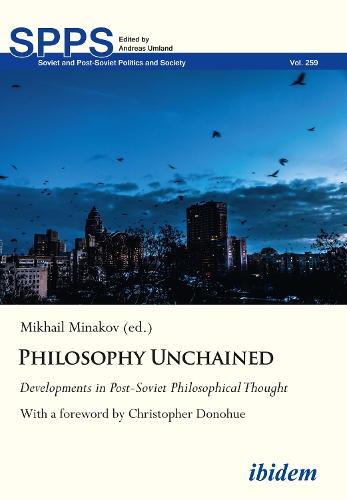
The East European nations' common past in the Soviet Union connects them in terms of both their political histories and the evolution of their philosophical thought. The USSR's dissolution created new opportunities, domestic and international, in science, politics, and business. De-Sovietization meant for philosophy that it lost its former significance as a political-ideological tool of the authorities, and its previous role in society. Philosophers of the former Soviet bloc now found themselves able to communicate with colleagues around the world. This volume's chapters analyze the renewal of the philosophical enterprise over the last thirty to forty years, in Belarus, Georgia, Latvia, Lithuania, Moldova, Russia, Ukraine, and Uzbekistan. Among its authors are Yevgeniy Abdullaev, Viktoras Bakhmetjevas, Alexandru Cosmescu, Maija Kule, Denys Kiryukhin, Giorgi Khuroshvili, Mikhail Maiatsky, Tatyana Shchittsova, and Mikhail Minakov.
Full Product Details
Author: Mykhailo Minakov ,
Andreas Umland ,
Christopher Donohue ,
Yevgeiy Abdullaev
Publisher: ibidem-Verlag, Jessica Haunschild u Christian Schon
Imprint: ibidem-Verlag, Jessica Haunschild u Christian Schon
Edition: New edition
Dimensions:
Width: 14.80cm
, Height: 0.20cm
, Length: 21.00cm
Weight: 0.323kg
ISBN: 9783838217680
ISBN 10: 3838217683
Pages: 376
Publication Date: 23 January 2023
Audience:
Professional and scholarly
,
Professional & Vocational
Format: Paperback
Publisher's Status: Active
Availability: In Print

This item will be ordered in for you from one of our suppliers. Upon receipt, we will promptly dispatch it out to you. For in store availability, please contact us.
Reviews
But what happened to philosophy in Soviet hands when the Soviet Union faded away? The answer is in this volume.--Ivan Krastev, Centre for Liberal Strategies in Sofia It is this overview of the new critical potentials in the post-Communist East that makes the book an obligatory reading for all who care about our common destiny.--Slavoj Zizek, University of London/University of Ljubljana Nothing can help us more incisively than this book to grasp how thinking, though imperceptible and immaterial, can be put and kept in chains or can suddenly break free from chains.--Alessandro Ferrara, University of Rome Tor Vergata The book is a must-read not only for those who are interested in a deep understanding of post-Soviet philosophy, its history, and its place in the world but also for those who want to truly explore the inner side of post-Soviet being and consciousness.--Julie Reshe, University College Cork and University College Dublin The book offers new and original cartography of the post-Soviet intellectual space and its development.--Nikolaj Plotnikov, Ruhr-University Bochum This book is a long-needed assessment of the transformations of philosophy after the fall of the Soviet Union, when a wide range of possibilities opened up for philosophical thinking.--Daniela Steila, University of Turin This book offers an excellent handle with which to grasp the inherent difficulty of reconciling states, civil societies, and academic knowledge in fraught national settings.--Diana Pinto, Historian
Author Information
Dr. Mikhail Minakov is Senior Advisor at the Woodrow Wilson Center for International Scholars, Washington, DC, as well as editor of the Kennan Institute’s blog Ukraine Focus. He is also editor of the Ideology and Politics Journal and the philosophical website Koine. Among Minakov’s recent books are From “The Ukraine” to Ukraine (co-edited with Georgii Kasianov and Matthew Rojansky, ibidem-Verlag 2021), Post-Soviet Secessionism (co-edited with Daria Isachenko and Gwendolyn Sasse, ibidem-Verlag 2021), The Dialectics of Modernity in Eastern Europe (in Russian, Laurus 2020), and Development and Dystopia (ibidem-Verlag 2018). His over 120 articles have appeared in, among other journals, Russian Politics and Law, Protest, Southeastern Europe, Transit, Studi slavistici, Mondo economico, Porownania, Neprikosnovennyi zapas, Sententiae, Krytyka, Agora, Ukraina moderna, and Filosofska dumka. Andreas Umland, M.Phil. (Oxford), Dr.Phil. (FU Berlin), Ph.D. (Cambridge), Research Fellow at the Swedish Institute of International Affairs in Stockholm, Senior Expert at the Ukrainian Institute for the Future in Kyiv, and Associate Professor at the National University of Kyiv-Mohyla Academy. Dr. Christopher Donohue is Associate Professor of Sociology at Montclair State University, NJ.