Overview
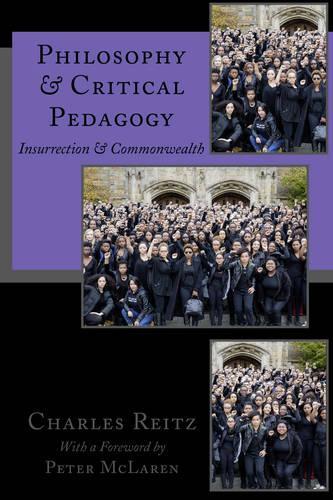
Critical pedagogy, political economics, and aesthetic theory combine with dialectical and materialist understandings of science, society, and revolutionary politics to develop the most radical goals of society and education. In Philosophy and Critical Pedagogy: Insurrection and Commonwealth, Marcuse’s hitherto misunderstood and neglected philosophy of labor is reconsidered, resulting in a labor theory of ethics. This develops commonwealth criteria of judgment regarding the real and enduring economic and political possibilities that concretely encompass all of our engagement and action. Marcuse’s newly discovered 1974 Paris Lectures are examined and the theories of Georg Lukács and Ernest Manheim contextualize the analysis to permit a critical assessment of the nature of dialectical methodology today. Revolutionary strategy and a common-ground political program against intensifying inequalities of class, race, and gender comprise the book’s commonwealth counter-offensive.
Full Product Details
Author: Peter McLaren ,
Michael A. Peters ,
Charles Reitz
Publisher: Peter Lang Publishing Inc
Imprint: Peter Lang Publishing Inc
Edition: New edition
Volume: 7
Dimensions:
Width: 15.00cm
, Height: 1.50cm
, Length: 22.50cm
Weight: 0.390kg
ISBN: 9781433133626
ISBN 10: 1433133628
Pages: 255
Publication Date: 27 April 2016
Audience:
Professional and scholarly
,
Professional & Vocational
Format: Paperback
Publisher's Status: Active
Availability: Manufactured on demand

We will order this item for you from a manufactured on demand supplier.
Reviews
We live in a time of great unrest. The effects of racism, economic exploitation, and other forms of social oppression are beginning to be contested in many pockets of our society. In these times, Charles Reitz's new book is a must-read for those who are seeking a new theoretical framework for addressing recent structures and mechanisms of alienation and exploitation. This book provides us with a history of dialectics as well as insights into how dialectical thinking can help us grasp and transform our society. The conversation created between Marx, Marcuse, and Manheim is very informative. One of the greatest contributions by Reitz is his rethinking of the idea of commonwealth. Those of us who are interested in further developing our democratic experiment will gain much from this book. (Arnold L. Farr, Professor of Philosophy, University of Kentucky) Reitz's groundbreaking essays, engaging the work of Marx, Marcuse, and Manheim, demonstrate how we might reformulate our relationship with labor, a central component of a liberated society. Reitz provides hope that we can develop, through critical education, an emancipatory consciousness and the radical praxis from which a liberated society may emerge. (Sarah Surak, Assistant Professor, Departments of Political Science and Environmental Studies, Salisbury University, Maryland) This volume persuasively restores philosophy to its rightful and necessary place in education. From investigations of historical experience, through critiques of conservative figures, Reitz arrives at new ways critical theory can revive our entire culture. And this is achieved with such clarity and resolve that the reader comes away understanding socialist humanism could save us after all. (Fred Whitehead, co-editor, Freethought on the American Frontier)
"""We live in a time of great unrest. The effects of racism, economic exploitation, and other forms of social oppression are beginning to be contested in many pockets of our society. In these times, Charles Reitz's new book is a must-read for those who are seeking a new theoretical framework for addressing recent structures and mechanisms of alienation and exploitation. This book provides us with a history of dialectics as well as insights into how dialectical thinking can help us grasp and transform our society. The conversation created between Marx, Marcuse, and Manheim is very informative. One of the greatest contributions by Reitz is his rethinking of the idea of commonwealth. Those of us who are interested in further developing our democratic experiment will gain much from this book."" (Arnold L. Farr, Professor of Philosophy, University of Kentucky) ""Reitz's groundbreaking essays, engaging the work of Marx, Marcuse, and Manheim, demonstrate how we might reformulate our relationship with labor, a central component of a liberated society. Reitz provides hope that we can develop, through critical education, an emancipatory consciousness and the radical praxis from which a liberated society may emerge."" (Sarah Surak, Assistant Professor, Departments of Political Science and Environmental Studies, Salisbury University, Maryland) ""This volume persuasively restores philosophy to its rightful and necessary place in education. From investigations of historical experience, through critiques of conservative figures, Reitz arrives at new ways critical theory can revive our entire culture. And this is achieved with such clarity and resolve that the reader comes away understanding socialist humanism could save us after all."" (Fred Whitehead, co-editor, Freethought on the American Frontier)"
We live in a time of great unrest. The effects of racism, economic exploitation, and other forms of social oppression are beginning to be contested in many pockets of our society. In these times, Charles Reitz's new book is a must-read for those who are seeking a new theoretical framework for addressing recent structures and mechanisms of alienation and exploitation. This book provides us with a history of dialectics as well as insights into how dialectical thinking can help us grasp and transform our society. The conversation created between Marx, Marcuse, and Manheim is very informative. One of the greatest contributions by Reitz is his rethinking of the idea of commonwealth. Those of us who are interested in further developing our democratic experiment will gain much from this book. (Arnold L. Farr, Professor of Philosophy, University of Kentucky) Reitz's groundbreaking essays, engaging the work of Marx, Marcuse, and Manheim, demonstrate how we might reformulate our relationship with labor, a central component of a liberated society. Reitz provides hope that we can develop, through critical education, an emancipatory consciousness and the radical praxis from which a liberated society may emerge. (Sarah Surak, Assistant Professor, Departments of Political Science and Environmental Studies, Salisbury University, Maryland) This volume persuasively restores philosophy to its rightful and necessary place in education. From investigations of historical experience, through critiques of conservative figures, Reitz arrives at new ways critical theory can revive our entire culture. And this is achieved with such clarity and resolve that the reader comes away understanding socialist humanism could save us after all. (Fred Whitehead, co-editor, Freethought on the American Frontier) We live in a time of great unrest. The effects of racism, economic exploitation, and other forms of social oppression are beginning to be contested in many pockets of our society. In these times, Charles Reitz's new book is a must-read for those who are seeking a new theoretical framework for addressing recent structures and mechanisms of alienation and exploitation. This book provides us with a history of dialectics as well as insights into how dialectical thinking can help us grasp and transform our society. The conversation created between Marx, Marcuse, and Manheim is very informative. One of the greatest contributions by Reitz is his rethinking of the idea of commonwealth. Those of us who are interested in further developing our democratic experiment will gain much from this book. (Arnold L. Farr, Professor of Philosophy, University of Kentucky) Reitz's groundbreaking essays, engaging the work of Marx, Marcuse, and Manheim, demonstrate how we might reformulate our relationship with labor, a central component of a liberated society. Reitz provides hope that we can develop, through critical education, an emancipatory consciousness and the radical praxis from which a liberated society may emerge. (Sarah Surak, Assistant Professor, Departments of Political Science and Environmental Studies, Salisbury University, Maryland) This volume persuasively restores philosophy to its rightful and necessary place in education. From investigations of historical experience, through critiques of conservative figures, Reitz arrives at new ways critical theory can revive our entire culture. And this is achieved with such clarity and resolve that the reader comes away understanding socialist humanism could save us after all. (Fred Whitehead, co-editor, Freethought on the American Frontier)
Author Information
Charles Reitz studied philosophy at Freiburg University, attaining his PhD in educational studies from the State University of New York. He is the author of Art, Alienation, and the Humanities: A Critical Engagement with Herbert Marcuse and editor of Crisis and Commonwealth: Marcuse, Marx, McLaren.