Overview
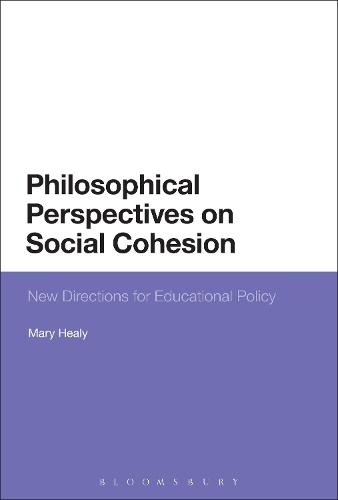
What would the civic relationship between citizens in a socially cohesive society look like? What models might we use to educate young people to support developing these bonds? Do these different models have different implications for how we structure the bonds that support a civic relationship? Philosophical Perspectives on Social Cohesion challenges the basis of how we characterize civic bonds and how we best organize schools to encourage and develop them. Mary Healy argues that metaphors and social imaginaries often give a framework for considering our interrelatedness. She re-examines the metaphor of fraternity, used as a precursor to elements of the 'Big Society', arguing that such attempts to align fraternity with liberty are mistaken and that equality plays a vital role. At a time of increasing diversity of school provision, this pertinent book indicates the connection between how we organize school structures and the models of citizenship we value.
Full Product Details
Author: Mary Healy (University of Roehampton, UK)
Publisher: Bloomsbury Publishing PLC
Imprint: Bloomsbury Academic
Dimensions:
Width: 15.60cm
, Height: 1.00cm
, Length: 23.40cm
Weight: 0.263kg
ISBN: 9781474234641
ISBN 10: 147423464
Pages: 184
Publication Date: 23 April 2015
Audience:
College/higher education
,
Tertiary & Higher Education
Format: Paperback
Publisher's Status: Active
Availability: Manufactured on demand

We will order this item for you from a manufactured on demand supplier.
Reviews
What does 'social cohesion' really mean in Western liberal democracies and, more importantly, what should it ideally mean? If we identify the answer to that question, we next need to ask what sort of school structures and educational interventions are required to actualise this ideal. Mary Healy's rich and fascinating study not only sheds new conceptual light on the notion of civic relationships and its dense metaphorical layers, it also offers sensible practical advice to educators and policy-makers on how education for social cohesion can be made into a tangible goal for schooling. * Kristjan Kristjansson, Professor of Character Education and Virtue Ethics, University of Birmingham, UK * Written with clarity and commitment, this is not only a timely book, it is also one of enduring significance. In increasingly fragmented and fragmenting times it reminds us of the foundational importance of attending imaginatively, deliberately and insistently to what binds us together as citizens and as human beings in a democratic society. Education has a key role to play here that is not well served by the populist fundamentalism of the market with its inherent capacity for division and exclusion. This book helps us return to fundamentals, to deeper human purposes and more profound views of human flourishing. We would do well to take its arguments and recommendations seriously and attend to their consequences with some urgency. Unless we do so, we will intensify an increasing immiseration of the present; perpetuate an arrogant, ungenerous view of common humanity; and invite a future that is irresponsibly and avoidably careless of what matters most in creating and sustaining democracy as a way of living and learning together. * Michael Fielding, Emeritus Professor of Education, Institute of Education, University of London, UK *
What does 'social cohesion' really mean in Western liberal democracies and, more importantly, what should it ideally mean? If we identify the answer to that question, we next need to ask what sort of school structures and educational interventions are required to actualise this ideal. Mary Healy's rich and fascinating study not only sheds new conceptual light on the notion of civic relationships and its dense metaphorical layers, it also offers sensible practical advice to educators and policy-makers on how education for social cohesion can be made into a tangible goal for schooling. Kristj n Kristj nsson, Professor of Character Education and Virtue Ethics, University of Birmingham, UK Written with clarity and commitment, this is not only a timely book, it is also one of enduring significance. In increasingly fragmented and fragmenting times it reminds us of the foundational importance of attending imaginatively, deliberately and insistently to what binds us together as citizens and as human beings in a democratic society. Education has a key role to play here that is not well served by the populist fundamentalism of the market with its inherent capacity for division and exclusion. This book helps us return to fundamentals, to deeper human purposes and more profound views of human flourishing. We would do well to take its arguments and recommendations seriously and attend to their consequences with some urgency. Unless we do so, we will intensify an increasing immiseration of the present; perpetuate an arrogant, ungenerous view of common humanity; and invite a future that is irresponsibly and avoidably careless of what matters most in creating and sustaining democracy as a way of living and learning together. Michael Fielding, Emeritus Professor of Education, Institute of Education, University of London, UK
What does 'social cohesion' really mean in Western liberal democracies and, more importantly, what should it ideally mean? If we identify the answer to that question, we next need to ask what sort of school structures and educational interventions are required to actualise this ideal. Mary Healy's rich and fascinating study not only sheds new conceptual light on the notion of civic relationships and its dense metaphorical layers, it also offers sensible practical advice to educators and policy-makers on how education for social cohesion can be made into a tangible goal for schooling. Kristjan Kristjansson, Professor of Character Education and Virtue Ethics, University of Birmingham, UK Written with clarity and commitment, this is not only a timely book, it is also one of enduring significance. In increasingly fragmented and fragmenting times it reminds us of the foundational importance of attending imaginatively, deliberately and insistently to what binds us together as citizens and as human beings in a democratic society. Education has a key role to play here that is not well served by the populist fundamentalism of the market with its inherent capacity for division and exclusion. This book helps us return to fundamentals, to deeper human purposes and more profound views of human flourishing. We would do well to take its arguments and recommendations seriously and attend to their consequences with some urgency. Unless we do so, we will intensify an increasing immiseration of the present; perpetuate an arrogant, ungenerous view of common humanity; and invite a future that is irresponsibly and avoidably careless of what matters most in creating and sustaining democracy as a way of living and learning together. Michael Fielding, Emeritus Professor of Education, Institute of Education, University of London, UK
Author Information
Mary Healy is Senior Lecturer in Education at the University of Roehampton, UK.