Overview
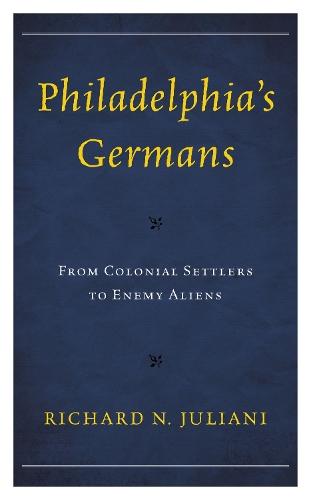
In Philadelphia’s Germans: From Colonial Settlers to Enemy Aliens, Richard N. Juliani examines the social, cultural, and political life, along with the ethnic consciousness, of Philadelphia’s Germans, from their participation in the founding of the colony of Pennsylvania to the entry of the United States into World War I. This book focuses on their paradoxical transformation from loyal citizens, who made great contributions as they became increasingly Americanized, to a people viewed as a foreign threat to the safety and security of the city and nation. It also considers the policies and treatment of government and views of the local press in reporting and interpreting the dilemma of German Americans during the transition.
Full Product Details
Author: Richard N. Juliani
Publisher: Bloomsbury Publishing Plc
Imprint: Lexington Books
Dimensions:
Width: 16.00cm
, Height: 2.70cm
, Length: 22.80cm
Weight: 0.739kg
ISBN: 9781793651792
ISBN 10: 1793651795
Pages: 342
Publication Date: 21 October 2021
Audience:
Professional and scholarly
,
Professional & Vocational
Format: Hardback
Publisher's Status: Active
Availability: Manufactured on demand

We will order this item for you from a manufactured on demand supplier.
Reviews
Armed with his deep knowledge of ethnic Philadelphia, Richard Juliani recounts in this book the rich history of one of the city's major communities, charting its development from colonial times down through the jarring years when the recently unified German homeland became an enemy nation after American entry into World War I. Juliani finds especially valuable material in Philadelphia's newspapers to corroborate his thesis that, although the city's Germans were reluctant to abandon their German identity, and they conceived assimilation as a flexible and multicultural process, the First World War set them on a path toward Anglo Conformism.--William J. Connell, Seton Hall University The Statue of Liberty welcomes all to our shores and E Plurbus Unum, Out of Many, One, appears on the Great Seal of the United States as well as on the obverse side of the dollar bill. Yet as Richard Juliani so deftly and richly reminds us in his new book, Philadelphia Germans, the immigrant story is far more complex and extraordinarily relevant at present, when xenophobia and tribalism again threaten the very fabric of the American Experiment.--David R. Contosta, Chestnut Hill College
Meticulously researched and clearly presented, Richard Juliani's Philadelphia's Germans: From Colonial Settlers to Enemy Aliens tells the story of Philadelphia and Pennsylvanian Germans from their arrival in the 17th century to their unexpected confrontation with American society and politics during World War I. While the book's focus may be local and regional, and set in times past, its themes and findings apply to the immigrant experience across the country and across time. The reader cannot help but see today's contentious debate about race and immigration (the culture wars ) reflected, if not foreshadowed, in Juliani's portrayal of German Americans and their struggle to prove their loyalty and Americanness while the nation was at war with Germany. His work aims to understand how a model minority like the Germans--the largest immigrant group in American history; the first to oppose slavery; the first to enlist against the British in the Revolution; the largest to serve the Union in both the American Civil War and World War I; the group most crucial to America's industrialization and labor movements; and the group that transformed American culture, giving us recreational Sundays, kindergarten, beer and pretzels--could become the feared, dreaded, reviled and detested aliens and foreigners of early 20th century America. American society, polity and media viciously attacked their names, language, newspapers, music, foods, clubs and organizations as un-American and often restricted them to certain locations or confiscated their homes and possessions. Juliani, a sociologist, prefers to see himself as a historical anthropologist, someone who treats the boundary where history meets sociology. As such, he has not only given us an excellent study of a forgotten piece of American history, but he has the insights to confront the question of assimilation and how this process transforms both the group itself and the larger American society. He asks questions that to this day have no consensus: How do we define America ? What does it mean to be an American ? German Americans, struggling with this issue since the 17th century, have much to teach us.--Caroline Golab, Thomas Jefferson University Armed with his deep knowledge of ethnic Philadelphia, Juliani recounts in this book the rich history of one of the city's major communities, charting its development from colonial times down through the jarring years when the recently unified German homeland became an enemy nation after the American entry into World War I. Juliani finds especially valuable material in Philadelphia's newspapers to corroborate his thesis that, although the city's Germans were reluctant to abandon their 'German identity' and conceived assimilation as a flexible and multicultural process, the First World War set the city's Germans on a path toward Anglo-conformism.--William J. Connell, Seton Hall University The Statue of Liberty welcomes all to our shores and e pluribus unum, 'out of many, one, ' appears on the Great Seal of the United States as well as on the reverse side of the dollar bill. Yet, as Richard N. Juliani so deftly and richly reminds us in his new book, Philadelphia's Germans: From Colonial Settlers to Enemy Aliens, the immigrant story is far more complex and extraordinarily relevant at present, when xenophobia and tribalism again threaten the very fabric of the American experiment.--David R. Contosta, Chestnut Hill College
The Statue of Liberty welcomes all to our shores and e pluribus unum, ‘out of many, one,’ appears on the Great Seal of the United States as well as on the reverse side of the dollar bill. Yet, as Richard N. Juliani so deftly and richly reminds us in his new book, Philadelphia’s Germans: From Colonial Settlers to Enemy Aliens, the immigrant story is far more complex and extraordinarily relevant at present, when xenophobia and tribalism again threaten the very fabric of the American experiment. -- David R. Contosta, Chestnut Hill College Armed with his deep knowledge of ethnic Philadelphia, Juliani recounts in this book the rich history of one of the city’s major communities, charting its development from colonial times down through the jarring years when the recently unified German homeland became an enemy nation after the American entry into World War I. Juliani finds especially valuable material in Philadelphia’s newspapers to corroborate his thesis that, although the city’s Germans were reluctant to abandon their ‘German identity’ and conceived assimilation as a flexible and multicultural process, the First World War set the city’s Germans on a path toward Anglo-conformism. -- William J. Connell, Seton Hall University Meticulously researched and clearly presented, Richard Juliani’s Philadelphia’s Germans: From Colonial Settlers to Enemy Aliens tells the story of Philadelphia and Pennsylvanian Germans from their arrival in the 17th century to their unexpected confrontation with American society and politics during World War I. While the book’s focus may be local and regional, and set in times past, its themes and findings apply to the immigrant experience across the country and across time. The reader cannot help but see today’s contentious debate about race and immigration (the “culture wars”) reflected, if not foreshadowed, in Juliani’s portrayal of German Americans and their struggle to prove their loyalty and Americanness while the nation was at war with Germany. His work aims to understand how a “model minority” like the Germans—the largest immigrant group in American history; the first to oppose slavery; the first to enlist against the British in the Revolution; the largest to serve the Union in both the American Civil War and World War I; the group most crucial to America’s industrialization and labor movements; and the group that transformed American culture, giving us recreational Sundays, kindergarten, beer and pretzels—could become the feared, dreaded, reviled and detested “aliens” and “foreigners” of early 20th century America. American society, polity and media viciously attacked their names, language, newspapers, music, foods, clubs and organizations as “un-American” and often restricted them to certain locations or confiscated their homes and possessions. Juliani, a sociologist, prefers to see himself as a “historical anthropologist,” someone who treats the boundary where history meets sociology. As such, he has not only given us an excellent study of a forgotten piece of American history, but he has the insights to confront the question of assimilation and how this process transforms both the group itself and the larger American society. He asks questions that to this day have no consensus: How do we define “America”? What does it mean to be an “American”? German Americans, struggling with this issue since the 17th century, have much to teach us. -- Caroline Golab, Thomas Jefferson University
Armed with his deep knowledge of ethnic Philadelphia, Juliani recounts in this book the rich history of one of the city's major communities, charting its development from colonial times down through the jarring years when the recently unified German homeland became an enemy nation after the American entry into World War I. Juliani finds especially valuable material in Philadelphia's newspapers to corroborate his thesis that, although the city's Germans were reluctant to abandon their 'German identity' and conceived assimilation as a flexible and multicultural process, the First World War set the city's Germans on a path toward Anglo-conformism.--William J. Connell, Seton Hall University The Statue of Liberty welcomes all to our shores and e pluribus unum, 'out of many, one, ' appears on the Great Seal of the United States as well as on the reverse side of the dollar bill. Yet, as Richard N. Juliani so deftly and richly reminds us in his new book, Philadelphia's Germans: From Colonial Settlers to Enemy Aliens, the immigrant story is far more complex and extraordinarily relevant at present, when xenophobia and tribalism again threaten the very fabric of the American experiment.--David R. Contosta, Chestnut Hill College
Author Information
Richard N. Juliani is emeritus professor of sociology at Villanova University.