Overview
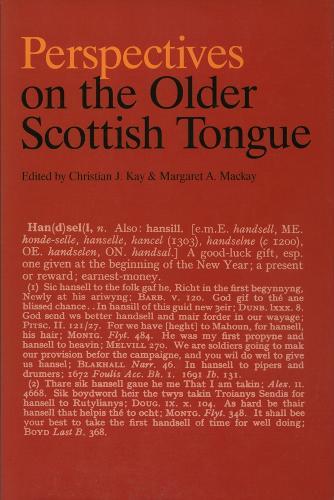
This book celebrates the rich diversity of the Scots language and the culture it embodies. It marks two important events in Scots language scholarship: the completion of the Dictionary of the Older Scottish Tongue (DOST) in 2001 and the publication of its final volumes in 2002. The thirteen chapters which comprise the volume cover many aspects of Scottish life as illuminated by the words used to describe them. The writers, experts in their own fields, are linked by the fact that they have all made use of the wealth of information in DOST to advance their research. Their topics include the use of DOST in reading literature, in tracing the consumption of cereals and wine in early Scotland, in elucidating place names and terms used in shipping, building and measurement, and in defining such complex concepts as homicide and the role of the 'gossip'. Nor is the history and structure of the dictionary itself forgotten. There is a study of its development from its beginnings in the 1920s, together with biographical notes on its editors over the years. There are also chapters drawing comparisons with the Middle English Dictionary, the Linguistic Atlas of Older Scots and the proposed historical dictionary of Scottish Gaelic. The book will thus appeal to those interested in the history of Scots and Scotland, and to those with a more general interest in the history of languages and development of dictionaries.
Full Product Details
Author: Christian Kay (Professor of English Language, University of Glasgow) ,
Margaret Mackay (Professor of English Language, University of Glasgow)
Publisher: Edinburgh University Press
Imprint: Edinburgh University Press
Dimensions:
Width: 15.60cm
, Height: 2.40cm
, Length: 23.40cm
Weight: 0.506kg
ISBN: 9780748622818
ISBN 10: 0748622810
Pages: 240
Publication Date: 15 April 2005
Audience:
General/trade
,
College/higher education
,
General
,
Tertiary & Higher Education
Format: Hardback
Publisher's Status: Active
Availability: Temporarily unavailable

The supplier advises that this item is temporarily unavailable. It will be ordered for you and placed on backorder. Once it does come back in stock, we will ship it out to you.
Reviews
This collection of essays invites us to share in the vivid and lively culture of which Older Scots was once the living language. This fine collection of essays celebrating the completion of the Dictionary of the Older Scottish Tongue is testimony to the value of the historical dictionary as a cultural, as well as a lexical, document. The essays are wide-ranging: some concentrate on the data in DOST (on wines, cereal crops and products, legal language, literary vocabulary, etc.); others use the definitions in DOST as a jumping-off point for further analysis (of the function of a 'gossip', timber construction, weights and measures); and still others connect DOST with related dictionaries and linguistic atlases. These essays are essential reading for anyone interested in the language and culture of early Scotland. -- Robert E. Lewis, Editor-in-Chief, Middle English Dictionary 'This collection of essays invites us to share in the vivid and lively culture of which Older Scots was once the living language.' - Scots Language, 25 This collection of essays invites us to share in the vivid and lively culture of which Older Scots was once the living language. This fine collection of essays celebrating the completion of the Dictionary of the Older Scottish Tongue is testimony to the value of the historical dictionary as a cultural, as well as a lexical, document. The essays are wide-ranging: some concentrate on the data in DOST (on wines, cereal crops and products, legal language, literary vocabulary, etc.); others use the definitions in DOST as a jumping-off point for further analysis (of the function of a 'gossip', timber construction, weights and measures); and still others connect DOST with related dictionaries and linguistic atlases. These essays are essential reading for anyone interested in the language and culture of early Scotland. 'This collection of essays invites us to share in the vivid and lively culture of which Older Scots was once the living language.' - Scots Language, 25
This collection of essays invites us to share in the vivid and lively culture of which Older Scots was once the living language. This fine collection of essays celebrating the completion of the Dictionary of the Older Scottish Tongue is testimony to the value of the historical dictionary as a cultural, as well as a lexical, document. The essays are wide-ranging: some concentrate on the data in DOST (on wines, cereal crops and products, legal language, literary vocabulary, etc.); others use the definitions in DOST as a jumping-off point for further analysis (of the function of a 'gossip', timber construction, weights and measures); and still others connect DOST with related dictionaries and linguistic atlases. These essays are essential reading for anyone interested in the language and culture of early Scotland. -- Robert E. Lewis, Editor-in-Chief, Middle English Dictionary 'This collection of essays invites us to share in the vivid and lively culture of which Older Scots was once the living language.' - Scots Language, 25 This collection of essays invites us to share in the vivid and lively culture of which Older Scots was once the living language. This fine collection of essays celebrating the completion of the Dictionary of the Older Scottish Tongue is testimony to the value of the historical dictionary as a cultural, as well as a lexical, document. The essays are wide-ranging: some concentrate on the data in DOST (on wines, cereal crops and products, legal language, literary vocabulary, etc.); others use the definitions in DOST as a jumping-off point for further analysis (of the function of a 'gossip', timber construction, weights and measures); and still others connect DOST with related dictionaries and linguistic atlases. These essays are essential reading for anyone interested in the language and culture of early Scotland. 'This collection of essays invites us to share in the vivid and lively culture of which Older Scots was once the living language.' - Scots Language, 25
Author Information
Christian J. Kay is Professor of English Language, University of Glasgow. Margaret A. Mackay is Director of Archives, Department of Celtic and Scottish Studies, University of Edinburgh