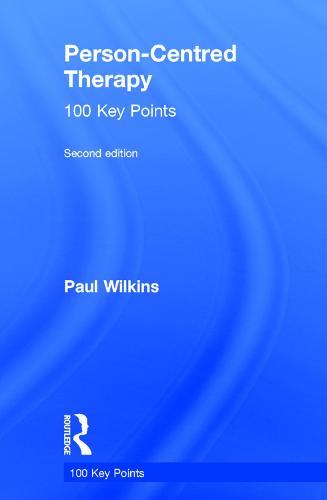
Full Product Details
Author: Paul Wilkins
Publisher: Taylor & Francis Ltd
Imprint: Routledge
Edition: 2nd edition
Weight: 0.620kg
ISBN: 9780415743709
ISBN 10: 0415743702
Pages: 310
Publication Date: 07 December 2015
Audience:
College/higher education
,
Professional and scholarly
,
Tertiary & Higher Education
,
Professional & Vocational
Format: Hardback
Publisher's Status: Active
Availability: In Print

This item will be ordered in for you from one of our suppliers. Upon receipt, we will promptly dispatch it out to you. For in store availability, please contact us.
Reviews
As a succinct overview of person-centred theory and practice, this book is a valuable handbook for students as they move through their training and into the early stages of practice. It offers an up-to-date guide to the key concepts, discussions and controversies in contemporary person-centred counselling. The development of theoretical ideas is presented as a natural process, inspired by research and practice. The inclusion of child development and the impact of social and environmental forces on psychological distress offer welcome additions to mainstream person-centred thinking. - Connie Johnson, Senior Teaching Fellow, University of Edinburgh; Counsellor and supervisor in private practice. This is an extraordinarily important book. Paul Wilkins did a great job in combining scholarly profound descriptions of the person-centred essentials with a clear and easy-to-read language. It serves the academic as well as the practitioner as both introduction and reference book to a wide range of topics from the philosophical underpinnings via an overview of criticisms and thoughtful rebuttals to the social dimensions and (as a new section to the second edition) recent developments . I like particularly that Wilkins thoroughly follows Rogers' original intentions in describing the core values of a truly client-centred approach to psychotherapy and at the same time does justice to the different branches and developments that originated the classical endeavour.- Peter F. Schmid, Sigmund Freud University, Vienna
As a succinct overview of person-centred theory and practice, this book is a valuable handbook for students as they move through their training and into the early stages of practice. It offers an up-to-date guide to the key concepts, discussions and controversies in contemporary person-centred counselling. The development of theoretical ideas is presented as a natural process, inspired by research and practice. The inclusion of child development and the impact of social and environmental forces on psychological distress offer welcome additions to mainstream person-centred thinking. - Connie Johnson, Senior Teaching Fellow, University of Edinburgh; Counsellor and supervisor in private practice. This is an extraordinarily important book. Paul Wilkins did a great job in combining scholarly profound descriptions of the person-centred essentials with a clear and easy-to-read language. It serves the academic as well as the practitioner as both introduction and reference book to a wide range of topics from the philosophical underpinnings via an overview of criticisms and thoughtful rebuttals to the social dimensions and (as a new section to the second edition) recent developments . I like particularly that Wilkins thoroughly follows Rogers' original intentions in describing the core values of a truly client-centred approach to psychotherapy and at the same time does justice to the different branches and developments that originated the classical endeavour.- Peter F. Schmid, Sigmund Freud University, Vienna
As a succinct overview of person-centred theory and practice, this book is a valuable handbook for students as they move through their training and into the early stages of practice. It offers an up-to-date guide to the key concepts, discussions and controversies in contemporary person-centred counselling. The development of theoretical ideas is presented as a natural process, inspired by research and practice. The inclusion of child development and the impact of social and environmental forces on psychological distress offer welcome additions to mainstream person-centred thinking. - Connie Johnson, Senior Teaching Fellow, University of Edinburgh; Counsellor and supervisor in private practice. This is an extraordinarily important book. Paul Wilkins did a great job in combining scholarly profound descriptions of the person-centred essentials with a clear and easy-to-read language. It serves the academic as well as the practitioner as both introduction and reference book to a wide range of topics from the philosophical underpinnings via an overview of criticisms and thoughtful rebuttals to the social dimensions and (as a new section to the second edition) recent developments . I like particularly that Wilkins thoroughly follows Rogers' original intentions in describing the core values of a truly client-centred approach to psychotherapy and at the same time does justice to the different branches and developments that originated the classical endeavour.- Peter F. Schmid, Sigmund Freud University, Vienna As a succinct overview of person-centred theory and practice, this book is a valuable handbook for students as they move through their training and into the early stages of practice. It offers an up-to-date guide to the key concepts, discussions and controversies in contemporary person-centred counselling. The development of theoretical ideas is presented as a natural process, inspired by research and practice. The inclusion of child development and the impact of social and environmental forces on psychological distress offer welcome additions to mainstream person-centred thinking. - Connie Johnson, Senior Teaching Fellow, University of Edinburgh; Counsellor and supervisor in private practice. This is an extraordinarily important book. Paul Wilkins did a great job in combining scholarly profound descriptions of the person-centred essentials with a clear and easy-to-read language. It serves the academic as well as the practitioner as both introduction and reference book to a wide range of topics from the philosophical underpinnings via an overview of criticisms and thoughtful rebuttals to the social dimensions and (as a new section to the second edition) recent developments . I like particularly that Wilkins thoroughly follows Rogers' original intentions in describing the core values of a truly client-centred approach to psychotherapy and at the same time does justice to the different branches and developments that originated the classical endeavour.- Peter F. Schmid, Sigmund Freud University, Vienna
Author Information
Paul Wilkins is a person-centred academic, practitioner and supervisor. After managing local authority mental health resources, he worked as a senior lecturer at Manchester Metropolitan University until 2009.