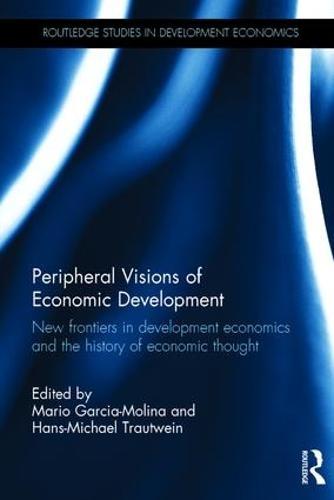
Full Product Details
Author: Mario Garcia-Molina ,
Hans-Michael Trautwein (University of Oldenburg, Germany)
Publisher: Taylor & Francis Ltd
Imprint: Routledge
Dimensions:
Width: 15.60cm
, Height: 2.10cm
, Length: 23.40cm
Weight: 0.657kg
ISBN: 9781138909229
ISBN 10: 113890922
Pages: 342
Publication Date: 12 October 2015
Audience:
College/higher education
,
Tertiary & Higher Education
,
Undergraduate
Format: Hardback
Publisher's Status: Active
Availability: In Print

This item will be ordered in for you from one of our suppliers. Upon receipt, we will promptly dispatch it out to you. For in store availability, please contact us.
Reviews
'...the sequential reading of all the chapters of the book produces a solid perspective. This seems to be due in particular to how the different perspectives relate to the broad theme of economic development. This debate gains in density and complexity throughout the chapters, exceeding the specific perspective of the field of development economics, as it emerged in the postwar period, and taking economic development as a perennial and cross-cutting issue in economic thought. In this regard, the book is no doubt an important contribution to the debate on economic development in connection with a perspective on the history of economic thought.' Alexandre Mendes Cunha, Universidade Federal de Minas Gerais, Journal of the History of Economic Thought
'...the sequential reading of all the chapters of the book produces a solid perspective. This seems to be due in particular to how the different perspectives relate to the broad theme of economic development. This debate gains in density and complexity throughout the chapters, exceeding the specific perspective of the field of development economics, as it emerged in the postwar period, and taking economic development as a perennial and cross-cutting issue in economic thought. In this regard, the book is no doubt an important contribution to the debate on economic development in connection with a perspective on the history of economic thought.' Alexandre Mendes Cunha, Universidade Federal de Minas Gerais, Journal of the History of Economic Thought
'...the sequential reading of all the chapters of the book produces a solid perspective. This seems to be due in particular to how the different perspectives relate to the broad theme of economic development. This debate gains in density and complexity throughout the chapters, exceeding the specific perspective of the field of development economics, as it emerged in the postwar period, and taking economic development as a perennial and cross-cutting issue in economic thought. In this regard, the book is no doubt an important contribution to the debate on economic development in connection with a perspective on the history of economic thought.' Alexandre Mendes Cunha, Universidade Federal de Minas Gerais, Journal of the History of Economic Thought
Author Information
Mario Garcia-Molina is Professor of Economics at the Universidad Nacional de Colombia, Colombia Hans-Michael Trautwein is Professor of International Economics at the University of Oldenburg, Germany