Overview
European countries, including the DIALOG countries, have faced a major de- graphic change and transition in the last thirty years. They are experiencing lo- term downward trends in fertility, leading to demographic ageing. Fertility rates are now below replacement level in nearly all countries. As a result, natural p- ulation growth rates are starting to decline, or population sizes are falling o- right. At the same time, the proportion of elderly dependants continues to grow while the working-age population declines in absolute and relative terms (see Kontula and Miettinen 2005). Moreover, net immigration, which potentially could offset declines in working-age population, remains generally low in most European countries (Grant et al. 2004). There are a great number of societal problems that arise from this demographic transition. The International Monetary Fund (2004) argues that the impact of - coming demographic changes on economical growth could be substantial. The h- toric association between demographicand macro-economicvariablessuggests that the projected increase in elderly dependency ratios and the projected decline in the share of the working-age population could result in slower per capita GDP growth, and lower saving and investment (IMF 2004, 147). For example, the estimates s- gest that demographic change could reduce annual real per capita GDP growth in 1 1 advanced countries by an average of / % point by 2050, i. e. , growth would be / % 2 2 point lower than if the demographic structure had remained the same as in 2000 (IMF 2004, 147).
Full Product Details
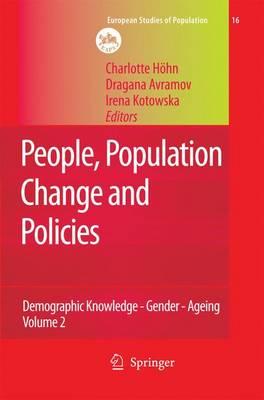
Author: Charlotte Höhn ,
Dragana Avramov ,
Irena E. Kotowska
Publisher: Springer
Imprint: Springer
Edition: 2008 ed.
Volume: 16/2
Dimensions:
Width: 15.50cm
, Height: 1.90cm
, Length: 23.50cm
Weight: 0.551kg
ISBN: 9789400795952
ISBN 10: 9400795955
Pages: 347
Publication Date: 14 November 2014
Audience:
Professional and scholarly
,
Professional & Vocational
Format: Paperback
Publisher's Status: Active
Availability: Manufactured on demand

We will order this item for you from a manufactured on demand supplier.
Reviews
From the reviews: This publication is a welcome exception to the rule that an international study yields one volume of comparative chapters and another devoted to analysis of the data of each participating country. The study was meant to provide the scientific basis for population-related policies . the summary contain a great many novel and thought-provoking observations. people thinking about policies, or working and writing on Europe s population issues will, no doubt, find it useful to have these volumes at hand on their desk. (Dirk J. van de Kaa, European Journal of Population, Vol. 25, 2009)
From the reviews: This publication is a welcome exception to the rule that an international study yields one volume of comparative chapters and another devoted to analysis of the data of each participating country. ... The study was meant to provide the `scientific basis for population-related policies'. ... the summary contain a great many novel and thought-provoking observations. ... people thinking about policies, or working and writing on Europe's population issues will, no doubt, find it useful to have these volumes at hand on their desk. (Dirk J. van de Kaa, European Journal of Population, Vol. 25, 2009)
From the reviews: This publication is a welcome exception to the rule that an international study yields one volume of comparative chapters and another devoted to analysis of the data of each participating country. ... The study was meant to provide the 'scientific basis for population-related policies'. ... the summary contain a great many novel and thought-provoking observations. ... people thinking about policies, or working and writing on Europe's population issues will, no doubt, find it useful to have these volumes at hand on their desk. (Dirk J. van de Kaa, European Journal of Population, Vol. 25, 2009)